











 Secure payments
Standard refund policy
Trade Assurance
Secure payments
Standard refund policy
Trade Assurance
| Product Type | Memory Module |
|---|---|
| Compliance Standards | RoHS |
| Memory Capacity | 8 GB |
| Memory Technology | DDR3 |
| Product Voltage | 1.5V |
| RAM Speed | 1866MHz |
| RAM Standard | DDR3-1866/PC3-14900 |
| Error Identifying | ECC |
| Signal Type | Registered |
| Column Access Strobe (CAS) | CL13 |
| Rank | Dual Rank x4 |
| Quantity of Pins | 240-pin |
| RAM Genre | RDIMM |
This registered DDR3-1866 ECC RDIMM is tailored for server platforms demanding high data integrity, making it ideal for virtualization clusters and in-memory databases where stability under continuous load is critical. Its dual-rank x4 organization and CL13 latency balance high-density memory configurations with efficient command handling, while the registered signal type minimizes bus loading in multi-DIMM setups for enhanced reliability.
1. ECC memory actively corrects single-bit errors, preventing silent data corruption in financial transactions and mission-critical database workloads.
2. Registered signal buffering stabilizes the command and address buses, enabling the deployment of dense memory configurations without compromising signal integrity in large-scale virtualization hosts.
3. 8 GB capacity per module strikes a practical balance for mid-range server nodes, supporting a comfortable number of containers or moderate virtual machine density without excessive power draw.
4. 1866 MHz frequency delivers sufficient throughput for in-memory caching and real-time analytics, reducing data retrieval latency under concurrent user spikes.
5. Dual Rank x4 organization maximizes bank-level parallelism, allowing the memory controller to pipeline requests efficiently and sustain high bandwidth during mixed read/write operations.
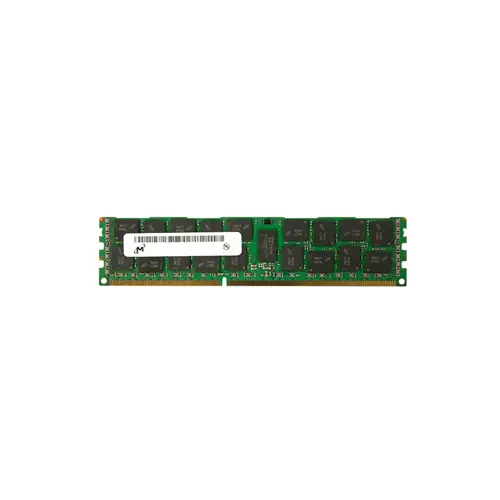
The Micron MT36JSF1G72PZ-1G9K1 is an 8GB DDR3-1866 Registered ECC RDIMM purpose-built for enterprise server environments, and its four defining characteristics translate directly into infrastructure resilience where generic memory cannot compete. First, ECC error correction actively eliminates single-bit flips caused by background radiation—a silent threat that, in a dense virtualization cluster, can corrupt a hypervisor’s state and cascade into weeks of phantom instability across dozens of business-critical VMs. Second, the Registered buffer re-drives command and address signals, decoupling electrical loading so you can fully populate 24 DIMM slots in a 2U server without signal degradation. For an in-memory database such as Redis or SAP HANA, this architectural headroom means scaling to massive capacities while maintaining the absolute stability required for financial transaction integrity. Third, the Dual Rank x4 organization utilizes on-die interleaving to deliver substantially higher sustained bandwidth under parallel workloads; when multiple virtual machines contend for memory simultaneously, rank interleaving smooths out latency spikes that would otherwise throttle heavy OLTP queries. Finally, the 1866MHz frequency with CL13 low latency yields a peak transfer rate of 14.9 GB/s, accelerating real-time analytics and rapid data ingestion so your warehouse refreshes complete within strict maintenance windows. Every characteristic converges on one outcome: uncompromising data fidelity and deterministic performance in always-on deployments, where downtime is measured in revenue per second.
The specified module is a server-grade DDR3 ECC Registered RDIMM (8GB, PC3-14900, dual-rank x4, 1.5V). It is designed for enterprise servers where data integrity, signal stability, and sustained operation are critical.
General Virtualization
Populate all memory channels symmetrically to maximize interleaving and capacity for multiple VMs. In a typical dual-socket server with three channels per CPU and two DIMMs per channel, install 12 identical 8GB RDIMMs (6 per CPU) for a balanced 96GB total. If you require more headroom, fill all 24 slots with these modules to reach 192GB, but be aware that 2DPC may downclock to 1600MHz on some platforms.
In-Memory Database
Maximize total capacity and reliability by fully populating every slot with identical 8GB RDIMMs—for example, 16×8GB (128GB) or 24×8GB (192GB) in a dual-socket system. This provides ample space for large in-memory datasets while using dual-rank DIMMs for robust error correction. For latency-sensitive deployments, consider one DIMM per channel to maintain the full 1866MHz speed; if capacity demands override, 2DPC is acceptable with a slight frequency drop.
High-Performance Computing (HPC)
Prioritize memory bandwidth by installing only one DIMM per channel. In a dual-socket server with four channels per CPU, deploy 8 identical 8GB RDIMMs (four per CPU) to achieve a clean 64GB configuration at full 1866MHz with the lowest latency. Should an application need more memory, upgrade to higher-capacity RDIMMs in a 1DPC layout instead of adding a second DIMM per channel, preserving peak bandwidth critical for HPC workloads.
Rigorously tested, compatible with Dell PowerEdge R720, R620, HP DL380p Gen8, and more.
Q: Can I mix this MT36JSF1G72PZ-1G9K1 with other memory modules of different brands or speeds?
A: Mixing RDIMMs of different brands or speeds is not recommended. The system will downclock all modules to the slowest common speed and may face stability issues. For consistent ECC operation, use identical part numbers.
Q: Is this memory compatible with my Intel Xeon E5-2600 v2 or AMD Opteron 6300 series server?
A: This DDR3-1866 ECC Registered DIMM is compatible with platforms supporting Registered DDR3 memory. Verify your server board's qualified vendor list to ensure full support for dual-rank x4 8GB RDIMMs.
Q: What is the recommended DIMM population order for optimal performance on a dual-processor server?
A: Populate identical modules per memory channel, starting with the furthest DIMM slot from the CPU. Balance capacity evenly between processors. Consult your system manual for specific multi-channel guidelines to achieve maximum throughput.
Q: Does this module support overclocking or XMP profiles?
A: No. This is an enterprise-grade Registered DIMM operating at JEDEC standard DDR3-1866 CL13. It does not feature XMP or support overclocking, as server memory prioritizes data integrity and stability under continuous load.
Q: What warranty and typical failure rate can I expect?
A: This module includes a 1-year warranty. Enterprise Registered memory is designed for high reliability, with an annualized failure rate typically below 0.5% in controlled data center environments when properly cooled.