











 Secure payments
Standard refund policy
Trade Assurance
Secure payments
Standard refund policy
Trade Assurance
| Product Type | Memory Module |
|---|---|
| Compliance Standards | RoHS |
| Memory Capacity | 8 GB |
| Memory Technology | DDR3 |
| Product Voltage | 1.5V |
| RAM Speed | 1866MHz |
| RAM Standard | DDR3-1866/PC3-14900 |
| Error Identifying | ECC |
| Signal Type | Registered |
| Column Access Strobe (CAS) | CL13 |
| Rank | Dual Rank x4 |
| Quantity of Pins | 240-pin |
| RAM Genre | RDIMM |
This DDR3-1866 RDIMM with ECC and a registered signal type is purpose-built for server platforms handling virtualization, in-memory databases, and other mission-critical workloads where data integrity is non-negotiable. Its dual-rank x4 organization and CL13 latency provide a balanced mix of memory bandwidth and low access delay, while the registered architecture stabilizes signal integrity across densely populated DIMM slots.
1. Registered signal buffering reduces command bus loading, allowing servers to populate all memory channels densely without sacrificing signal integrity or uptime in large-scale virtualization hosts.
2. ECC error correction proactively scrubs single-bit faults, preserving transactional accuracy and preventing silent data corruption in financial, database, and analytics workloads.
3. Dual Rank x4 organization leverages rank interleaving to pipeline memory operations, sustaining peak throughput during simultaneous VM migrations and heavy multi-tenant requests.
4. The 8 GB capacity per module strikes an efficient density for consolidating moderate virtual machines, maximizing memory slots on 2-socket servers while keeping power and thermal profiles contained.
5. 1866 MHz clock speed delivers PC3-14900 bandwidth, accelerating in-memory computing and reducing latency in caching layers for business intelligence and content distribution platforms.
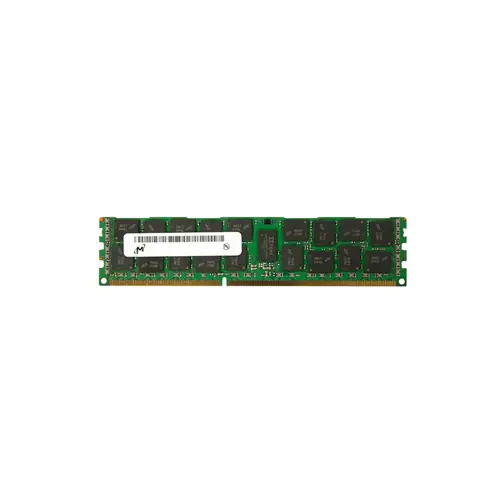
The Micron MT36JSF1G72PZ-1G9K1HE is an 8GB DDR3-1866 Registered DIMM purpose-built for server environments where data integrity and uptime are non-negotiable. Its ECC technology actively corrects single-bit errors and detects multi-bit faults, shielding your virtualization cluster from the silent data corruption that can crash hypervisors and corrupt VM state files overnight. The registered signal buffer stabilizes command and address lines, allowing you to populate all memory channels to maximum capacity without signal degradation—essential when hosting dozens of virtual machines or scaling an in-memory database. As a dual-rank x4 module, it leverages rank interleaving to prefetch and pipeline data more efficiently, reducing latency spikes under the heavy concurrent access patterns typical of OLTP and Redis workloads. With a 1866MHz clock speed and CL13 latency, it delivers the responsive throughput that keeps persistent in-memory analytics and real-time query engines performing consistently. In a hyper-converged infrastructure or a dedicated database server, this RDIMM means fewer unexplained errors, higher reliable capacity, and responsive performance that directly impacts user experience.
General Virtualization
For a hypervisor hosting multiple VMs, registered ECC memory is essential to ensure data integrity. Configure the server with a minimum of four 8 GB modules (32 GB total) to populate a quad-channel architecture, balancing cost and density for moderate consolidation workloads. Add identical DIMMs in matched sets to maintain balanced memory access and unlock maximum throughput under mixed-application pressure.
In-Memory Database
In-memory databases such as Redis or SAP HANA demand both reliability and large capacity. Start with a minimum of eight modules (64 GB) using symmetrical population across all memory channels to minimize latency. The 1866 MHz speed is adequate, but prioritize populating all channels evenly over pure clock frequency, and always duplicate the configuration for fail-over resilience with strict ECC validation active.
High-Performance Computing (HPC)
HPC clusters running MPI or simulation codes benefit from massively parallel memory bandwidth. Populate every DIMM slot per node with identical 8 GB RDIMMs, aiming for 128 GB or more per node to hold working datasets locally. The dual-rank x4 organization improves signal integrity under full-load conditions, but plan for active cooling as fully loaded registered memory can throttle under sustained computation if thermal margins are slim.
Rigorously tested DDR3 server memory, compatible with Dell PowerEdge R720, HPE ProLiant DL380p Gen8, and similar systems.
Q: Can I mix this MT36JSF1G72PZ-1G9K1HE with other memory modules of different brands or speeds?
A: Mixing brands or speeds is not recommended in server environments. Identical modules ensure signal integrity and stability. Using mismatched DIMMs may cause POST failures or performance degradation under registered ECC operation.
Q: Is this memory compatible with my system?
A: This is a DDR3-1866 Registered ECC RDIMM. Please verify your Intel Xeon E5 v2/E7 v3 or AMD Opteron 6300/8300 series platform supports 1.5V 8GB Dual Rank x4 modules and check the vendor’s qualified memory list for this specific part number.
Q: What is the recommended DIMM population order for optimal performance?
A: Populate identical DIMMs per memory channel, starting with the slot farthest from the CPU. For dual-processor servers, balance memory evenly across both processors. Always follow the motherboard's slot numbering diagram for proper channel interleaving.
Q: Does this module support overclocking or XMP profiles?
A: No. This is a server-grade Registered ECC module, designed for strict JEDEC DDR3-1866 CL13 operation. It does not support overclocking or Intel XMP profiles, prioritizing data integrity and 24/7 stability over performance tuning.
Q: What warranty and typical failure rate can I expect?
A: This module includes a one-year warranty. It meets enterprise reliability standards with very low annualized failure rates (AFR) typical for RDIMMs. Actual longevity depends on proper cooling and operating within specified environmental conditions.