











 Secure payments
Standard refund policy
Trade Assurance
Secure payments
Standard refund policy
Trade Assurance
| Product Type | Memory Module |
|---|---|
| Compliance Standards | RoHS |
| Memory Capacity | 8 GB |
| Memory Technology | DDR3 |
| Product Voltage | 1.5V |
| RAM Speed | 1866MHz |
| RAM Standard | DDR3-1866/PC3-14900 |
| Error Identifying | ECC |
| Signal Type | Registered |
| Column Access Strobe (CAS) | CL13 |
| Rank | Dual Rank x4 |
| Quantity of Pins | 240-pin |
| RAM Genre | RDIMM |
This server-grade RDIMM with ECC and Registered signaling is purpose-built for virtualization hosts and in-memory databases, where uncompromised data integrity and robust signal stability across fully populated channels are essential. Its dual-rank x4 organization boosts interleaving efficiency to sustain throughput, while the tight CL13 latency at 1866MHz ensures predictable response times under continuous enterprise workloads.
1. ECC memory actively detects and corrects single-bit errors, preventing silent data corruption that could compromise critical financial or database transactions in a 24/7 server environment.
2. Registered signal type stabilizes the command bus for high-density memory configurations, ensuring reliable operation when populating all DIMM slots in a virtualization host.
3. DDR3-1866 speed delivers 14.9 GB/s peak bandwidth per channel, accelerating in-memory analytics and reducing latency for frequently accessed datasets.
4. Dual Rank x4 organization interleaves access across internal banks, sustaining throughput under heavy multi-threaded workloads like large-scale web serving.
5. RDIMM form factor provides the buffering required for scaling capacity without sacrificing signal integrity, essential for memory-intensive server applications such as caching layers.
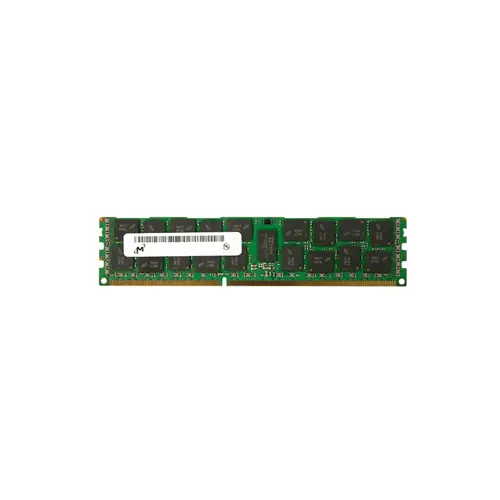
When you are running a virtualized cluster hosting multiple mission-critical VMs, the integrity of every single bit matters. This Micron 8GB DDR3-1866 RDIMM (MT36JSF1G72PZ-1G9K1HG) is engineered precisely for that reality. Its ECC technology continuously detects and corrects single-bit memory errors—spontaneous bit flips caused by background radiation or cosmic rays—which directly prevents silent data corruption, VM crashes, and unexplained application failures that erode user trust. The Registered signal buffer stabilizes the electrical load on the memory bus, allowing you to populate all channels with high-density modules without sacrificing signal integrity; this means your hypervisor can safely address larger memory pools for more concurrent VMs and heavier in-memory database workloads.
Equally critical is the dual-rank x4 organization running at a true 1866MHz with CL13 latency. Dual rank interleaves access across two internal rank groups, delivering substantially higher sustained bandwidth than a single-rank equivalent. In an in-memory analytics platform like SAP HANA, this translates to faster column scans and aggregation queries, and in a heavily consolidated VMware or Hyper-V cluster, it reduces latency spikes during simultaneous VM backups or live migrations. Every specification—ECC, Registered buffer, dual rank, and 1866MHz speed—works together to turn an ordinary server into a reliable, high-throughput engine for enterprise virtualization and real-time data processing.
General Virtualization
For virtualized workloads, use a minimum of 12 to 16 of these 8 GB Registered DIMMs to reach 96–128 GB total, populating three or four identically configured modules per memory channel across both CPUs. This balanced, high-capacity setup ensures consistent performance for mixed tenant VMs while ECC and register functions safeguard stability. When budget is tight, start with one DIMM per channel (e.g., 8 modules for 64 GB) and scale evenly.
In-Memory Database
Deploy a dense configuration by installing two DIMMs per channel (2DPC) using all 24 slots on a dual‑socket server, delivering 192 GB of resilient capacity. The dual‑rank x4 design and CL13 latency of these 1866 MHz modules provide the fast response times required by Redis or SAP HANA, though 2DPC may slightly lower frequency. Enable memory mirroring or sparing where available to protect critical data sets without sacrificing overall throughput.
High-Performance Computing
In bandwidth‑bound HPC simulations, install only one DIMM per channel (1DPC) – typically eight modules for 64 GB on a dual‑socket quad‑channel platform – to maintain the full 1866 MHz speed and lowest access latency. For capacity‑driven jobs, a 2DPC setup with 16 modules (128 GB) is acceptable, accepting a modest clock down‑step, but always keep channels symmetrically populated to avoid performance imbalances across nodes.
Validated for servers: Dell PowerEdge R710, HP ProLiant DL380p G8, Lenovo ThinkServer RD430. Rigorously tested for compatibility.
Q: Can I mix this MT36JSF1G72PZ-1G9K1HG with other memory modules of different brands or speeds?
A: Mixing with different brands or speeds is not recommended. Registered DIMMs require identical specifications (rank, CAS latency, voltage) to maintain signal integrity. Using mismatched modules may cause POST failures or stability issues in server environments. Always match exact part numbers.
Q: Is this memory compatible with my system?
A: This is an RDIMM for platforms supporting DDR3-1866 Registered ECC memory, such as Intel Xeon E5-2600 v2 or AMD Opteron 6300 series. Verify your server board supports 240-pin RDIMMs with 1.5V operation and a quad-rank x4 configuration. Consult your system’s memory QVL list.
Q: What is the recommended DIMM population order for optimal performance?
A: Follow your server motherboard’s manual. Typically, populate identical DIMMs per channel starting with the slots farthest from the CPU (often blue or black slots). Maintain balanced configurations across all memory channels to enable interleaving and achieve full bandwidth. This dual-rank x4 module requires careful slot assignment.
Q: Does this module support overclocking or XMP profiles?
A: No. This is a server-grade registered ECC module operating strictly at JEDEC-standard DDR3-1866 CL13. It does not support XMP overclocking profiles. Server platforms prioritize stability and data integrity; overclocking is disabled in the firmware and would void warranty.
Q: What warranty and typical failure rate can I expect?
A: This Micron module comes with a 1-year warranty. As enterprise hardware, it undergoes rigorous testing and exhibits an annualized failure rate (AFR) well below 0.5% under specified environmental conditions. Failure is rare when operated within standard server temperature and humidity ranges.