











 Secure payments
Standard refund policy
Trade Assurance
Secure payments
Standard refund policy
Trade Assurance
| Product Type | Memory Module |
|---|---|
| Memory Capacity | 8 GB |
| Memory Technology | DDR3 |
| Product Voltage | 1.5V |
| RAM Speed | 1866MHz |
| RAM Standard | DDR3-1866/PC3-14900 |
| Error Identifying | ECC |
| Signal Type | Registered |
| Column Access Strobe (CAS) | CL13 |
| Rank | Dual Rank x4 |
| Quantity of Pins | 240-pin |
| RAM Genre | RDIMM |
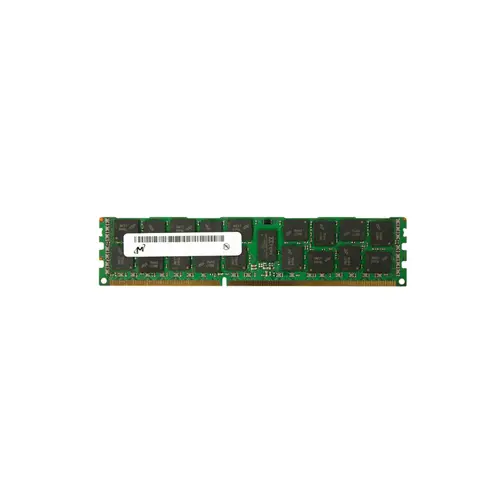
Specifically designed for legacy server platforms running virtualization or in-memory databases, this 8GB DDR3-1866 Registered ECC RDIMM ensures critical data integrity through hardware error correction. The Registered signal type stabilizes multi-DIMM configurations across high-density systems, and its dual-rank x4 architecture with CL13 latency optimizes command scheduling and access efficiency under sustained workloads.
1. ECC error correction actively detects and corrects single-bit memory errors, safeguarding transactional database integrity in always-on enterprise servers where silent data corruption is unacceptable.
2. Registered signal buffering decouples the memory controller from raw DRAM loads, enabling high-capacity configurations essential for large-scale virtualization without signal instability.
3. Dual Rank x4 organization interleaves accesses across internal banks, saturating the memory channel to deliver consistent bandwidth for multiple concurrent virtual machines under heavy consolidation.
4. PC3-14900 speed grade sustains high throughput per channel, reducing latency in in-memory analytics and accelerating real-time decision-making on data-intensive platforms.
5. The 8 GB per module density allows cost-effective scalability to triple-digit total capacities, equipping hypervisor clusters with the large memory footprint demanded by dense container and VM workloads.
The Micron MT36JSF1G72PZ-1G9K1KG is an 8GB DDR3-1866 registered server memory module, and its four cornerstone characteristics directly solve the most critical pain points in data center environments. The ECC error correction safeguards against silent data corruption caused by single-bit flips, which is vital when you are running a dense virtualization cluster. A flipped bit in a guest operating system kernel can crash dozens of virtual machines or corrupt transactional records; ECC detects and corrects these errors on-the-fly, preserving service continuity and data accuracy without human intervention. The registered signal buffer addresses the challenge of scaling memory capacity: it stabilizes the electrical load on the memory controller, enabling you to fully populate all channels with high-density DIMMs for massive in-memory databases like SAP HANA without random boot failures or stability drops. The 1866MHz interface, delivering up to 14.9GB/s of peak bandwidth per channel, directly reduces query latency in memory key-value stores such as Redis, accelerating real-time analytics and user-facing response times. Finally, the dual-rank x4 organization implements rank interleaving, which boosts command throughput under the highly concurrent, random-access workloads typical of multi-tenant virtualized servers, while the x4 DRAM chip architecture enhances RAS by limiting the impact of a single chip failure. For your virtualized enterprise applications or high-performance databases, this translates into uncompromised data integrity, predictable performance under full load, and the headroom to scale memory capacity confidently.
General Virtualization
For modest virtualization hosts, deploy six or eight of these 8 GB registered DIMMs to reach 48 GB–64 GB per socket. Populate dual‑channel or triple‑channel groups evenly to maximize memory bandwidth for multiple VMs, and leave at least two slots free for future scaling. Favouring identical dual‑rank DIMMs ensures consistent latency under mixed VM workloads.
In-Memory Database
In‑memory datasets demand both capacity and reliability. Install twelve to sixteen modules per dual‑socket server, yielding 96 GB–128 GB, so large tables fit entirely in RAM. Spread pairs across all memory channels and use sparingly placed RDIMMs to maintain registered buffering signal integrity. Full population with dual‑rank x4 RDIMMs also exploits chip‑kill ECC for critical data protection.
High-Performance Computing
HPC clusters benefit from balanced bandwidth, not just volume. Match six or eight identical 8 GB sticks per node for 48 GB–64 GB, aligning population exactly with the CPU’s native channel count (often three or four channels for DDR3 platforms). This symmetric layout delivers peak GB/s memory streams to simulation codes, while the 1866 MT/s speed and dual‑rank configuration sustain high throughput in data-parallel loops.
Strictly tested for servers: compatible with Dell PowerEdge R720, HP ProLiant DL380p Gen8, Lenovo System x3650 M4.
Q: Can I mix this MT36JSF1G72PZ-1G9K1KG with other memory modules of different brands or speeds?
A: Mixing different brands or speeds is not recommended. Registered ECC memory relies on identical rank, timing, and frequency to ensure signal integrity. Mismatched DIMMs may cause POST failures or silent data corruption.
Q: Is this memory compatible with my Intel Xeon or AMD Opteron server platform?
A: It is compatible with servers supporting DDR3 Registered ECC RDIMMs, such as Intel Xeon E5-2600 v1/v2 or AMD Opteron 6300 series. Verify your motherboard officially supports 8GB dual-rank x4 1866MT/s modules.
Q: What is the recommended DIMM population order for optimal performance on a dual-processor server?
A: For optimal performance, populate identical DIMMs symmetrically across memory channels per CPU. Start with the farthest slot from the processor in each channel, following the motherboard’s specific population guide for balanced interleaving.
Q: Does this module support overclocking or XMP profiles?
A: No. As a server-grade Registered ECC DIMM, it operates only at standard JEDEC timing (DDR3-1866 CL13). It does not support XMP, overclocking, or voltage adjustments; stability and data integrity are prioritized.
Q: What warranty and typical failure rate can I expect with this memory?
A: This module comes with a 1-year warranty. Enterprise-class registered memory exhibits a very low annualized failure rate (typically under 0.5%) when operated within specified thermal and voltage limits.