











 Secure payments
Standard refund policy
Trade Assurance
Secure payments
Standard refund policy
Trade Assurance
| Product Type | Memory Module |
|---|---|
| Compliance Standards | RoHS |
| Memory Capacity | 8 GB |
| Memory Technology | DDR3 |
| Product Voltage | 1.5V |
| RAM Speed | 1866MHz |
| RAM Standard | DDR3-1866/PC3-14900 |
| Error Identifying | ECC |
| Signal Type | Registered |
| Column Access Strobe (CAS) | CL13 |
| Rank | Dual Rank x8 |
| Quantity of Pins | 240-pin |
| RAM Genre | RDIMM |
This registered DDR3-1866 RDIMM, with its ECC and dual-rank x8 organization, provides robust data integrity and enhanced memory interleaving ideal for virtualized environments and in-memory databases on server platforms. The 13-cycle CAS latency and registered signaling deliver stable, low-latency operation under heavy multi-DIMM loads, ensuring reliable 24/7 uptime for mission-critical workloads.
1. ECC protection continuously corrects single-bit errors and detects multi-bit faults, preserving data integrity for transaction-heavy databases and file systems in always-on server environments.
2. Registered buffering decouples the memory controller from the DRAM load, enabling large-capacity RAM configurations that keep latency predictable as virtual machine density scales up.
3. An 8 GB capacity per stick provides enough headroom to run multiple guest operating systems simultaneously, maximizing consolidation ratios without immediate hardware expansion.
4. Running at 1866 MHz pushes peak bandwidth higher, accelerating in-memory caching and query responses that directly benefit real-time business intelligence dashboards.
5. Dual Rank x8 organization interleaves access across internal banks, elevating command-per-clock efficiency to sustain throughput when numerous VMs place competing demands on shared memory channels.
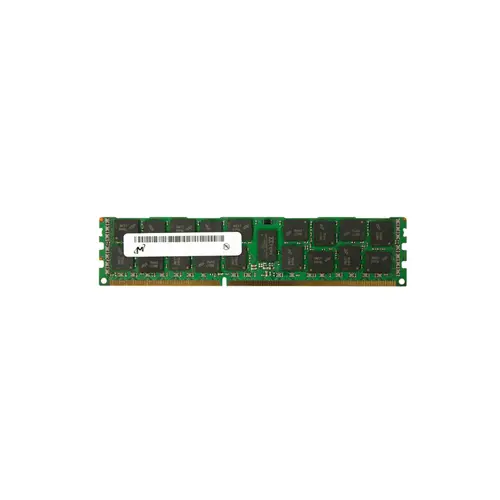
The Micron MT18JSF1G72PDZ‑1G9 is a server‑grade DDR3‑1866 RDIMM built for environments where continuous uptime and data fidelity are absolute requirements. Four of its characteristics translate directly into real‑world dependability. ECC error correction instantly neutralizes single‑bit faults caused by cosmic radiation, eliminating silent data corruption. In a hypervisor cluster hosting dozens of virtual machines, such an undetected error could crash a guest OS or poison a financial database; ECC turns that probabilistic disaster into uninterrupted operation. The registered buffer reduces electrical loading on the command and address bus, enabling dense memory configurations up to maximum DIMM slots without signal degradation, so a fully populated 512 GB virtualization host boots and runs stably under full thermal load. The dual‑rank x8 organization enables rank interleaving, where the memory controller overlaps accesses between the two internal ranks to achieve near‑continuous data flow. This dramatically accelerates in‑memory databases like Redis or SAP HANA during heavy concurrent queries. Finally, 1866 MT/s speed paired with CL13 latency delivers the responsive throughput that real‑time analytics demand. For your virtualized cluster or transactional database, this RDIMM safeguards both the integrity of your data and the resilience of your services.
General Virtualization
For general virtualization hosts, this 8 GB Registered DDR3-1866 ECC module provides reliability through error correction, but capacity quickly becomes the primary constraint. Deploy a balanced population of at least eight identical modules (64 GB total) across all memory channels to maximize bandwidth and support a moderate number of virtual machines. Avoid mixing ranks or speeds; populate in matched sets per memory controller channel to maintain interleaving and avoid performance penalties.
In-Memory Database
In-memory databases demand both capacity and sustained low latency, making density the priority. Start with the maximum supported configuration using these 8 GB RDIMMs—typically 16 or more modules (128 GB+) across all available slots—to keep entire datasets in RAM. Ensure all channels are populated identically to maintain balanced memory access; dual-rank x8 modules like these offer a good compromise between capacity and command rate, but monitor thermal headroom in dense deployments.
High-Performance Computing (HPC)
HPC workloads require the highest achievable memory bandwidth and predictable performance under load. Fully populate every memory channel with identical 8 GB RDIMMs, respecting the platform’s optimal DIMM-per-channel ratio (often one to two). This ensures maximum memory interleaving and consistent 1866 MT/s speed across all cores. Carefully validate the population order against the server vendor’s slot mapping to avoid falling back to a lower speed or losing channel bandwidth.
Rigorously tested server DDR3 RDIMM, compatible with Dell PowerEdge R720, HP ProLiant DL380p Gen8, and Lenovo ThinkServer RD630.
Q: Can I mix this MT18JSF1G72PDZ-1G9 with other memory modules of different brands or speeds?
A: Mixing is not recommended. For stable server operation, use identical RDIMMs with the same 1866MHz speed, CL13, 1.5V, and Dual Rank x8 organization. Mismatched specs may cause POST failures or signal integrity issues.
Q: Is this memory compatible with my Intel Xeon or AMD Opteron server platform?
A: This DDR3-1866 ECC Registered DIMM is compatible with platforms supporting 1.5V, 240-pin RDIMMs, such as Intel Xeon E5/E5 v2 or AMD Opteron 6300 series. Please verify your motherboard’s memory QVL for 8GB RDIMM support.
Q: What is the recommended DIMM population order for optimal performance?
A: Populate identical DIMMs per channel, starting with the first slot (often blue) on each memory channel to balance interleaving. Consult the server board manual for exact slot numbering to ensure proper NUMA and channel configuration.
Q: Does this module support overclocking or XMP profiles?
A: No. This is a JEDEC-compliant server RDIMM operating at standard DDR3-1866 (PC3-14900) with no XMP support. It is designed for reliability and stability in 24/7 environments, not for overclocking.
Q: What warranty and typical failure rate can I expect?
A: This memory carries a 1-year warranty. Its ECC and registered architecture, combined strict RoHS manufacturing, results in a very low annualized failure rate (AFR), typically below 0.2% under correct operating conditions.