











 Secure payments
Standard refund policy
Trade Assurance
Secure payments
Standard refund policy
Trade Assurance
| Product Type | Memory Module |
|---|---|
| Compliance Standards | RoHS |
| Memory Capacity | 8 GB |
| Memory Technology | DDR3 |
| Product Voltage | 1.5V |
| RAM Speed | 1866MHz |
| RAM Standard | DDR3-1866/PC3-14900 |
| Error Identifying | ECC |
| Signal Type | Registered |
| Column Access Strobe (CAS) | CL13 |
| Rank | Single Rank x4 |
| Quantity of Pins | 240-pin |
| RAM Genre | RDIMM |
This 8GB DDR3-1866 RDIMM with ECC and Registered signaling is designed for legacy server platforms, making it an ideal choice for memory-intensive workloads like virtualization and in-memory databases where data integrity is critical. Its Single Rank x4 configuration combined with CL13 latency ensures stable, low-latency performance in multi-DIMM configurations, effectively reducing electrical loading on the memory bus.
1. ECC protection detects and corrects single-bit memory errors silently, ensuring transactional integrity in financial databases and preventing silent data corruption in long-running virtualization clusters.
2. Registered signal buffering stabilizes electrical loads on the memory bus, allowing dense server boards to populate all DIMM slots without sacrificing command-signal integrity at scale.
3. The 1866 megatransfers per second speed elevates theoretical throughput per channel, directly accelerating in-memory analytics and reducing latency for concurrent virtual machine disk caches.
4. An eight-gigabyte capacity per module delivers optimal density for mid-range virtualization hosts, balancing the guest-to-DIMM ratio while preserving room for future node expansion.
5. Single Rank x4 organization using four-bit-wide DRAM components improves bank-level parallelism and reduces access granularity, boosting bandwidth efficiency for randomized server workloads like OLTP and real-time recommendation engines.
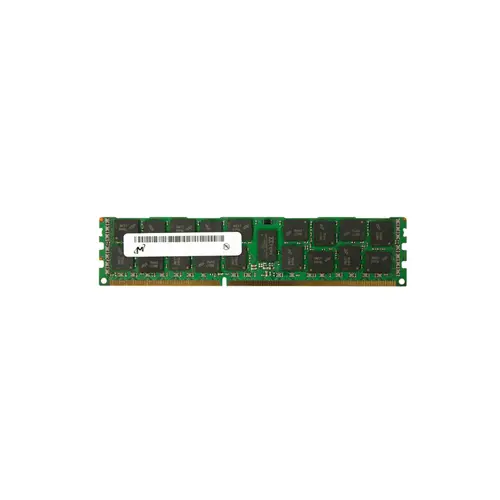
The MT18JSF1G72PZ-1G9N1 is an 8GB DDR3-1866 Registered DIMM purpose-built for servers and workstations, where a single undetected memory error can cascade into costly downtime. Its four defining characteristics translate directly into operational resilience for the data center.
First, ECC error correction continuously detects and corrects single-bit flips caused by background radiation or electrical noise, preventing silent data corruption in always-on virtualization clusters. When a hypervisor hosts dozens of VMs, memory integrity is non-negotiable — ECC ensures that a flipped bit in a critical database transaction or a machine-learning tensor is caught and repaired in real time, preserving accuracy without service interruption.
Second, the Registered buffer architecture stabilizes signal integrity across high-density configurations. In an in-memory database like Redis or SAP HANA, you often populate all DIMM slots to maximize capacity; registered logic reduces electrical loading on the memory controller, so your system remains stable even with 384 GB or more of RAM under sustained 100% load.
Third, the 1866 MT/s speed and PC3-14900 bandwidth, combined with a single-rank x4 organization, deliver lower latency during parallel data accesses. This is vital for virtualized environments where multiple VMs compete for I/O — the single rank helps the memory controller schedule requests more efficiently, giving each VM the responsive performance it demands during peak business hours. Together, these features mean fewer errors, higher density, and predictable throughput for mission-critical workloads.
General Virtualization
For general virtualization hosts, this 8GB DDR3-1866 RDIMM provides a solid building block. A dual-socket server should be populated with at least six to eight identical modules per CPU to enable balanced memory interleaving and maximize memory bandwidth. Aim for a minimum total of 64–128GB, with DIMMs evenly distributed across all memory channels, to comfortably host a dozen mixed-workload VMs while leaving headroom for hypervisor overhead.
In-Memory Database
In-memory databases demand both capacity and the data integrity offered by ECC Registered memory. Deploy these modules in the maximum supported quantity for your server, typically filling all 24 DIMM slots in a dual-socket system to reach 192GB and beyond. Populate every channel identically to sustain the high-frequency 1866MT/s speed, which reduces latency on large datasets, and always configure identical ranks per channel to avoid performance penalties from rank imbalance.
High-Performance Computing (HPC)
HPC clusters benefit from the predictable latency of CL13 registered DIMMs. Per node, install modules in multiples of the memory channel count—usually eight or twelve—to fully saturate the processor’s memory bandwidth for parallel simulation and modeling codes. While many HPC workloads scale well with 64–128GB per node, memory-bound applications (e.g., computational fluid dynamics) will require populating all slots to push per-node capacity toward 256GB or more, balancing capacity with the lowest possible latency.
Rigorously tested server RAM, verified compatible with Dell PowerEdge R720, R620, HP DL380p Gen8, etc.
Q: Can I mix this MT18JSF1G72PZ-1G9N1 with other memory modules of different brands or speeds?
A: Mixing RDIMMs of different brands or speeds is not advised. It often forces all modules to default to the lowest speed and may introduce signaling inconsistencies, undermining ECC reliability and 1866MHz performance.
Q: Is this memory compatible with my server system?
A: This DDR3-1866 Registered ECC DIMM targets Intel Xeon E5/E7 v1/v2 and select AMD Opteron platforms with 240-pin slots. Always check your server board’s qualified vendor list to confirm support.
Q: What is the recommended DIMM population order for optimal performance?
A: Populate identical DIMMs per channel starting with the farthest slot from the CPU. Uniform configurations enable balanced interleaving and maximize memory bandwidth while preserving ECC scrubbing functions on your server board.
Q: Does this module support overclocking or XMP profiles?
A: No. As an RDIMM built for mission-critical servers, it operates strictly at JEDEC-standard DDR3-1866 timings. Overclocking and XMP are unsupported to guarantee data integrity and long-term reliability.
Q: What warranty and typical failure rate can I expect?
A: The module is covered by a 1-year warranty. Engineered with ECC and premium Micron components, it exhibits an annualized failure rate well below 0.5% under typical 24/7 server environments.