











 Secure payments
Standard refund policy
Trade Assurance
Secure payments
Standard refund policy
Trade Assurance
| Product Type | Memory Module |
|---|---|
| Memory Capacity | 8 GB |
| Memory Technology | DDR3 |
| Product Voltage | 1.5V |
| RAM Standard | DDR3-1866/PC3-14900 |
| Error Identifying | ECC |
| Signal Type | Registered |
| Column Access Strobe (CAS) | CL13 |
| Rank | Single Rank x4 |
| Quantity of Pins | 240-pin |
| RAM Genre | RDIMM |
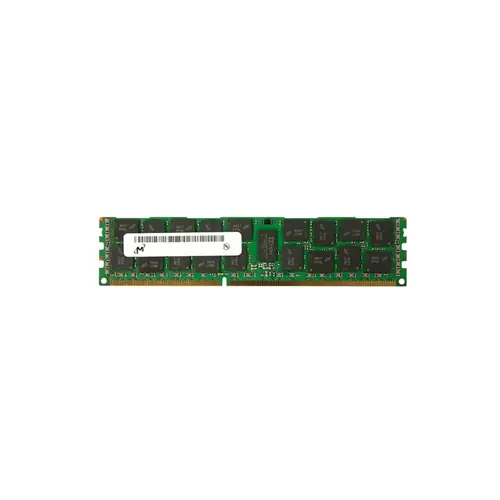
This DDR3-1866 Registered ECC memory module is engineered for server platforms, ensuring data integrity in virtualization and in-memory database workloads. Its Registered signal type and x4-organized Single Rank configuration provide superior signal stability and reduced electrical loading, enabling reliable operation at CL13 latency in dense multi-DIMM server deployments.
1. ECC error correction safeguards every data bit against single-bit corruption, eliminating silent memory errors that could crash long-running enterprise workloads.
2. Registered signal buffering reduces electrical load on the memory controller, enabling stable high-density server configurations under sustained heavy access.
3. 8 GB module capacity provides a right-sized building block for virtualization hosts, maximizing VM density without oversubscribing memory resources.
4. DDR3-1866 speed delivers up to 14.9 GB/s bandwidth, cutting latency in caching tiers and accelerating database query throughput in multi-tenant environments.
5. Single Rank x4 organization minimizes bus loading for cleaner signal integrity, crucial for maintaining reliability when multiple DIMMs populate a server board.
The MT18JSF1G72PZ-1G9F1 is an 8 GB DDR3-1866 Registered ECC DIMM, purpose-built for servers where uptime and data integrity are absolute priorities. In a virtualized cluster hosting multiple VMs, even a single undetected bit flip can silently corrupt a database transaction or trigger a cascading failure across nodes. The integrated ECC engine actively corrects single-bit errors, transforming an invisible threat into a non-event and protecting your live services from unpredictable crashes. That protection is reinforced by the Registered buffer, which decouples the electrical load from the memory controller, enabling you to populate all channels with confidence—critical when scaling to 192 GB or more per host without sacrificing signal stability or balancing act compromises in the BIOS.
Running an in-memory database or a heavy transactional workload exposes another layer of risk: latency and rank contention. This module’s single-rank x4 organization combined with CL13 latency at 1866 MT/s delivers a disciplined, predictable command-response window, reducing bus turnaround overhead compared to dual-rank mixes. The result is smoother throughput during peak OLTP bursts, where every nanosecond of queuing shows up in end-user response times. Backed by a standard 1.5 V operating voltage, it keeps thermal stress manageable in dense rack environments, ensuring that your cache pools and database indexes stay responsive 24/7. This is not just memory—it is the silent guardian of your data’s accuracy and your infrastructure’s uninterrupted availability.
General Virtualization
Populate all memory channels with identical 8 GB RDIMMs to ensure balanced performance. For a dual‑socket server using four channels per CPU, eight modules deliver 64 GB total, comfortably supporting dozens of light to moderate VMs. When higher density is needed, double to 16 modules for 128 GB while preserving consistent latency and ECC coverage.
In-Memory Database
Maximize capacity by filling every DIMM slot with these 8 GB modules. In a dual‑processor platform with three or four channels and two DIMMs per channel, 16 modules provide 128 GB, a solid footprint for medium‑scale in‑memory datasets. Follow the vendor‑recommended population order to maintain full ECC and consider sparing or mirroring for critical uptime.
High-Performance Computing (HPC)
For bandwidth‑sensitive workloads, install one 8 GB DIMM per channel to sustain the full DDR3‑1866 frequency. A typical dual‑socket configuration uses eight modules (64 GB) for maximum throughput per core. If larger memory is required, add a second DIMM per channel while expecting mild frequency downclocking, and validate against job‑level performance targets.
Rigorously tested server memory, compatible with Dell PowerEdge R720, HP DL380p Gen8, and similar systems.
Q: Can I mix this MT18JSF1G72PZ-1G9F1 with other memory modules of different brands or speeds?
A: Mixing is strongly discouraged for server environments. Registered ECC modules must match in speed, rank, and timings to ensure signal integrity and platform stability. Always populate with identical part numbers.
Q: Is this memory compatible with my Intel Xeon or AMD Opteron server board?
A: This 8GB DDR3-1866 Registered ECC RDIMM is compatible with platforms supporting 1.5V DDR3 ECC memory. Please verify your board supports 240-pin RDIMMs and DDR3-1866 speeds via its Qualified Vendor List.
Q: What is the recommended DIMM population order for optimal performance?
A: Follow your server motherboard manual. Typically, populate identical DIMMs per channel, starting with slots farthest from the CPU. For single rank x4 modules, balance channels to maximize memory bandwidth and interleaving.
Q: Does this module support overclocking or XMP profiles?
A: No. This is a JEDEC-compliant enterprise server module (DDR3-1866, CL13) and does not support XMP or overclocking. It operates only at its rated specifications to ensure error-free ECC functionality.
Q: What warranty and typical failure rate can I expect?
A: This Micron module includes a 1-year warranty. Typical Annualized Failure Rate (AFR) for server-grade RDIMMs is below 0.5% under normal usage, reflecting high reliability for 24/7 enterprise workloads.