











 Secure payments
Standard refund policy
Trade Assurance
Secure payments
Standard refund policy
Trade Assurance
| Product Type | Memory Module |
|---|---|
| Compliance Standards | RoHS |
| Memory Capacity | 8 GB |
| Memory Technology | DDR3 |
| Product Voltage | 1.5V |
| RAM Speed | 1866MHz |
| RAM Standard | DDR3-1866/PC3-14900 |
| Error Identifying | ECC |
| Signal Type | Unbuffered |
| Column Access Strobe (CAS) | CL13 |
| Rank | Dual Rank |
| Quantity of Pins | 240-pin |
| RAM Genre | DIMM |
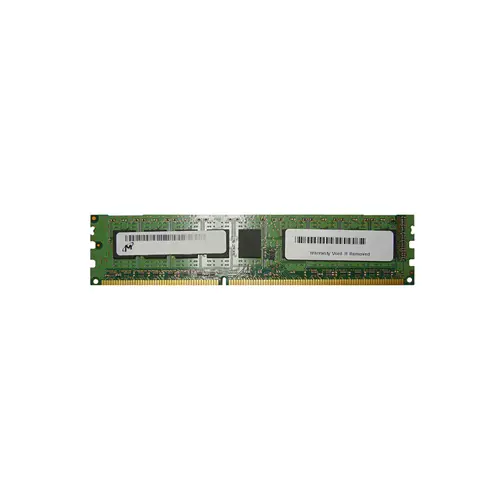
This 8GB DDR3-1866 module, built as an unbuffered ECC DIMM, is server-class memory expressly suited for entry-level servers and workstations (e.g., Intel Xeon E3 platforms) where it reliably handles virtualization and in-memory database workloads. Its dual-rank configuration boosts throughput through rank interleaving while ECC actively corrects single-bit errors, delivering essential data integrity around the clock.
1. ECC protection detects and corrects single-bit memory errors in real time, safeguarding transactional data integrity in always-on server environments where even silent corruption is unacceptable.
2. Unbuffered architecture reduces memory access latency, giving single-socket servers a responsiveness edge for latency-sensitive workloads like caching or lightweight database operations.
3. Dual Rank organization populates both rank select lines to sustain higher command rates, effectively extending memory bandwidth headroom under heavily threaded application loads.
4. 1866MHz data rate increases peak transfer bandwidth, directly accelerating in-memory analytics and reducing fetch delays for frequently requested datasets.
5. An eight-gigabyte module provides sufficient capacity per channel to support a healthy number of virtual machines, helping maintain consolidation density on value-oriented server platforms.
Designed for server and workstation platforms, the MT18JSF1G72AZ-1G9-N is an 8GB DDR3-1866 module whose four defining characteristics—ECC, unbuffered signaling, dual-rank architecture, and 1866MHz speed at CL13—directly eliminate real operational pain points. In a virtualized cluster running VMware ESXi or Hyper-V, ECC acts as a silent, always-on guardian. It catches and corrects single-bit memory errors caused by background radiation before a flipped bit can corrupt a virtual machine’s kernel data or crash the entire hypervisor, translating directly into non-negotiable uptime for your multi-tenant services. When you deploy an in-memory database like Redis, the unbuffered design avoids the extra clock-cycle penalty of registered DIMMs, slicing access latency for each key-value transaction. Simultaneously, the dual-rank layout interleaves memory banks to boost sustained bandwidth, preventing request throttling during traffic spikes. The genuine 1866MHz clock and tight CL13 timing ensure that every clock cycle delivers maximum throughput. Together, these features keep your cache layer screaming fast and your critical workloads immune to silent data corruption, turning hardware reliability into genuine business continuity.
Server Memory Capacity Planning
This 8 GB DDR3-1866 ECC Unbuffered DIMM targets entry servers and workstations where data integrity is critical. Below are configuration recommendations for common server workloads.
General Virtualization
Install identical 8 GB modules across all memory channels to maximize bandwidth. For a dual‑socket host with four channels per CPU, start with eight DIMMs (64 GB) to support 15–20 light VMs; scale to sixteen modules (128 GB) for higher density. Keep spare slots open for future growth without replacing existing DIMMs.
In-Memory Database
Fill all channels completely to sustain balanced interleaving and achieve the largest reliable capacity. Sixteen 8 GB DIMMs deliver 128 GB, a solid foundation for Redis, Memcached, or development-grade SAP HANA nodes. Full population preserves critical ECC protection and prevents bandwidth loss from unbalanced configurations.
High-Performance Computing (HPC)
Populate a single DIMM per channel to maintain the full 1866 MHz speed—adding a second DIMM often forces a down‑clock on DDR3 platforms. Equip each node with eight modules (64 GB) across four channels. This yields enough capacity per core for simulation and modeling while delivering the sustained memory throughput essential for parallel cluster jobs.
Rigorously tested server memory; compatible with Dell PowerEdge R210 II, HP ProLiant ML310e Gen8, and Lenovo ThinkServer TS140.
Q: Can I mix this MT18JSF1G72AZ-1G9-N with other memory modules of different brands or speeds?
A: Mixing modules is not recommended in server environments. Different brands, speeds, or ranks may cause instability. For reliable ECC operation, use identical modules with matched timings.
Q: Is this memory compatible with my system?
A: This DDR3-1866 ECC Unbuffered DIMM is designed for Intel Xeon E3/E5 or AMD Opteron platforms supporting 1.5V DDR3 ECC UDIMM. Verify your server motherboard’s qualified vendor list for this specific part.
Q: What is the recommended DIMM population order for optimal performance?
A: Populate identical modules in symmetric slots per memory channel, typically starting with slot 1 on each channel. For dual-rank DIMMs like this, install in matched pairs to maintain balanced memory interleaving and full ECC functionality.
Q: Does this module support overclocking or XMP profiles?
A: No. This is a JEDEC-compliant server memory module built for stability. It does not support XMP profiles or overclocking; it operates strictly at DDR3-1866 with CL13 timings for reliable 24/7 workloads.
Q: What warranty and typical failure rate can I expect?
A: This module includes a one-year warranty. Enterprise-grade DRAM like this has an extremely low annualized failure rate, typically below 0.2%, ensuring high reliability for critical server operations.