











 Secure payments
Standard refund policy
Trade Assurance
Secure payments
Standard refund policy
Trade Assurance
| Product Type | Memory Module |
|---|---|
| Compliance Standards | RoHS |
| Memory Capacity | 8 GB |
| Memory Technology | DDR3 |
| Product Voltage | 1.5V |
| RAM Speed | 1866MHz |
| RAM Standard | DDR3-1866/PC3-14900 |
| Error Identifying | ECC |
| Signal Type | Unbuffered |
| Column Access Strobe (CAS) | CL13 |
| Rank | Dual Rank x8 |
| Quantity of Pins | 240-pin |
| RAM Genre | UDIMM |
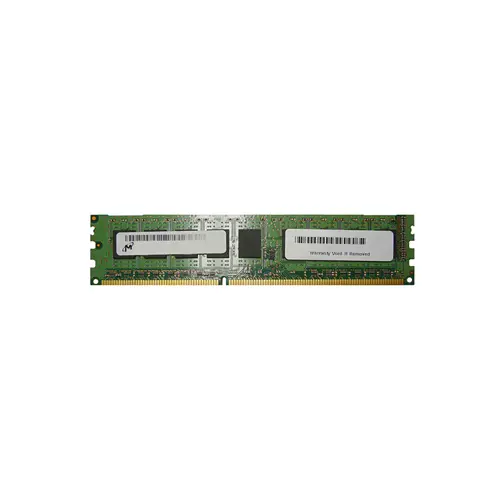
This 8GB DDR3-1866 ECC unbuffered DIMM is engineered for entry-level servers and single-socket workstations where data integrity is critical, leveraging error-correcting code to prevent silent data corruption in virtualization and light database workloads. Its dual-rank x8 organization and tight CL13 latency deliver balanced bandwidth and reduced access delays, making it an optimal upgrade for Intel Xeon E3 or comparable platforms that require reliable, power-efficient 1.5V memory.
1. ECC protection detects and corrects single-bit errors in real time, preserving data integrity for mission-critical server applications where even silent corruption is unacceptable.
2. Unbuffered signaling minimizes latency between the memory controller and DRAM chips, delivering snappier access for entry-level server workloads that benefit from direct communication.
3. DDR3 technology running at elevated frequency offers a sweet spot of bandwidth, enabling faster data throughput for aging virtualization hosts that still handle moderate user loads.
4. Eight-gigabyte capacity provides a practical building block for small businesses, allowing enough headroom to run multiple lightweight virtual machines or a modest database without immediate swapping.
5. Dual Rank x8 organization interleaves accesses across more DRAM pages, which keeps memory channels efficiently utilized and sustains stable performance under concurrent multi-threaded operations.
When you are hours into rendering a 4K timeline or locked in a competitive AAA match, memory behavior defines your experience. The Micron MT18JSF1G72AZ-1G9E1 is an 8GB DDR3-1866 UDIMM engineered for desktop workstations where reliability meets real speed. Its true advantage emerges in two punishing scenarios.
First, consider a video editor compositing multi-layer effects. This module runs at 1866MHz with dual-rank x8 organization, delivering higher sustained bandwidth than single-rank alternatives. The dual-rank design interleaves memory banks, so during heavy scrubbing and encoding, the CPU stays fed without pipeline stalls — rendering finishes faster. Second, in open-world gaming, the CL13 latency and unbuffered architecture minimize the delay between a frame request and data delivery. That tight CAS timing translates directly into fewer micro-stutters when textures stream on the fly.
What truly sets it apart is ECC error correction, rare in desktop memory. A single-bit flip from background radiation can corrupt a render output or crash a long gaming session. This module silently corrects those errors, giving professionals and enthusiasts the stability of a server-grade safeguard without sacrificing the low-latency, plug-and-play simplicity of a standard 240-pin UDIMM at 1.5V.
General Virtualization
For light to moderate virtualization, populate the server with four of these 8 GB ECC UDIMMs to achieve 32 GB total, which comfortably runs a handful of virtual machines on a hypervisor. Always install modules in matching sets to ensure balanced memory channels, and leave half the DIMM slots free if future scaling is anticipated—upgrading to 64 GB by fully populating all channels is a straightforward mid-life refresh.
In-Memory Database
A single 8 GB module is rarely sufficient for in-memory datasets, so deploy six to eight identical sticks across all available channels to reach 48–64 GB while preserving dual-rank performance. This configuration maximizes throughput for Redis or Memcached instances and keeps the entire working set in DRAM, drastically reducing query latency. Given the ECC protection, data integrity is strengthened against single-bit errors, a critical requirement when memory holds the primary database state.
High-Performance Computing (HPC)
HPC workloads benefit from maximum memory bandwidth, so install one ECC UDIMM per channel—typically four modules in a quad-channel board—to fully utilize the architecture without introducing rank-switching overhead. For memory-capacity-bound simulations, doubling to eight 8 GB DIMMs (two per channel) provides 64 GB while still operating at 1866 MT/s, provided the platform’s memory controller supports dual-rank-per-channel configurations stably.
Rigorously tested server memory, compatible with Dell PowerEdge T20, HP ML10 v2, and Lenovo TS140.
Q: Can I mix this MT18JSF1G72AZ-1G9E1 with other memory modules of different brands or speeds?
A: Mixing is not advised. The system will downclock to the slowest module, potentially compromising ECC integrity. For guaranteed stability in server workloads, deploy identical kits validated for your platform.
Q: Is this memory compatible with my system?
A: This DDR3-1866 ECC UDIMM targets servers/workstations with Intel Xeon E3 series or select AMD AM3+ platforms. Confirm your board explicitly supports 8GB 240-pin 1.5V ECC Unbuffered modules before purchasing.
Q: What is the recommended DIMM population order for optimal performance?
A: Populate identical modules in matched-color slots per your server board manual, typically slot 1 & 3 or 2 & 4 first. This activates dual-channel interleaving, maximizing throughput for memory-intensive operations.
Q: Does this module support overclocking or XMP profiles?
A: No. This is a JEDEC-compliant ECC module. Overclocking and XMP are unsupported, as server memory prioritizes error-free data integrity and stability over frequency headroom.
Q: What warranty and typical failure rate can I expect?
A: Backed by a one-year warranty. Micron‘s mature DDR3 process maintains an AFR well below 0.5% under proper conditions, while on-die ECC corrects single-bit errors for exceptional field reliability.