











 Secure payments
Standard refund policy
Trade Assurance
Secure payments
Standard refund policy
Trade Assurance
| Product Type | Memory Module |
|---|---|
| Compliance Standards | RoHS |
| Memory Capacity | 8 GB |
| Memory Technology | DDR3 |
| Product Voltage | 1.5V |
| RAM Speed | 1866MHz |
| RAM Standard | DDR3-1866/PC3-14900 |
| Error Identifying | ECC |
| Signal Type | Unbuffered |
| Column Access Strobe (CAS) | CL13 |
| Rank | Dual Rank x8 |
| Quantity of Pins | 240-pin |
| RAM Genre | UDIMM |
This UDIMM ECC DDR3-1866 module is engineered for entry-level servers and workstations where data integrity is critical, making it ideal for virtualization, memory-resident databases, and other reliability-sensitive workloads. Its dual-rank x8 organization leverages rank interleaving to improve memory bandwidth efficiency, while the CL13 latency ensures responsive performance in synchronous operations.
1. ECC error correction detects and corrects single-bit faults in real time, preserving data integrity for always-on small business servers where even minor memory errors can crash critical applications.
2. 8 GB capacity per module fits lightweight virtualization hosts, comfortably running multiple containerized services or domain controllers without immediate need for expansion.
3. 1866 MHz speed provides sufficient memory bandwidth to smooth concurrent user requests in file-sharing or web-proxy roles, preventing I/O stalls under moderate traffic.
4. Dual Rank x8 organization enables rank interleaving, which hides refresh overhead and lifts effective throughput when the processor juggles parallel database or email tasks.
5. Unbuffered signal type reduces command-to-data latency, giving single-socket entry servers snappier response in latency-sensitive workloads like VoIP or edge caching.
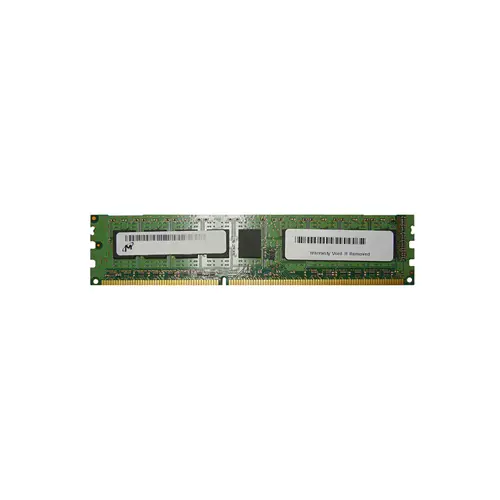
The Micron MT18JSF1G72AZ-1G9E3 is an 8GB DDR3-1866 ECC Unbuffered DIMM purpose‑built for entry‑level servers and workstations where data integrity and cost efficiency converge. In a small business virtualization cluster running multiple VMs on a hypervisor, a single undetected memory bit flip can cascade into guest operating system kernel panics or database index corruption, leading to unplanned downtime. The module’s ECC engine silently detects and corrects single‑bit errors in real time, transforming a potential business interruption into an invisible repair. Meanwhile, the dual‑rank x8 organization interleaves two independent sets of memory chips, elevating command‑scheduling efficiency and sustaining bandwidth when the hypervisor demands aggregate throughput for concurrent virtual machines. That 1866 MHz speed becomes essential in an in‑memory database such as Redis, where sub‑millisecond latency directly dictates transaction performance. Because the DIMM is unbuffered, the memory controller talks directly to the DRAM, trimming command‑to‑response latency compared to registered alternatives—a tangible advantage for latency‑sensitive analytics queries that must scan large hash tables. Together, ECC error resilience, dual‑rank parallelism, 1866 MHz frequency, and the low‑latency unbuffered topology form a balanced solution that keeps critical services stable and responsive without exceeding a pragmatic hardware budget.
Based on the specifications (DDR3-1866, ECC, Unbuffered, 240-pin UDIMM), this is a server memory module designed for entry-level servers and workstations that require data integrity. Below is capacity planning guidance for typical server workloads.
General Virtualization
Populate all memory channels evenly with these 8 GB UDIMMs. A dual-socket triple-channel server can use six modules for 48 GB, comfortably hosting 10–15 light VMs. For higher consolidation densities, install 12 modules to reach 96 GB while preserving balanced interleaving. Always use identical modules to maintain a symmetric NUMA configuration.
In-Memory Database
In-memory databases demand high capacity and fault tolerance. Populate every available slot, allowing 2 DIMMs per channel, to achieve 128 GB or more. Prefer maximum capacity over peak speed; the slight frequency drop at full population is acceptable, and ECC guarantees data integrity. Verify that the server firmware supports the full unbuffered ECC module count.
High-Performance Computing
For HPC, memory bandwidth is critical. Use one module per channel (1DPC) to sustain the full 1866 MT/s speed. On a quad-channel platform, four 8 GB UDIMMs deliver 32 GB with optimal latency for compute-bound simulations. Scale to eight modules for 64 GB only when capacity becomes the bottleneck, maintaining 1DPC to avoid latency penalties.
Rigorously tested server memory, compatible with Dell PowerEdge T110 II, HP MicroServer Gen8, Lenovo ThinkServer TS140, and more.
Q: Can I mix this MT18JSF1G72AZ-1G9E3 with other memory modules of different brands or speeds?
A: Mixing ECC UDIMMs from different brands or speeds is not recommended. Mismatched modules may prevent ECC operation and cause system instability. All installed DIMMs should share identical specifications for validated reliability.
Q: Is this memory compatible with my system?
A: This DDR3-1866 ECC Unbuffered DIMM targets servers and workstations, supporting Intel Xeon E3/E5 or AMD Opteron with C200/C600 series chipsets. Confirm your board accepts 240-pin, 1.5V ECC UDIMMs at 1866 MHz.
Q: What is the recommended DIMM population order for optimal performance?
A: For optimal performance, populate identical DIMMs in the first slot of each channel (commonly blue slots). In dual-socket platforms, balance capacity equally across CPUs and follow the motherboard’s memory interleaving guidelines.
Q: Does this module support overclocking or XMP profiles?
A: No. This is a server-class ECC DIMM adhering to JEDEC DDR3-1866 at CL13. It does not support XMP or overclocking; its design prioritizes error correction and long-term signal integrity over high-frequency tuning.
Q: What warranty and typical failure rate can I expect?
A: The module includes a 1-year warranty. Engineered for 24/7 operation, ECC UDIMMs exhibit a very low annualized failure rate, typically below 0.2%, providing dependable uptime in mission-critical server environments.