











 Secure payments
Standard refund policy
Trade Assurance
Secure payments
Standard refund policy
Trade Assurance
| Product Type | Memory Module |
|---|---|
| Compliance Standards | RoHS |
| Memory Capacity | 8 GB |
| Memory Technology | DDR3 |
| Product Voltage | 1.5V |
| RAM Speed | 1866MHz |
| RAM Standard | DDR3-1866/PC3-14900 |
| Error Identifying | ECC |
| Signal Type | Registered |
| Column Access Strobe (CAS) | CL13 |
| Rank | Single Rank x4 |
| Quantity of Pins | 240-pin |
| RAM Genre | RDIMM |
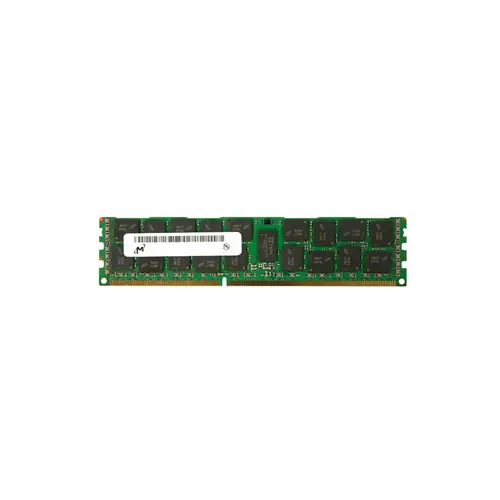
This DDR3-1866 RDIMM is engineered for server platforms, ideal for memory-intensive workloads like virtualization and in-memory databases where ECC error correction and registered signal integrity are critical to prevent data corruption. Its single-rank x4 configuration and CL13 latency optimize electrical loading and bandwidth efficiency, ensuring reliable operation in dense, multi-DIMM deployments.
1. 8GB capacity per module allows finer-grained memory provisioning in virtualized clusters, helping operators allocate just the right footprint to each VM without wasting costly server resources.
2. 1866MHz clock speed sustains high throughput for in-memory caching tiers, ensuring consistent sub-millisecond data retrieval under heavy concurrent user loads.
3. On-the-fly ECC error correction eliminates silent data corruption in long-running computation jobs, a must-have for financial modeling or scientific simulations where result accuracy is non-negotiable.
4. Registered signaling stabilizes command and address lines across fully populated DIMM slots, letting dual-socket servers scale to hundreds of gigabytes without signal degradation or boot failures.
5. Single Rank x4 organization boosts bank-group parallelism, lowering queuing delays during burst memory traffic typical of database query engines and real-time analytics platforms.
This server-grade RDIMM delivers four critical attributes for enterprise workloads. First, ECC error correction silently fixes single-bit memory faults caused by cosmic radiation. In a virtualized cluster with dozens of VMs, this prevents silent data corruption that could bring down entire services, safeguarding uptime and data integrity. Second, the registered buffer decouples the memory controller’s electrical load, letting you populate all DIMM slots stably. For an in-memory database like SAP HANA demanding hundreds of gigabytes of RAM, this scalability is non-negotiable. Third, the 1866MHz clock and Single Rank x4 organization provide up to 14.9 GB/s bandwidth with reduced bus loading, accelerating transaction processing and query response times under heavy concurrency. Fourth, a tight CL13 latency further sharpens performance, making sure virtualized applications get data without delay. Together, these features make the Micron MT18JSF1G72PZ-1G9E1HI a reliable, high-throughput building block for your data center.
This is a DDR3-1866 8GB RDIMM (Registered ECC), making it strictly server memory. Use the capacity planning guidelines below for key enterprise workloads.
General Virtualization
Populate memory channels evenly to avoid bottlenecks. For a dual-processor server with four channels each, begin with eight 8GB DIMMs (64GB) running at one DIMM per channel for full speed, then scale to sixteen (128GB) at two DIMMs per channel as virtual machine density increases. Registered ECC guards against data corruption under sustained load.
In-Memory Database
Achieve large capacity and low latency by leveraging single-rank x4 modules. Fill all channels with two DIMMs per channel if the platform supports 1866MHz; this typically means deploying twelve or sixteen 8GB DIMMs (96–128GB) to hold indexes and tables entirely in RAM. The 1866MT/s speed combined with CL13 timings provides the fast access required for high transaction rates.
High-Performance Computing (HPC)
Bandwidth is paramount. Install exactly one DIMM per channel—eight 8GB DIMMs (64GB) for an eight-channel system—to maintain the full 1866MHz frequency. This maximizes memory bandwidth for compute-bound parallel simulations and avoids the performance penalty of rank downclocking.
Validated RDIMM rigorously tested for Dell PowerEdge R720, HP DL380p Gen8, and Lenovo x3550 M4.
Q: Can I mix this MT18JSF1G72PZ-1G9E1HI with other memory modules of different brands or speeds?
A: Mixing Registered DIMMs of different brands or speeds is not recommended. It may cause system instability, force all modules to the lowest common speed, or prevent booting. For best reliability, use identical modules with the same part number.
Q: Is this memory compatible with my system? Which Intel or AMD platforms support this RDIMM?
A: This DDR3-1866 Registered ECC DIMM requires a server motherboard with an ECC-supporting chipset. It typically works with Intel Xeon E5-2600 v2 series and AMD Opteron 6300 series platforms. Please verify your board's qualified vendor list for RDIMM support.
Q: What is the recommended DIMM population order for optimal performance with this module?
A: For single-rank x4 Registered DIMMs, populate identical DIMMs per channel, filling slots according to the server board's memory population guidelines. Generally, start with the slots farthest from the CPU, following a balanced configuration across all memory channels to avoid performance penalties.
Q: Does this module support overclocking or XMP profiles?
A: No. This Registered ECC server memory complies with JEDEC PC3-14900 standards only. It is engineered for 24/7 stability in mission-critical environments and does not support overclocking or XMP profiles, which would compromise data integrity and reliability.
Q: What warranty and typical failure rate can I expect for this server memory?
A: This module includes a one-year warranty. Failure rates for enterprise-class RDIMMs are typically very low, often below 0.1% annually, when operated within specified temperature, voltage, and workload parameters. Proper chassis cooling further ensures long-term reliability.