











 Secure payments
Standard refund policy
Trade Assurance
Secure payments
Standard refund policy
Trade Assurance
| Product Type | Memory Module |
|---|---|
| Compliance Standards | RoHS |
| Memory Capacity | 8 GB |
| Memory Technology | DDR3 |
| RAM Speed | 1866 |
| RAM Standard | DDR3-1866/PC3-14900 |
| Error Identifying | Non-ECC |
| Signal Type | Unbuffered |
| Column Access Strobe (CAS) | CL13 |
| Rank | Dual Rank x8 |
| Quantity of Pins | 204-pin |
| RAM Genre | SoDIMM |
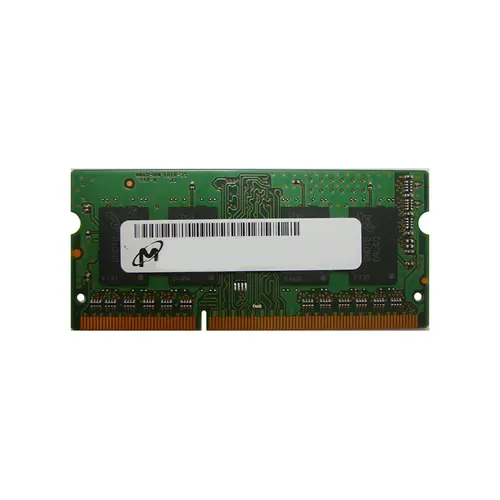
Designed as a non-ECC unbuffered DDR3-1866 SoDIMM, this 8 GB module is optimized for upgrading legacy laptops and small-form-factor mobile workstations where compatibility and plug-and-play simplicity are critical. Its dual-rank x8 organization and tight CL13 latency maximize memory bandwidth in dual-channel configurations, delivering a tangible performance uplift for multitasking and memory-intensive mobile workloads without increasing power draw.
1. The SoDIMM form factor allows a straightforward, tool-free upgrade in most notebooks, letting users instantly boost system responsiveness without professional assistance.
2. Eight gigabytes of capacity provides ample room for modern operating systems and productivity suites, minimizing disk swapping during conference calls, email, and document editing on the go.
3. Running at 1866 megatransfers per second accelerates data movement to the processor, which helps integrated graphics deliver smoother video streaming and snappier window animations on a power-constrained platform.
4. The tight CAS latency of thirteen cycles reduces wait states for active memory rows, translating to perceptibly shorter application launch times and more fluid multitasking in everyday mobile use.
5. Dual rank x8 organization banks more memory chips onto the module, improving interleaving efficiency to sustain performance under load while staying within the tight power and thermal envelopes of thin-and-light notebooks.
Based on the 204-pin SO-DIMM form factor, the Micron MT16KTF1G64HZ-1G9E2 is unequivocally a notebook memory module, purpose-built to address the most urgent demands of mobile users. Its four defining characteristics translate directly into tangible real-world advantages. First, low-voltage DDR3L operation at 1.35V significantly reduces power draw, which becomes critically important when you are editing a 4K video timeline on a mobile workstation at a remote shoot or running a local virtual machine during a cross-country flight—every watt saved extends your unplugged productivity. Second, the 1866 MHz speed paired with a tight CAS latency of 13 ensures that data requests are serviced with minimal delay; on a thin-and-light laptop juggling dozens of browser tabs alongside a large spreadsheet, this eliminates the micro-stutters that fracture concentration. Third, the dual-rank x8 organization enables internal bank interleaving that can boost bandwidth by over 10% compared to single-rank alternatives, giving a photographer who batch-processes RAW images in the field a noticeably smoother pipeline. Fourth, the unbuffered, non-ECC architecture and standardized 204-pin SO-DIMM footprint guarantee effortless compatibility, allowing any user to upgrade from a sluggish 4GB configuration to a responsive 8GB in minutes. Together, these features directly answer the twin pain points of notebook ownership: never having enough runtime, and never having enough responsive memory headroom.
Laptop Upgrade
For typical laptops with one or two SO-DIMM slots, this 8 GB DDR3-1866 module provides a straightforward upgrade path. If your system currently runs a single 4 GB or 8 GB stick, adding a second identical module enables dual‑channel mode and doubles capacity to 16 GB, noticeably improving responsiveness under multitasking. Always verify the platform’s maximum supported capacity and ensure the existing module operates at the same speed and rank to avoid compatibility issues.
Mobile Workstation
Professional workloads such as 3D rendering, CAD, or light virtualisation demand ample memory. Installing two of these 8 GB dual‑rank modules delivers 16 GB in a reliable dual‑channel configuration, satisfying most certified ISV requirements for mid‑range mobile workstations. For maximum capacity, confirm if the chipset supports 32 GB; if limited to 16 GB, this pair remains the optimal config. Pair with an SSD to prevent the memory from becoming the bottleneck in large datasets.
Ultrabook Power Saving
Ultrabooks often require low‑voltage DDR3L to meet thermal and battery targets. If this module is a DDR3L‑1866 variant, a single 8 GB stick offers a good balance between capacity and power draw, while two 8 GB sticks in dual‑channel boost throughput with only a minor impact on runtime. Should the module be standard 1.5 V, it may still work but will consume more power; preference should be given to DDR3L parts to preserve the system’s all‑day battery advantage.
Ensure compatibility: rigorously tested for reliable performance in laptops such as Lenovo ThinkPad T430, Dell Latitude E6430, HP EliteBook 8470p.
Q: Can I mix this MT16KTF1G64HZ-1G9E2 with other memory modules of different brands or speeds?
A: Mixing is not recommended. SoDIMMs from different brands or speeds may cause instability. The system will clock down to the slowest module, but dual‑rank compatibility and timing mismatches can still lead to boot failures in notebooks.
Q: Is this memory compatible with my notebook?
A: This 8 GB DDR3‑1866 SoDIMM suits Intel 4th Gen (Haswell) or select AMD DDR3‑based notebooks. Verify 204‑pin slot, dual‑voltage 1.35 V/1.5 V support, and chipset limitations. We strongly recommend checking your manufacturer's qualified vendor list.
Q: What is the recommended DIMM population order for optimal performance in a laptop?
A: Most notebooks have two slots. For dual‑channel performance, install identical modules in pairs. Populate the primary slot first if using a single 8 GB stick. No special population order is required beyond standard dual‑channel pairing.
Q: Does this module support overclocking or XMP profiles?
A: This JEDEC‑compliant PC3‑14900 module does not support XMP or overclocking. It runs at 1866 MT/s with fixed CL13 timings. Notebook platforms typically lack BIOS overclocking options, so the memory operates at its native specification.
Q: What warranty and typical failure rate can I expect?
A: We provide a 1‑year warranty. The module is built with RoHS‑compliant components and undergoes full electrical testing. Typical AFR (annualized failure rate) is below 0.5% under normal notebook operating conditions.