











 Secure payments
Standard refund policy
Trade Assurance
Secure payments
Standard refund policy
Trade Assurance
| Product Type | Memory Module |
|---|---|
| Compliance Standards | RoHS |
| Memory Capacity | 8 GB |
| Memory Technology | DDR3 |
| RAM Speed | 1866MHz |
| RAM Standard | DDR3-1866/PC3-14900 |
| Error Identifying | Non-ECC |
| Signal Type | Unbuffered |
| Column Access Strobe (CAS) | CL13 |
| Rank | Dual Rank x8 |
| Quantity of Pins | 240-pin |
| RAM Genre | UDIMM |
This DDR3-1866 UDIMM is a desktop memory module ideally suited for gaming and content creation workloads, where its dual-rank x8 organization boosts sustained bandwidth and the CL13 low latency sharpens system responsiveness. The unbuffered, non-ECC design simplifies installation in mainstream desktops, making it a reliable plug-and-play upgrade for cost-effective productivity builds.
1. The 1866MHz clock speed provides a noticeable uplift in frame pacing for budget-minded gaming rigs, ensuring smoother visuals in less GPU-bound scenarios.
2. CL13 column access strobe latency slashes memory response time, delivering the crisp command execution that competitive gamers need for rapid in-game reactions.
3. An 8GB capacity hits the sweet spot for mainstream multitasking, letting you keep browsers, chat apps, and productivity tools open without slowdowns during content creation sessions.
4. Dual Rank x8 organization interleaves memory accesses across banks, raising effective bandwidth to reduce stutter when editing high-resolution photos or rendering complex projects.
5. Unbuffered UDIMM design eliminates an extra clock cycle on every command, maximizing native controller responsiveness for overclockers chasing every last millisecond in timing-sensitive workloads.
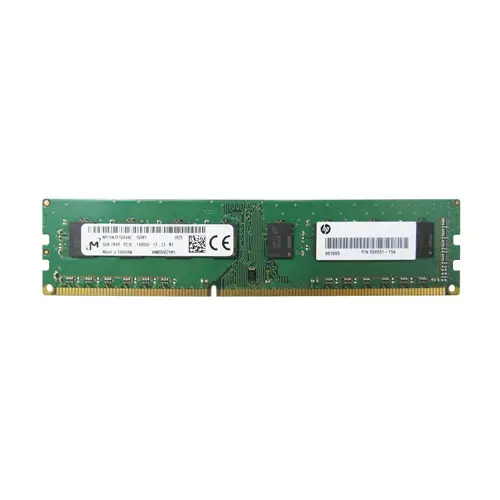
Designed as a desktop UDIMM, the Micron MT16KTF1G64AZ-1G9P1 brings DDR3-1866 speed and a tight CL13 latency directly to your system's responsiveness. In demanding AAA games, that low CAS latency means the CPU spends less time waiting for data, translating to smoother frame pacing and snappier in-game reactions when every millisecond counts. The dual-rank x8 organization takes this further by interleaving memory banks, which boosts effective bandwidth. For video rendering and 3D modeling workloads, this architecture keeps data flowing steadily to the processor even during heavy multi-threaded renders, reducing stutters and accelerating export times. The unbuffered, non-ECC design eliminates the overhead of server-class error correction, ensuring full native speed on consumer desktop platforms and straightforward compatibility with a wide range of motherboards. With 8 GB of capacity, it hits the practical sweet spot for modern multitasking—handling complex creative projects or running a game alongside streaming software without the slowdown of paging. This module delivers what desktop users genuinely feel: fluid frame rates, shorter rendering waits, and a system that stays responsive under pressure.
Based on the provided specifications — Non-ECC, Unbuffered, 240‑pin UDIMM, DDR3‑1866, 8 GB dual‑rank module — this is desktop memory. It suits consumer platforms that rely on unbuffered DIMMs. Below is the capacity planning guidance tailored to typical desktop workloads.
Gaming Build
For modern gaming, dual‑channel operation is critical to prevent memory bottlenecks. Install two of these 8 GB modules as a matched pair to achieve 16 GB total at 1866 MHz, which comfortably handles current titles and background tasks. If your motherboard has four slots, adding a second identical 2×8 GB kit yields a 32 GB configuration while still maintaining symmetrical dual‑channel performance.
Content Creation
Heavy workflows like 4K video editing, 3D rendering, and complex compositing thrive on high capacity. Populate all four DIMM slots with these 8 GB UDIMMs to reach 64 GB, keeping dual‑rank per channel for decent bandwidth. This setup reduces reliance on scratch disks and allows smoother timeline scrubbing and multi‑application rendering suites. Verify that your motherboard and CPU support the full 64 GB addressable space.
General Productivity
For office suites, web browsing, and multitasking, a single 8 GB module offers an affordable entry point. Users on a tighter budget can start with one stick and later add a second identical module to activate dual‑channel mode, doubling both capacity and memory bandwidth. This incremental approach balances cost and responsiveness perfectly for everyday use.
Rigorously tested, compatible with desktops including Dell OptiPlex 9020, HP EliteDesk 800 G1, Lenovo ThinkCentre M93p.
Q: Can I mix this MT16KTF1G64AZ-1G9P1 with other memory modules of different brands or speeds?
A: Mixing is possible but strongly discouraged. The onboard memory controller will match the slowest installed module's speed and timings, potentially causing instability. For guaranteed dual-channel operation, use identical modules.
Q: Is this memory compatible with my system?
A: This 240-pin DDR3 UDIMM fits mainstream desktop boards using Intel 7/8/9-series or AMD FM2+/AM3+ chipsets. Verify your motherboard supports 8GB dual-rank modules and a 1866MHz memory clock for full compatibility.
Q: What is the recommended DIMM population order for optimal performance?
A: Populate identical modules in the same-colored slots first, typically A2 and B2 on modern 4-slot boards. This enables dual-channel interleaving and maximizes bandwidth. Always consult your motherboard manual for the exact population sequence.
Q: Does this module support overclocking or XMP profiles?
A: This is a JEDEC-compliant DDR3-1866 unbuffered module without XMP. It runs at its rated speed and CL13 native timings by default. Manual overclocking is not officially supported and may void your warranty.
Q: What warranty and typical failure rate can I expect?
A: This module includes a 1-year limited warranty. Quality DRAM from Micron typically exhibits an annualized failure rate (AFR) well under 0.5%, ensuring reliable long-term operation under normal desktop usage conditions.