











 Secure payments
Standard refund policy
Trade Assurance
Secure payments
Standard refund policy
Trade Assurance
| Product Type | Memory Module |
|---|---|
| Compliance Standards | RoHS |
| Memory Capacity | 8 GB |
| Memory Technology | DDR3 |
| Product Voltage | 1.35V |
| RAM Speed | 1600MHz |
| RAM Standard | DDR3-1600/PC3-12800 |
| Error Identifying | ECC |
| Signal Type | Registered |
| Column Access Strobe (CAS) | CL11 |
| Rank | Single Rank x4 |
| Quantity of Pins | 240-pin |
| RAM Genre | RDIMM |
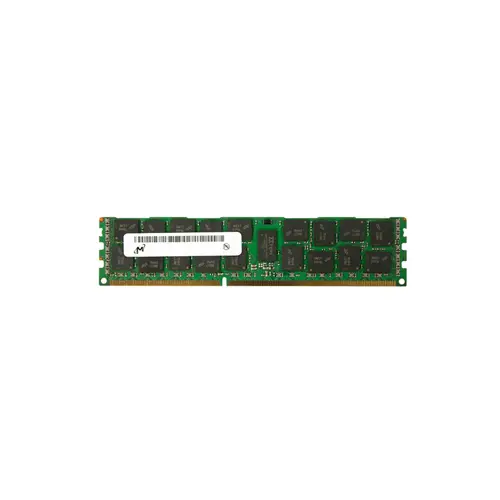
This 8GB DDR3-1600 Registered ECC RDIMM, configured as single-rank x4 with CL11 latency, ensures reliable signal integrity and data integrity for dense server environments and is ideally suited for virtualization platforms and in-memory databases where error-free operation is critical.
1. Registered signal type enables the memory controller to drive multiple DIMMs per channel without signal degradation, essential for scaling up memory capacity in dense server racks.
2. ECC protection silently detects and corrects single-bit memory errors, preventing data corruption that would otherwise crash virtualized workloads or financial transactions.
3. An 8 GB capacity per module strikes a balance between granularity and density, allowing fine-tuned provisioning for mid-sized virtual machines without wasting resources.
4. DDR3-1600 speed delivers up to 12.8 GB/s of peak bandwidth per channel, sustaining smooth database queries and caching under concurrent user loads.
5. 1.35V low voltage operation shrinks the thermal footprint across fully populated server nodes, directly lowering data center cooling overhead and energy bills.
For your enterprise server infrastructure, this 8GB DDR3-1600 RDIMM is engineered to eliminate the silent threats that undermine data integrity and uptime. The ECC technology is your frontline defense against single-bit memory errors—a common occurrence due to background radiation—which can corrupt transactional records in an in-memory database like Redis or SAP HANA, leading to costly financial discrepancies. When you are running a dense virtualization cluster with multiple VMs per node, the Registered signal buffer becomes non-negotiable; it stabilizes the electrical load from numerous memory modules, ensuring that your hypervisor remains rock-solid under heavy contention instead of triggering a server crash that cascades across your hosted services. Moreover, the single-rank x4 organization and CL11 latency strike a deliberate balance between bandwidth efficiency and command rate, allowing your database queries to stream with lower latency while maximizing the data throughput the memory controller can sustain simultaneously. With a low 1.35V operating voltage, this module also reduces the thermal footprint inside your rack, lowering cooling costs and prolonging the lifespan of adjacent components in a 24/7 data center environment. This is not just memory; it is a stable, error-free foundation for mission-critical workloads where every bit counts.
General Virtualization
For a basic virtualization host running several light VMs, deploy at least four of these 8GB RDIMMs (32GB total) across the server’s memory channels to maintain balanced access. ECC protection is essential here to prevent silent data corruption in multi-tenant environments. Scale to 64GB or 96GB using identical modules if you plan to run more demanding virtualized workloads.
In-Memory Database
In-memory databases like Redis or SAP HANA thrive on capacity and low latency. Populate all available DIMM slots with these 8GB DDR3-1600 registered modules to maximize bandwidth while keeping the dataset entirely in RAM. Aim for a minimum of 64GB, but plan for 128GB or more to accommodate dataset growth and avoid costly disk swapping.
High-Performance Computing (HPC)
HPC clusters benefit from memory bandwidth as much as capacity. Install six or eight of these single-rank x4 RDIMMs per dual-socket node to fully utilize each processor’s memory channels. The 1.35V operating voltage reduces power draw across a dense cluster, and the registered signal type ensures stability even when all slots are populated under continuous heavy computation.
Rigorously tested server memory for Dell PowerEdge R720, HPE ProLiant DL380p Gen8, Lenovo System x3650 M4.
Q: Can I mix this MT18KSF1G72PZ-1G6E1FE with other memory modules of different brands or speeds?
A: Mixing RDIMMs of different brands or speeds is not recommended as it may cause system instability or prevent booting. All installed modules should match in rank, speed, and timings.
Q: Is this memory compatible with my Intel or AMD server platform?
A: This DDR3-1600 Registered ECC module is compatible with servers supporting 1.35V RDIMMs. Verify your motherboard's memory QVL and support for buffered ECC DDR3, typically older Intel Xeon E5/E5 v2 or AMD Opteron platforms.
Q: What is the recommended DIMM population order for optimal performance?
A: Follow your server motherboard's manual for balanced memory channels. Typically, populate identical DIMMs in matching slots across memory channels first, starting with the farthest slot from the CPU per channel.
Q: Does this module support overclocking or XMP profiles?
A: No. This RDIMM is built to strict JEDEC DDR3-1600 standards with CL11 latency. Server memory prioritizes stability and data integrity, and does not support XMP or overclocking features.
Q: What warranty and typical failure rate can I expect?
A: This Micron module includes a one-year warranty. Enterprise RDIMMs are screened for high reliability, with expected annualized failure rates well below 1%. Proper handling and environmental conditions ensure long-term stability.