











 Secure payments
Standard refund policy
Trade Assurance
Secure payments
Standard refund policy
Trade Assurance
| Product Type | Memory Module |
|---|---|
| Memory Capacity | 8 GB |
| Memory Technology | DDR4 |
| Product Voltage | 1.2V |
| RAM Speed | 133MHz |
| RAM Standard | DDR4-2133/PC4-17000 |
| Error Identifying | ECC |
| Signal Type | Registered |
| Column Access Strobe (CAS) | CL15 |
| Rank | Single Rank x4 |
| Quantity of Pins | 288-pin |
| RAM Genre | NVDIMM |
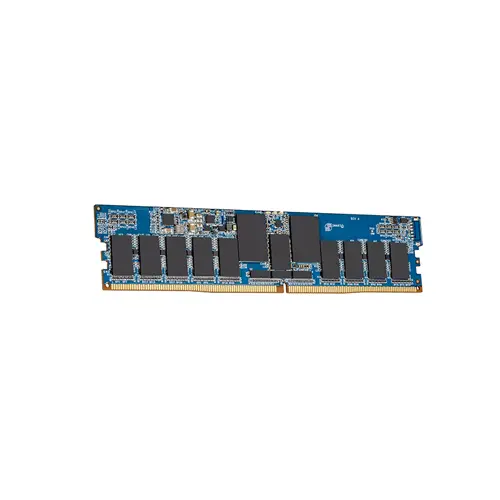
This high-density, 8GB NVDIMM-N module merges DDR4-2133 performance with persistent storage capability, making it ideal for in-memory databases and write-intensive transactional workloads where sudden power loss would be catastrophic. Its Registered, single-rank x4 design with ECC ensures robust signal integrity on densely populated server boards, while the CL15 latency and low 1.2V operation maintain a balance between access speed and energy efficiency in virtualized environments.
1. NVDIMM technology preserves critical in-flight data instantly during power loss, turning volatile memory into a persistence layer that eliminates recovery delays for transactional databases.
2. ECC corrects single-bit errors on the fly, ensuring long-running analytics jobs produce accurate results without silent data corruption in always-on server environments.
3. Registered signal buffering stabilizes command and address lines, enabling dense memory populations to run reliably under the heavy load of virtualized server fleets.
4. 8 GB capacity as a non-volatile DIMM dedicates ample room to accelerate write caching and journaling, slashing storage I/O bottlenecks for write-intensive enterprise applications.
5. DDR4-2133 bandwidth delivers a balanced 17 GB/s throughput, providing sufficient memory bandwidth to keep modern server cores fed while maintaining cool, energy-efficient operation.
The Micron MTA18ASF1G72XF1Z-2G1Y11AAIGE is a server-class 8GB DDR4 NVDIMM, purpose-built to solve the most pressing reliability challenges in enterprise data centers. Its four core attributes—NVDIMM persistence, ECC error correction, registered signal buffering, and a single-rank x4 layout—translate directly into real-world resilience. In a virtualized cluster hosting dozens of business-critical VMs, a sudden power loss would traditionally wipe in-flight cache and session data, forcing hours of recovery. The NVDIMM’s onboard flash backup instantly preserves DRAM contents, allowing services to resume in seconds without transactional corruption. For an in-memory database processing financial trades, ECC is non-negotiable: it detects and corrects single-bit flips caused by background radiation or voltage drift, preventing a silent data error from cascading into a million-dollar miscalculation. Meanwhile, the registered buffer stabilizes command and address signals when all memory channels are fully populated, so you can scale to hundreds of gigabytes across a multi-DIMM configuration without risking signal degradation or unexplained crashes. The single-rank x4 design and 1.2V DDR4 voltage keep thermal load low in dense rack deployments, sustaining consistent 2133MT/s bandwidth under continuous heavy I/O—ensuring your analytics queries return fast, accurate results around the clock.
General Virtualization
For general virtualization hosts, a balanced memory-to-core ratio is critical. Deploy these 8 GB NVDIMMs in multiples of 8 or 16 modules across dual-socket servers to reach 128–256 GB, ensuring ample headroom for moderate VM density. Use the non-volatile capacity to accelerate hypervisor paging or store persistent VM metadata, reducing boot storms and improving fault tolerance.
In-Memory Database
In-memory databases demand the lowest latency and data persistence. Populate all memory channels symmetrically with a minimum of 16 modules (128 GB) per node, dedicating the NVDIMM’s persistent regions for transaction logs and fast restart. Configure the NVDIMMs in App Direct mode so the database engine can directly manage durability, slashing recovery times to seconds after a power loss.
High-Performance Computing
HPC clusters need extreme bandwidth and checkpoint efficiency. Fill each CPU’s memory channels with one 8 GB NVDIMM per channel, achieving 64 GB per socket for massively parallel MPI jobs. Use the persistent capability to store application checkpoints in-place, dramatically reducing I/O overhead during long simulation runs and enabling near-instantaneous node state preservation for fault-tolerant workflows.
Rigorously tested, compatible with servers like Dell PowerEdge R740, HPE ProLiant DL380 Gen10, Lenovo ThinkSystem SR650.
Q: Can I mix this MTA18ASF1G72XF1Z-2G1Y11AAIGE with other memory modules of different brands or speeds?
A: Mixing registered ECC NVDIMM modules with different brands or speeds is not recommended. For server stability, populate only identical part numbers to avoid training failures, data integrity issues, and potential system crashes.
Q: Is this memory compatible with my system?
A: This DDR4-2133 registered ECC NVDIMM requires a server platform supporting NVDIMM-N technology, such as certain Intel Xeon Scalable or AMD EPYC systems with the proper BIOS and chipset. Verify your server's QVL list.
Q: What is the recommended DIMM population order for optimal performance?
A: Follow your server manual's memory population guidelines. Typically, populate identical DIMMs in matching slots per channel, starting with the first slot of each memory channel (often blue slots) to balance interleaving and maximize bandwidth.
Q: Does this module support overclocking or XMP profiles?
A: No. This is a JEDEC-compliant server memory module clocked at 2133 MHz with CL15 latency. It does not support overclocking or XMP profiles, as server environments prioritize long-term reliability over performance tuning.
Q: What warranty and typical failure rate can I expect?
A: This module includes a one-year warranty. Typical annualized failure rate (AFR) is well under 1% under normal server operating conditions, reflecting rigorous testing and premium NVDIMM component selection for maximum uptime.