











 Secure payments
Standard refund policy
Trade Assurance
Secure payments
Standard refund policy
Trade Assurance
| Product Type | Memory Module |
|---|---|
| Memory Capacity | 8 GB |
| Memory Technology | DDR4 |
| Product Voltage | 1.2V |
| RAM Speed | 2133MHz |
| RAM Standard | DDR4-2133/PC4-17000 |
| Error Identifying | ECC |
| Signal Type | Registered |
| Column Access Strobe (CAS) | CL15 |
| Rank | Single Rank x4 |
| Quantity of Pins | 288-pin |
| RAM Genre | RDIMM |
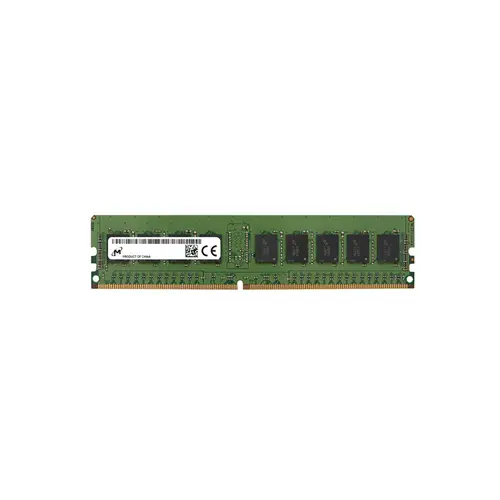
Designed for server platforms, this 8GB DDR4-2133 RDIMM with ECC and registered signaling delivers critical data integrity and stability for virtualization, in-memory databases, and other enterprise workloads. Its single-rank x4 configuration reduces electrical loading on the memory bus, enabling higher density deployments while maintaining reliable 1.2V operation at CL15 latency.
1. Error-correcting code detects and repairs single-bit errors in real time, safeguarding critical data integrity for virtualization hosts and database servers running non-stop operations.
2. Registered buffering decouples the command and address bus from the DRAM load, allowing dense multi-DIMM configurations to operate stably across all memory channels.
3. The moderate capacity grade provides a right-sized resource block, maximizing per-node VM density for lightweight cloud instances while keeping overall infrastructure cost efficient.
4. The data rate delivers steady sustained bandwidth per channel, perfectly matching the needs of consistent enterprise workload throughput and latency-sensitive transactional processing.
5. Single-rank organization with x4-wide devices minimizes electrical loading, which helps maintain signal integrity and full memory speed even when every slot is populated in a scaled-out server.
Judging by the RDIMM form factor, ECC, and registered signal type, this is a server-grade memory module. In data center environments, the Micron MTA18ASF1G72PZ-2G1A2II translates four core characteristics into measurable business resilience.
First, ECC error correction directly defends your virtualized cluster from silent data corruption. When dozens of VMs share physical resources, a single undetected bit flip in memory can cascade into hypervisor crashes or data integrity violations inside your database—ECC catches and corrects these single-bit errors before they become tickets, preserving uptime in multi-tenant deployments.
Second, the registered interface with a single-rank x4 organization stabilizes high-density memory channels. In an in-memory database like Redis or SAP HANA, populating all channels with registered DIMMs offloads electrical loading from the memory controller. This means you can fill every slot without sacrificing the 2133MHz operating speed, maintaining the low-latency bandwidth that real-time analytics and transaction-heavy workloads demand.
At 1.2V, the DDR4 standard also reduces the thermal footprint across a rack full of nodes, while 8GB capacity per stick offers the granular scaling you need to right-size caching tiers without overprovisioning. Together, these features guarantee that your virtualization hosts and memory databases run not just fast, but reliably under continuous load.
General Virtualization
For a typical hypervisor hosting multiple VMs, capacity per channel is critical. We recommend populating in balanced sets of four or eight identical 8 GB RDIMMs to enable quad-channel memory interleaving, yielding 32 GB or 64 GB total. This configuration balances density for moderate VM counts while fully utilizing the memory bandwidth of DDR4-2133 registered DIMMs.
In-Memory Database
In-memory databases such as Redis or SAP HANA demand capacity and low latency. A minimum of eight 8 GB modules (64 GB) per socket is advised, scaling to sixteen modules (128 GB) for larger working sets. Always install identical single-rank x4 RDIMMs in multiples of the platform’s memory channels to avoid performance penalties from rank imbalance.
High-Performance Computing (HPC)
HPC workloads require maximum sustained bandwidth. Populate all memory channels symmetrically—typically one 8 GB RDIMM per channel for an eight-channel system, giving 64 GB total. Sticking to single-rank modules at 2133 MT/s with CL15 ensures low command latency and stable registered signaling under heavy floating-point or parallel I/O loads.
Rigorously tested for compatibility with Dell PowerEdge R730, HPE ProLiant DL380 Gen9, Lenovo ThinkSystem SR550, and more.
Q: Can I mix this MTA18ASF1G72PZ-2G1A2II with other memory modules of different brands or speeds?
A: Mixing RDIMMs of different brands or speeds is not recommended in server environments. It may cause instability, reduced performance, or POST failures. For guaranteed reliability, populate all channels with identical registered modules.
Q: Is this memory compatible with my system?
A: This 8GB DDR4-2133 ECC Registered DIMM is designed for server platforms using Intel Xeon E5-2600 v3/v4 or similar processors with C610/C620 chipsets. Verify your motherboard supports 1.2V 288-pin RDIMMs.
Q: What is the recommended DIMM population order for optimal performance?
A: For optimal performance, populate identical RDIMMs in sets of 2 or 4 per memory channel, starting with the slot farthest from the CPU. Follow your server manual for balanced memory configurations to maximize bandwidth.
Q: Does this module support overclocking or XMP profiles?
A: No, this RDIMM adheres to JEDEC DDR4-2133 standards and does not support overclocking or XMP profiles. It is engineered for strict server reliability and data integrity at fixed 1.2V operating conditions.
Q: What warranty and typical failure rate can I expect?
A: This Micron memory module carries a one-year warranty. Enterprise-grade RDIMMs exhibit very low failure rates (AFR typically below 0.3%) due to rigorous screening and ECC error correction, ensuring maximum uptime in server applications.