











 Secure payments
Standard refund policy
Trade Assurance
Secure payments
Standard refund policy
Trade Assurance
| Product Type | Memory Module |
|---|---|
| Memory Capacity | 8 GB |
| Memory Technology | DDR4 |
| Product Voltage | 1.2V |
| RAM Speed | 2133MHz |
| RAM Standard | DDR4-2133/PC4-17000 |
| Error Identifying | ECC |
| Signal Type | Registered |
| Column Access Strobe (CAS) | CL15 |
| Rank | Dual Rank |
| Quantity of Pins | 288-pin |
| RAM Genre | DIMM |
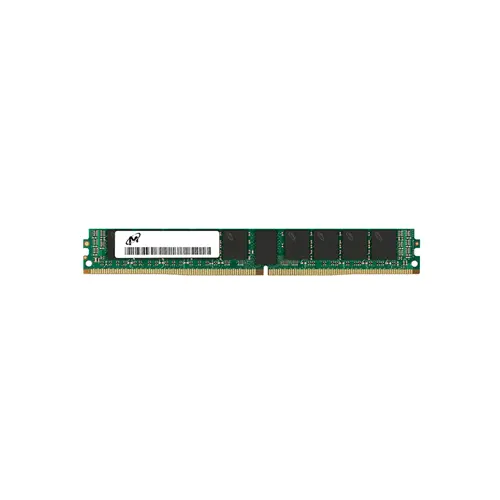
Engineered as an 8GB DDR4-2133 Registered DIMM with ECC and dual-rank architecture, this module is purpose-built for server platforms handling virtualization, in-memory databases, and mission-critical workloads where data integrity is paramount. Its Registered signal type stabilizes high-density configurations while the dual-rank design improves interleaving efficiency, and the CL15 CAS latency combined with ECC error correction ensures reliable, responsive operation under sustained memory loads.
1. ECC memory actively corrects single-bit errors in real time, safeguarding transactional databases and financial computations from silent data corruption that could otherwise trigger costly outages.
2. Registered signaling buffers the command and address buses, ensuring rock-solid signal integrity across fully populated server motherboards for large-scale virtualization farms.
3. Dual rank organization interleaves memory accesses across two internal banks, keeping the server’s memory channels continuously fed and lifting sustained bandwidth under heavy container orchestration.
4. An 8GB module density provides ample capacity per DIMM to host multiple memory-committed VMs, delaying expensive scale-out when consolidating mid-tier enterprise applications.
5. The 1.2V low-power operation cuts overall rack energy consumption and exhaust heat, helping data centers meet tighter thermal budgets without compromising application uptime.
Judging by its 288-pin DIMM form factor, ECC error correction, and registered signal type, the Micron MTA18ADF1G72PZ-2G1A1JG is unequivocally a server-grade memory module. Its four defining characteristics directly address the critical pain points of data center operators. First, the integrated ECC constantly scans for and corrects single-bit memory errors caused by background radiation, a silent threat that can corrupt financial transactions or hypervisor state in a dense VMware cluster, turning unpredictable crashes into non-events. Second, the registered buffer electrically isolates the DRAM chips from the memory controller, enabling a 24-DIMM server board to remain signal-stable under full load, which is non-negotiable when you need 512GB of reliable capacity for a business-critical SAP HANA instance. Third, its dual-rank organization interleaves two internal banks of memory, boosting effective bandwidth by roughly ten percent over single-rank modules; this directly cuts query latency in an in-memory Redis database during peak traffic. Finally, the DDR4 standard operating at a frugal 1.2 volts reduces thermal load and energy draw per DIMM, scaling into substantial opex savings across a pod of hundreds of blades without sacrificing the 2133MT/s throughput that keeps your virtualized workloads fluid.
General Virtualization
This 8GB Registered DDR4-2133 ECC DIMM suits entry-level hypervisor hosts or light VM density. For general virtualization, populate at least four identical modules to achieve 32GB, enabling a modest number of VMs without NUMA penalties. Always install in balanced channel configurations to maintain memory bandwidth and reliability under multi-tenant workloads.
In-Memory Database
In-memory databases like Redis or SAP HANA demand maximum capacity and error resilience. Deploy this module in fully populated banks—six or eight DIMMs per socket—to reach 48GB or 64GB, leveraging ECC to protect in-flight data. Pair with Registered DIMMs to maintain signal integrity when all slots are filled, and prioritize 2DPC (two DIMMs per channel) for cost-effective density.
High-Performance Computing
While 2133MHz is modest for HPC, dual-rank Registered DIMMs deliver steady bandwidth in multi-socket nodes. Use a minimum of four modules per socket to exploit quad-channel architectures, ensuring 32GB per node for simulation or modeling tasks. ECC is non-negotiable here to avoid silent data corruption during long-running parallel jobs; scale horizontally with identical kit pairs across cluster nodes.
Strictly validated for Dell PowerEdge R740, HPE DL380 Gen10, Lenovo SR650 and similar servers.
Q: Can I mix this MTA18ADF1G72PZ-2G1A1JG with other memory modules of different brands or speeds?
A: Mixing is strongly discouraged. Registered ECC modules require identical rank, speed, and timings. Mixing may cause system instability or prevent POST in server platforms.
Q: Is this memory compatible with my server?
A: This module is compatible with Intel and AMD servers using DDR4 Registered ECC memory. Verify your platform supports 8GB Dual Rank 2133MHz Registered DIMMs before purchase.
Q: What is the recommended DIMM population order for optimal performance?
A: Populate identical DIMMs per channel, starting with the farthest slot from the CPU. In multi-socket servers, balance memory across all memory controllers for best performance.
Q: Does this module support overclocking or XMP profiles?
A: No. This is a JEDEC-compliant server module operating at standard DDR4-2133. Overclocking and XMP are not supported, ensuring data integrity and stability for enterprise workloads.
Q: What warranty and typical failure rate can I expect?
A: This module includes a 1-year warranty. The annualized failure rate is typically well below 1%, as these enterprise-grade ECC modules are built for reliable 24/7 operation in servers.