











 Secure payments
Standard refund policy
Trade Assurance
Secure payments
Standard refund policy
Trade Assurance
| Product Type | Memory Module |
|---|---|
| Memory Capacity | 8 GB |
| Memory Technology | DDR4 |
| Product Voltage | 1.2V |
| RAM Speed | 2133MHz |
| RAM Standard | DDR4-2133/PC4-17000 |
| Error Identifying | ECC |
| Signal Type | Registered |
| Column Access Strobe (CAS) | CL15 |
| Rank | Dual Rank x8 |
| Quantity of Pins | 288-pin |
| RAM Genre | RDIMM |
This 8 GB DDR4-2133 Registered DIMM with ECC is a server-class memory module purpose-built for virtualization, in-memory databases, and mission-critical workloads that mandate data integrity. Its dual-rank x8 organization maximizes bank-level parallelism for higher sustained throughput, while the registered buffer and CL15 latency ensure stable signal integrity in dense multi-DIMM server deployments.
1. ECC protection detects and corrects single-bit errors in real time, safeguarding transactional databases and financial computations against silent data corruption that could otherwise crash critical services.
2. Registered signal buffering stabilizes command and address lines across large memory populations, allowing dense server configurations to scale without compromising boot reliability under heavy load.
3. Dual rank x8 organization leverages rank interleaving to keep data pipelines continuously fed, raising effective bandwidth for virtualized clusters where multiple VMs contend for memory access simultaneously.
4. CL15 column access latency fine-tunes read response timing, trimming microseconds off in-memory query operations that add up to tangible throughput gains in high-frequency trading or caching layers.
5. 1.2V low-voltage operation cuts per-DIMM power draw directly, which accumulates into significant thermal and energy savings across racks running 24/7, reducing total cost of ownership for hyperscale deployments.
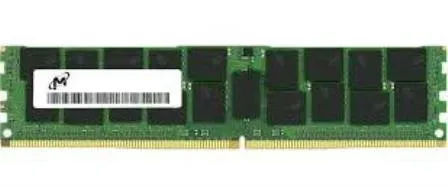
Designed specifically for enterprise servers, the Micron MTA18ASF1G72PDZ-2G1B1II is an 8GB DDR4-2133 RDIMM that turns four technical specifications into real-world operational resilience. Its ECC technology silently corrects single-bit memory errors caused by cosmic radiation or electrical noise, which means your virtualization cluster avoids silent data corruption during live VM migrations—preserving transaction integrity in multi-tenant cloud environments without costly application crashes. The registered buffer architecture stabilizes signal routing across densely populated motherboards, so when you scale a database server to 192GB or beyond, the memory controller drives clean commands to every rank without timing failures, keeping your in-memory database like Redis responsive under millions of concurrent queries. That dual-rank x8 organization interleaves access across two internal banks, elevating bandwidth for sequential database scans and reducing latency spikes during peak OLTP loads. Operating at 1.2V, this module also lowers thermal stress inside 1U rack enclosures, directly extending hardware lifespan while maintaining 2133MHz throughput on the PC4-17000 standard. For your SQL analytics node or hypervisor fleet, this module ensures that every clock cycle serves accurate, available data—not a troubleshooting ticket.
General Virtualization
This 8 GB DDR4-2133 RDIMM provides a stable foundation for modest virtualized environments using hypervisors like ESXi or Proxmox. For light workloads (3–5 VMs), a pair of these DIMMs (16 GB total) allows basic resource distribution. Scale to 4–6 modules (32–48 GB) per host to comfortably run several medium VMs, ensuring memory is balanced across channels for optimal bandwidth.
In-Memory Database
Deploying in-memory databases such as Redis or SAP HANA requires low latency and absolute data integrity, making ECC Registered memory critical. For small test instances, 2 modules (16 GB) suffice, but production caching layers often demand 64 GB or more. Populate all channels identically with multiple 8 GB RDIMMs to maximize interleaving and sustain low CAS 15 response times under heavy cache loads.
High-Performance Computing
HPC jobs thrive on memory bandwidth and reliability. Using this dual-rank DIMM in a populated dual-socket server (e.g., 8×8 GB for 64 GB per node) ensures balanced DIMM-per-channel configurations. For memory-bandwidth-bound simulations, install one DIMM per channel initially; scale by adding identical kits to double capacity without sacrificing speed, keeping rank interleaving active for smoother data throughput.
This rigorously tested ECC Registered DDR4 memory is compatible with Dell PowerEdge R740, HPE DL380 Gen10, Lenovo SR650, and more.
Q: Can I mix this MTA18ASF1G72PDZ-2G1B1II with other memory modules of different brands or speeds?
A: Mixing brands or speeds is strongly discouraged for RDIMMs. It may cause instability or POST failures. Always use identical modules with matching rank, speed, and revision to ensure reliable server operation.
Q: Is this memory compatible with my Intel Xeon or AMD EPYC server platform?
A: This 8GB DDR4-2133 ECC Registered DIMM is designed for Intel Xeon E5-2600 v3/v4 and select AMD EPYC 7001 series platforms. Please verify your motherboard’s QVL for exact compatibility.
Q: What is the recommended DIMM population order for optimal performance in a dual-socket server?
A: Populate identical DIMMs per channel symmetrically across both CPUs. Typically fill the furthest slots (slot 1 per channel) first, then add modules in matching pairs to maintain balanced memory interleaving.
Q: Does this module support overclocking or XMP profiles?
A: No. This is a JEDEC-standard Registered ECC module operating at fixed 2133MHz with CL15. Overclocking and XMP are not supported and would compromise data integrity in enterprise environments.
Q: What warranty and typical failure rate can I expect?
A: This module includes a one-year warranty. Under normal operating conditions, the annualized failure rate is typically below 0.5%, reflecting the high reliability expected of enterprise-grade RDIMMs.