











 Secure payments
Standard refund policy
Trade Assurance
Secure payments
Standard refund policy
Trade Assurance
| Product Type | Memory Module |
|---|---|
| Compliance Standards | RoHS |
| Memory Capacity | 8 GB |
| Memory Technology | DDR4 |
| Product Voltage | 1.2V |
| RAM Speed | 2133MHz |
| RAM Standard | DDR4-2133/PC4-17000 |
| Error Identifying | ECC |
| Signal Type | Registered |
| Column Access Strobe (CAS) | CL15 |
| Rank | Single Rank x4 |
| Quantity of Pins | 288-pin |
| RAM Genre | RDIMM |
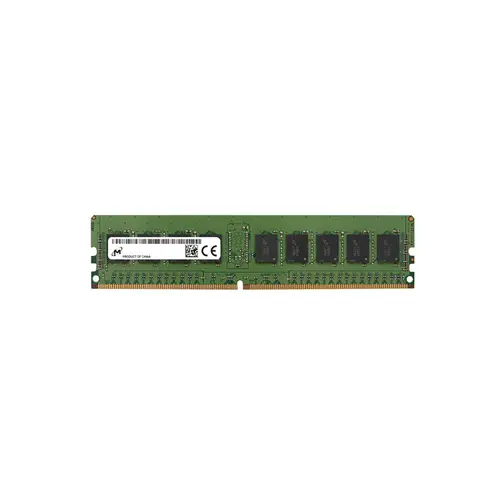
This RDIMM is engineered for server platforms requiring uncompromising data integrity, utilizing registered signal buffering and ECC to ensure rock-solid stability in virtualized environments and memory-intensive databases. Its single-rank x4 configuration at CL15 enables efficient channel loading and low latency, making it an optimal choice for scaling memory capacity without sacrificing access speed.
1. ECC protection silently corrects single-bit errors, preserving data integrity for financial transactions and mission-critical databases that cannot tolerate silent corruption.
2. Registered signal buffering stabilizes high-capacity memory deployments by reducing electrical load on the memory controller, essential for maintaining uptime in dense virtualization clusters.
3. 8 GB capacity provides a cost-efficient footprint for lightweight hypervisors, caching layers, or dedicated appliance instances without overprovisioning resources.
4. 2133 MHz transfer speed delivers up to 17 GB/s of bandwidth per channel, accelerating real-time analytics and in-memory processing workloads under sustained query pressure.
5. CL15 latency minimizes column access delay, sharpening response times for latency-sensitive enterprise applications like high-frequency trading or synchronous database replication.
As a DDR4 Registered DIMM with ECC, this memory module is purpose‑built for server environments where data integrity and uptime directly affect business revenue. Every specification addresses a distinct operational pain point that IT architects face.
The ECC technology silently corrects single‑bit errors caused by cosmic radiation or electrical noise. In a virtualisation cluster running dozens of virtual machines, an uncorrected bit flip can corrupt a financial transaction or silently propagate through a database replica—ECC eliminates that risk at the hardware level. Registered signal buffering stabilises the command and address lines when you populate multiple DIMMs per channel. This lets you scale to 256 GB or more without signal degradation, which is essential for dense private cloud hosts that must maximise VM density per rack unit.
The single‑rank x4 organisation provides an optimal balance of bandwidth and latency. For an in‑memory database like Redis or SAP HANA, it accelerates random access patterns by keeping the bank group overhead low, delivering predictable 17 GB/s throughput at CL15 latency. Combined with the 1.2 V operating voltage, it reduces thermal load in blade chassis, lowering cooling costs while sustaining 2133 MT/s performance around the clock. Every millisecond saved in a critical query, and every watt trimmed from the monthly power bill, makes this module a financially sound choice for modern scale‑out infrastructure.
Capacity Planning Guide for DDR4-2133 ECC RDIMM (8GB)
This is a server-class Registered DIMM with Error Correcting Code, designed for stability and data integrity in enterprise environments. Given the 8GB module size, capacity planning must balance channel population and total memory footprint for various workload profiles.
General Virtualization
For light to moderate hypervisor hosts (e.g., running 10–15 VMs), populate all available memory channels with one DIMM per channel to maximize bandwidth. Using six or eight of these 8GB modules (48–64GB total) provides a balanced pool for overhead and guest memory overcommit, but heavier virtualized clusters should consider larger capacity DIMMs first.
In-Memory Database
In-memory workloads like Redis or SAP HANA demand both capacity and latency consistency. A single 8GB module is insufficient—populate every channel with at least one 8GB RDIMM, then add a second rank per channel if supported, scaling to at least 128GB across the node. For large datasets, migrate to 32GB or 64GB RDIMMs, but 8GB sticks can serve caching or test instances in a cost-effective mirrored configuration.
High-Performance Computing
HPC applications benefit from maximum memory bandwidth. Install identical 8GB modules in sets that match the processor’s memory channels (typically six or eight), keeping one DIMM per channel to avoid interleaving penalties. While 64GB is a viable entry point for compute-bound tasks, memory-capacity-hungry simulations will quickly outgrow 8GB components—plan for higher density modules in production.
Validated server memory: compatible with Dell PowerEdge R760, HPE ProLiant DL380 Gen10, Lenovo ThinkSystem SR650, and more.
Q: Can I mix this MTA18ASF1G72PZ-2G1AVESEG with other memory modules of different brands or speeds?
A: Mixing modules is not recommended. For registered ECC memory, identical part numbers, ranks, and speeds ensure stable server operation. Mismatched DIMMs can cause POST failures or subtle data corruption.
Q: Is this memory compatible with my system?
A: It fits servers supporting DDR4-2133 ECC Registered DIMMs, such as platforms based on Intel Xeon E5-2600 v3/v4. Verify your motherboard’s qualified vendor list to confirm compatibility.
Q: What is the recommended DIMM population order for optimal performance?
A: In dual-processor servers, balance identical DIMMs across memory channels. Typically, populate the furthest slot from each CPU first. Always follow your server manufacturer’s specific population guide for best throughput.
Q: Does this module support overclocking or XMP profiles?
A: No. It is a JEDEC-compliant DDR4-2133 server module without XMP. Enterprise registered memory prioritizes reliability; overclocking is unsupported and would compromise data integrity in server environments.
Q: What warranty and typical failure rate can I expect?
A: This Micron module carries a one-year warranty. Typical server DRAM annualized failure rates are very low (under 0.5%), reflecting its rigorous testing and robust ECC design for mission-critical workloads.