











 Secure payments
Standard refund policy
Trade Assurance
Secure payments
Standard refund policy
Trade Assurance
| Product Type | Memory Module |
|---|---|
| Memory Capacity | 8 GB |
| Memory Technology | DDR4 |
| Product Voltage | 1.2V |
| RAM Speed | 2133MHz |
| RAM Standard | DDR4-2133/PC4-17000 |
| Error Identifying | ECC |
| Signal Type | Registered |
| Column Access Strobe (CAS) | CL15 |
| Rank | Dual Rank x8 |
| Quantity of Pins | 288-pin |
| RAM Genre | RDIMM |
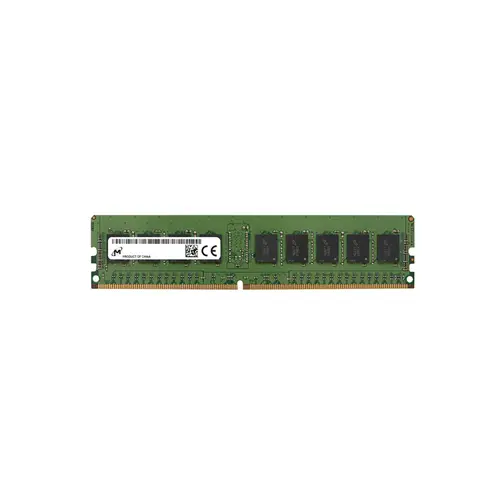
This DDR4-2133 Registered ECC RDIMM is engineered for server platforms running memory-intensive workloads such as virtualization, in-memory databases, and mission-critical enterprise applications where data integrity is paramount. Its dual-rank x8 configuration enables rank interleaving for improved bandwidth utilization, while the CL15 latency and 1.2V operating voltage ensure reliable, power-efficient performance in dense rack deployments.
1. Integrated ECC silently detects and corrects single-bit errors, upholding data integrity for critical workloads like SQL databases and ERP systems running on this server.
2. Registered signaling with an on-chip buffer stabilizes high-capacity memory configurations, ensuring reliable operation even when all DIMM slots are fully populated in a rack server.
3. Dual rank x8 design leverages bank interleaving to elevate memory bandwidth, allowing hypervisors to smoothly juggle numerous virtual machines under heavy consolidation.
4. 2133 MT/s transfer rate provides predictable, consistent memory bandwidth, perfectly suiting steady-state enterprise applications and scale-out object storage clusters.
5. 8 GB per module strikes a balance between density and cost, enabling flexible scaling for virtualized environments that demand modest yet reliable memory expansion.
When you are running a virtualized cluster or an in‑memory database, memory errors are not just glitches; they are direct threats to business continuity. The Micron MTA18ASF1G72PZ‑2G1AVESIG is a server‑grade DDR4 RDIMM built specifically for these workloads, and its four defining characteristics translate into real operational resilience.
First, ECC relentlessly corrects single‑bit errors caused by background radiation, preventing silent data corruption that could crash a hypervisor hosting dozens of virtual machines or return a wrong value in a financial database. Second, the registered buffer strengthens the command and address bus, letting you populate all memory channels with multiple DIMMs without sacrificing signal integrity. This is essential when your in‑memory platform—such as a Redis cluster or SAP HANA instance—requires hundreds of gigabytes of RAM for live analytics. Third, the dual‑rank x8 organization interleaves memory banks, boosting sustained bandwidth and lowering latency so concurrent query threads in a virtualized database farm run faster. Fourth, the low 1.2 V operating voltage slashes power consumption across a server rack, reducing cooling costs and improving your total cost of ownership over years of round‑the‑clock operation. With this module, data integrity, scalable capacity, performance, and efficiency all converge to keep your mission‑critical services up and accurate.
General Virtualization
For a DDR4-2133 registered ECC module, populate identical 8GB RDIMMs in balanced channels to maximize memory bandwidth. In typical virtualization hosts, install six or eight modules for 48–64GB total, ensuring one DIMM per channel to avoid performance penalties. This capacity comfortably supports 15–20 light to medium VMs, while leaving headroom for hypervisor overhead.
In-Memory Database
In-memory databases demand large, reliable memory pools. Deploy at least 12 identical 8GB RDIMMs for a 96GB configuration, fully populating all channels on a dual-socket server to leverage interleaving. ECC and registered signaling ensure data integrity under heavy write loads, reducing the risk of silent corruption during cache-intensive operations.
High-Performance Computing
HPC clusters benefit from uniform, high-density nodes. Install 8 or 16 modules per node (64GB or 128GB) to achieve peak memory bandwidth per core. The dual-rank x8 design at CL15 latency delivers consistent throughput for MPI workloads; populate all memory channels symmetrically to avoid NUMA imbalances that can stall parallel job completion.
Rigorously tested for server compatibility with Dell PowerEdge R740, HPE ProLiant DL380 Gen10, Lenovo ThinkSystem SR650, and more.
Q: Can I mix this MTA18ASF1G72PZ-2G1AVESIG with other memory modules of different brands or speeds?
A: Mixing with different brands or speeds is not recommended. For server stability, use identical modules. Mismatched RDIMMs may cause POST failures or unpredictable ECC errors, compromising data integrity.
Q: Is this memory compatible with my system?
A: This DDR4-2133 ECC Registered DIMM works with servers using Intel Xeon E5-2600 v4 or AMD EPYC 7000 series platforms. Confirm your board supports 288-pin RDIMMs and 1.2V operation.
Q: What is the recommended DIMM population order for optimal performance?
A: Consult your server board manual; typically populate farthest slots from the CPU per channel first. Balance identical dual rank x8 RDIMMs across channels to enable multi-channel mode and maximize bandwidth.
Q: Does this module support overclocking or XMP profiles?
A: No. This JEDEC-standard server memory operates at a fixed 2133MHz with CL15. Overclocking or XMP is not supported, ensuring 24/7 reliability. Speed is determined by host BIOS settings.
Q: What warranty and typical failure rate can I expect?
A: This module includes a 1-year warranty. Typical annualized failure rate for Micron ECC RDIMMs is below 0.5%, ensuring high reliability for mission-critical environments with proper cooling.