











 Secure payments
Standard refund policy
Trade Assurance
Secure payments
Standard refund policy
Trade Assurance
| Product Type | Memory Module |
|---|---|
| Memory Capacity | 8 GB |
| Memory Technology | DDR4 |
| Product Voltage | 1.2V |
| RAM Speed | 2133MHz |
| RAM Standard | DDR4-2133/PC4-17000 |
| Error Identifying | ECC |
| Signal Type | Registered |
| Column Access Strobe (CAS) | CL15 |
| Rank | Single Rank x4 |
| Quantity of Pins | 288-pin |
| RAM Genre | RDIMM |
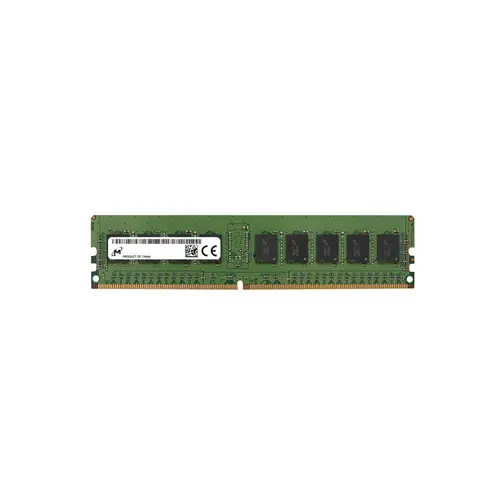
This DDR4-2133 registered ECC module is engineered for server platforms where data integrity is critical, such as virtualization hosts and in-memory databases, with single-rank x4 organization ensuring balanced load on the memory controller and 15-cycle CAS latency providing responsive access. The 288-pin RDIMM leverages registered signal buffering to maintain stability across densely populated memory channels, making it ideal for sustained, error-free operation in enterprise workloads.
1. Error-correcting code actively detects and corrects single-bit memory errors, preserving data integrity across long-running enterprise workloads and preventing silent corruption in transactional databases.
2. Registered signal buffering stabilizes command and address lines, enabling dense memory populations in multi-slot servers without compromising signal quality during heavy virtualization.
3. The entry-level capacity provides a cost-optimized memory building block ideal for lightweight container hosts, edge computing nodes, and cloud-native microservices that scale horizontally.
4. JEDEC-standard base frequency delivers consistent, predictable bandwidth suited for steady-state enterprise applications where reliability and compatibility outweigh peak throughput.
5. Low operating voltage curbs power consumption and thermal output across entire fleets, driving down cooling costs and improving energy efficiency in hyperscale data centers.
Judging by its RDIMM designation, ECC support, and registered signal type, the Micron MTA18ASF1G72PZ-2G1B1II is unmistakably a server-grade memory module. In the data center, where uptime is paramount, its four defining characteristics translate directly into operational resilience. The ECC circuitry continuously corrects single-bit memory errors caused by background radiation—left unchecked, such bit flips can silently corrupt financial ledgers or hypervisor states. Paired with the registered buffer, which redrives address and command signals to relieve the memory controller’s electrical load, this module lets you populate dense virtualization clusters without sacrificing signal integrity, enabling seamless live migration and resource scaling.
When running in-memory databases like Redis or SAP HANA, the module’s single-rank x4 organization and DDR4-2133 speed strike a critical balance between bandwidth and latency. Single rank ensures predictable access patterns and lower command bus contention, accelerating the millions of small, random reads that decision-support systems depend on. At the same time, the 1.2V operating voltage drives down energy consumption and thermal waste per DIMM, which cumulatively shrinks cooling overhead across hundreds of nodes. For IT architects, this means fewer surprises at scale: consistent data fidelity, higher VM density, faster query response, and a cooler electricity bill.
General Virtualization
When building a virtualization host with RDIMMs, populate all memory channels symmetrically to maximize bandwidth. A single 8 GB module is a starter; deploy at least four identical modules for dual‑socket systems to reach 32 GB and leverage channel interleaving. Scale in balanced increments (e.g., 8×8 GB for 64 GB) to avoid NUMA imbalances.
In‑Memory Database
In‑memory databases demand capacity and reliability above all. Start with a set of eight 8 GB RDIMMs to provide 64 GB per CPU, allowing medium‑sized datasets to reside fully in RAM. For larger workloads, double the module count to 16×8 GB (128 GB) while keeping ranks balanced—single‑rank modules like this one help maintain high clock speeds under heavy load.
High‑Performance Computing (HPC)
HPC clusters favor memory bandwidth per core. Install six or eight of these 8 GB RDIMMs per node to achieve 48–64 GB, which suits many compute‑intensive simulations. The Registered ECC design ensures data integrity during long runs; pair modules identically across nodes for consistent performance and simpler maintenance at scale.
Tested and certified for servers. Compatible with: Dell PowerEdge R630/R730, HPE ProLiant DL380 Gen9, Lenovo System x3650 M5.
Q: Can I mix this MTA18ASF1G72PZ-2G1B1II with other memory modules of different brands or speeds?
A: Mixing RDIMM brands or speeds is strongly discouraged for servers. It can cause signal integrity issues and disable ECC functionality, risking data corruption. Always use identical modules to ensure validated reliability.
Q: Is this memory compatible with my system?
A: This DDR4-2133 ECC Registered DIMM is validated for Intel Xeon E5-2600 v3/v4 and select AMD EPYC platforms. Please consult your server board's Qualified Vendor List (QVL) to confirm full compatibility.
Q: What is the recommended DIMM population order for optimal performance?
A: Follow your server motherboard's manual for DIMM population. Typically, install identical modules in matching memory channels (e.g., blue slots first) to balance interleaving and achieve maximum throughput.
Q: Does this module support overclocking or XMP profiles?
A: No. This is a JEDEC-compliant DDR4-2133 CL15 Registered ECC module engineered for server reliability. It does not support overclocking, XMP profiles, or any voltage beyond the standard 1.2V.
Q: What warranty and typical failure rate can I expect?
A: It includes a 1-year warranty. As a server-grade RDIMM built with ECC and stringent screening, the typical annualized failure rate (AFR) is well under 0.5% under proper thermal conditions.