











 Secure payments
Standard refund policy
Trade Assurance
Secure payments
Standard refund policy
Trade Assurance
| Product Type | Memory Module |
|---|---|
| Compliance Standards | RoHS |
| Memory Capacity | 8 GB |
| Memory Technology | DDR4 |
| Product Voltage | 1.2V |
| RAM Speed | 2133MHz |
| RAM Standard | DDR4-2133/PC4-17000 |
| Error Identifying | ECC |
| Signal Type | Registered |
| Column Access Strobe (CAS) | CL15 |
| Rank | Single Rank x4 |
| Quantity of Pins | 288-pin |
| RAM Genre | VLP RDIMM |
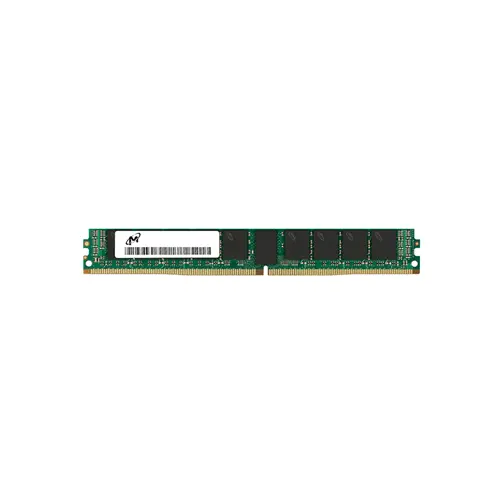
This VLP RDIMM is engineered for dense server deployments, where its ECC and registered signal type ensure unwavering data integrity and signal stability for memory-intensive workloads like virtualization and in-memory databases. The single-rank x4 organization paired with CL15 latency delivers efficient command pipelining and low access delays, maximizing throughput in compact 1U/2U rack servers where vertical clearance and thermal constraints are critical.
1. The VLP RDIMM form factor halts space conflicts in dense server chassis, directly enabling higher memory-per-node and greater virtual machine consolidation.
2. ECC protection silently corrects single-bit and detects multi-bit errors, preserving data integrity for financial transactions and critical databases under uninterrupted operation.
3. Registered signal buffering stabilizes command and address lines across heavy memory populations, ensuring reliable boot and runtime in multi-socket enterprise platforms.
4. Low-voltage operation curbs energy draw and hotspot formation inside the rack, allowing sustained performance without exceeding the data center's power envelope.
5. Single-rank organization with x4 DRAM reduces bus loading, delivering lean electrical margin that maintains consistent I/O scheduling for latency-sensitive virtualized applications.
In the data center, the Micron MTA18ADF1G72PZ-2G1A2 VLP RDIMM is engineered to remove the silent threats that cripple enterprise workloads. Its first critical strength is ECC error correction. In memory-resident databases like Redis or SAP HANA, a single bit flip in financial transaction data or real-time session states can corrupt a query result or trigger an unrecoverable crash. ECC continuously detects and corrects these single-bit errors, turning them from catastrophic events into non-events, which is non-negotiable for data integrity. Second, the registered signal buffering quiets the electrical chaos of high-density deployments. When you pack a virtualization cluster with a dozen VMware nodes, the registered clock driver stabilises the memory bus under heavy load, allowing you to safely populate all channels and run hundreds of VMs without random lockups or parity check hangs. Third, the very low profile form factor shaves precious millimeters off the module height. In 1U rack servers and blade chassis where airflow is already constrained, this unobstructed passage over the DIMM slots keeps thermals in check, extending the lifespan of nearby components. Finally, the 1.2V DDR4 voltage meaningfully lowers the power envelope. Across a 50-node cluster running around the clock, that efficiency cascades into reduced cooling overhead and a lower OpEx that directly feeds the bottom line.
General Virtualization
For a typical hypervisor hosting multiple VMs, populate all available memory channels with identical 8GB RDIMMs to maximize bandwidth and balance loads. Aim for at least 64–128GB total capacity per host, using 8 or 16 modules to leverage channel interleaving while leaving room for future expansion.
In-Memory Database
In-memory databases demand low latency and high reliability; fill all DIMM slots with these registered ECC modules to achieve the highest possible density without sacrificing error correction. Target a minimum of 128GB per server, scaling up to 256GB or more by using 16–24 modules, ensuring the entire dataset resides in fault‑tolerant RAM.
High-Performance Computing
HPC workloads benefit from consistent per‑core memory bandwidth, so install one 8GB RDIMM per memory channel (typically 8 modules per CPU) to run in balanced, fully‑populated mode. For compute‑bound clusters, build 64–128GB nodes by populating all channels with these single‑rank modules, keeping latency low and throughput predictable under heavy FPU and vector loads.
Rigorously tested server memory; compatible with Dell PowerEdge R740, HPE ProLiant DL380 Gen10, Lenovo ThinkSystem SR650, and Cisco UCS C220 M5.
Q: Can I mix this MTA18ADF1G72PZ-2G1A2 with other memory modules of different brands or speeds?
A: Mixing is not recommended. Registered ECC memory demands identical specifications for signal integrity. Mixed brands or speeds often cause POST failures and data errors in server environments.
Q: Is this memory compatible with my server system?
A: It is compatible with Intel Xeon E5-2600 v3/v4 and AMD EPYC platforms that support DDR4-2133 Registered ECC RDIMMs. Always consult your server’s qualified vendor list to confirm.
Q: What is the recommended DIMM population order for optimal performance?
A: Follow your server manual, typically populating identical DIMMs first in slot 1 of each memory channel per CPU. This ensures balanced interleaving and maximum memory throughput.
Q: Does this module support overclocking or XMP profiles?
A: No. This enterprise-class VLP RDIMM operates strictly at JEDEC DDR4-2133 CL15 specification for data integrity. It does not support overclocking or XMP profiles.
Q: What warranty and typical failure rate can I expect?
A: It includes a one-year warranty. These modules are engineered for high MTBF in 24/7 operation, delivering field failure rates far below industry average for mission-critical deployments.