











 Secure payments
Standard refund policy
Trade Assurance
Secure payments
Standard refund policy
Trade Assurance
| Product Type | Memory Module |
|---|---|
| Memory Capacity | 8 GB |
| Memory Technology | DDR4 |
| Product Voltage | 1.2V |
| RAM Speed | 2133MHz |
| RAM Standard | DDR4-2133/PC4-17000 |
| Error Identifying | ECC |
| Signal Type | Registered |
| Column Access Strobe (CAS) | CL15 |
| Rank | Dual Rank x8 |
| Quantity of Pins | 288-pin |
| RAM Genre | RDIMM |
This DDR4-2133 registered ECC module is purpose-built for server platforms running memory-intensive workloads such as virtualization and in-memory databases, where uncompromising data integrity is required. Its dual-rank x8 configuration maximizes capacity per channel on registered buses, while ECC and the registered signal type work in tandem to maintain stable, error-free operation under sustained 1.2V loads.
1. ECC protection silently corrects single-bit errors in real time, safeguarding data integrity for financial ledgers and virtualized database servers running around the clock.
2. Registered buffering stabilizes command and address signals, allowing hyperscale servers to populate all memory channels without compromising signal integrity under heavy load.
3. Dual-rank x8 organization keeps the memory pipeline continuously fed, raising sustained throughput for containerized microservices and memory-intensive hypervisors.
4. 2133MT/s transfer speed provides balanced performance for cost-optimized cloud nodes, ensuring predictable latency for web tiers and cache clusters without overspending on bandwidth.
5. An 8GB capacity per module fits dense scale-out deployments, letting operators pack more lightweight VMs or edge analytics containers into each rack while staying within tight thermal power envelopes.
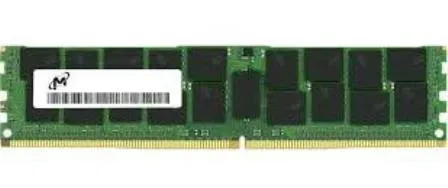
The Micron MTA18ASF1G72PDZ-2G1A is an 8GB DDR4-2133 RDIMM engineered for server platforms where uptime and data integrity are non-negotiable. Its ECC technology actively detects and corrects single-bit memory errors, which directly prevents silent data corruption in transactional databases and financial processing workloads. In a virtualized cluster running dozens of VMs, a single uncorrected bit flip can crash a hypervisor and take down critical services; ECC turns that risk into a self-healing event. The registered signal buffer decouples electrical loading from the memory controller, letting you populate all 24 or more DIMM slots per server without sacrificing stability. This is essential when scaling in-memory databases like SAP HANA, where every gigabyte counts and signal integrity must be perfect under heavy load. Meanwhile, the dual-rank x8 organization enables rank interleaving, delivering improved bandwidth and lower latency during simultaneous read-write operations common in virtual desktop infrastructure and database indexing jobs. Operating at just 1.2V, this module also helps lower the thermal footprint inside dense rack servers, reducing cooling costs over the system’s lifecycle without compromising the rigid reliability that enterprise IT demands.
General Virtualization
For moderate-density virtualization with a few light to medium VMs, a pair of 8 GB RDIMMs (16 GB total) is a typical starting point in a dual-socket server, filling one DIMM per channel to maintain balanced memory access. As VM density grows, scale to four or eight identical modules to enable all memory channels and maximize throughput while maintaining registered ECC reliability. Avoid mixing capacities or ranks in the same channel to prevent performance penalties and complex NUMA topologies.
In-Memory Database
In-memory databases demand both capacity and fault tolerance. Deploy at least eight 8 GB dual-rank RDIMMs per socket to reach 64 GB, providing sufficient headroom for dataset growth while fully utilizing memory interleaving. Dual-rank x8 modules at CL15 offer a solid balance of latency and bandwidth, and the ECC protection is mandatory to guard against silent data corruption in critical transactional workloads.
High-Performance Computing (HPC)
For bandwidth-sensitive HPC jobs, populate all memory channels with identical 8 GB registered DIMMs — typically one DIMM per channel — to achieve peak memory bandwidth per compute node. This configuration supports up to 128 GB across two sockets with 16 DIMM slots, enough for many memory-bound simulations. The stable 1.2 V, 2133 MHz registered signaling ensures consistent latency under sustained load, while easy DIMM expansion allows capacity boosts without discarding existing assets.
Rigorously tested, compatible with Dell PowerEdge R730, HPE ProLiant DL380 Gen9, Lenovo System x3650 M5.
Q: Can I mix this MTA18ASF1G72PDZ-2G1A with other memory modules of different brands or speeds?
A: Mixing is not recommended for server environments. Different brands, speeds, or ranks may cause instability or disable ECC functionality. Always use identical part numbers for guaranteed reliability.
Q: Is this memory compatible with my system?
A: This DDR4-2133 ECC Registered RDIMM is designed for Intel Xeon E5-2600 v3/v4 and select AMD EPYC platforms. Please verify your server's Qualified Vendor List (QVL) for exact compatibility.
Q: What is the recommended DIMM population order for optimal performance?
A: Follow your server motherboard's population guide. Typically, populate identical DIMMs per channel starting with the farthest slot from the CPU, balancing channels for optimal memory bandwidth and ECC operation.
Q: Does this module support overclocking or XMP profiles?
A: No. This is an ECC Registered server memory module operating at JEDEC standard timings. It does not support XMP profiles or overclocking, ensuring data integrity and system stability.
Q: What warranty and typical failure rate can I expect?
A: This module includes a 1-year warranty. Enterprise-grade server memory typically exhibits an annualized failure rate (AFR) well below 0.5%, engineered for 24/7 mission-critical workloads.