











 Secure payments
Standard refund policy
Trade Assurance
Secure payments
Standard refund policy
Trade Assurance
| Product Type | Memory Module |
|---|---|
| Compliance Standards | RoHS |
| Memory Capacity | 8 GB |
| Memory Technology | DDR4 |
| Product Voltage | 1.2V |
| RAM Speed | 2133MHz |
| RAM Standard | DDR4-2133/PC4-17000 |
| Error Identifying | ECC |
| Signal Type | Registered |
| Column Access Strobe (CAS) | CL15 |
| Rank | Single Rank x4 |
| Quantity of Pins | 288-pin |
| RAM Genre | RDIMM |
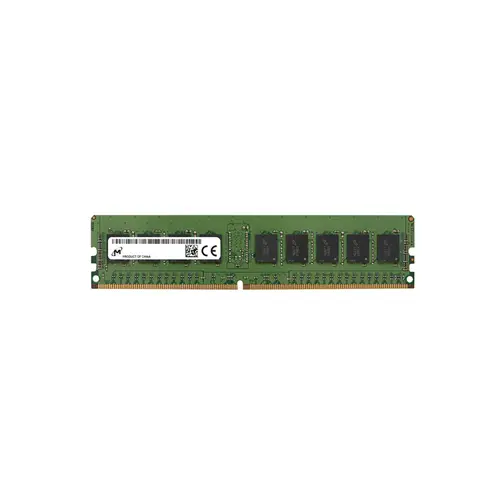
This Micron 8GB DDR4-2133 RDIMM is purpose-built for server platforms running virtualization or in-memory databases, where its ECC and registered signal type guarantee data integrity and signal stability in high-density configurations. The single-rank x4 organization combined with CL15 latency ensures efficient memory controller loading and consistent performance, making it ideal for scale-out enterprise workloads.
1. ECC corrects single-bit errors and detects multi-bit corruption in real time, preserving transactional integrity for mission‑critical database and financial servers.
2. Registered buffering stabilizes command and address signals across heavy memory loads, a prerequisite for confidently scaling RAM capacity in dense virtualization hosts.
3. The Single Rank x4 organization balances electrical loading and bank parallelism, sustaining consistent throughput under the mixed traffic patterns of enterprise storage appliances.
4. Running at a conservative 2133 MT/s base speed delivers deterministic latency and minimal power variance, which is essential for hyperscale workloads that value uniformity over peak headline bandwidth.
5. A low active voltage of 1.2 V curbs power consumption and eases thermal management, yielding measurable reductions in operating cost across always‑on cloud infrastructure.
The Micron MTA18ASF1G72PZ-2G1A2IJ is an 8GB DDR4-2133 RDIMM, purpose-built for server environments where uptime and data accuracy are non-negotiable. In a virtualisation cluster, one undetected bit flip can silently corrupt a database or crash multiple guest machines. The onboard ECC engine detects and corrects single-bit errors in real time, directly protecting in-memory transaction integrity and preventing costly service disruptions. Its registered architecture buffers command and address signals, so when you fully populate all memory channels in a hypervisor host, signal loading is managed cleanly—you can scale to dense configurations without sacrificing boot reliability or sustained performance. A single-rank x4 design reduces bus contention and delivers consistent latency under heavy multi-core load, exactly what an in-memory database like Redis or SAP HANA demands for predictable, low-latency key lookups. Operating at 1.2V, this module also trims power draw across a fleet of servers, lowering cooling costs and extending component lifespan in 24/7 datacentre environments. Every design choice behind this RDIMM translates directly to fewer errors, greater node stability, and lower total cost of ownership.
Based on the specifications—DDR4, ECC, Registered, RDIMM, 288-pin—this is server memory. Below is the capacity planning guidance for typical server workloads.
General Virtualization
Virtualized environments demand balanced capacity and headroom. Start with at least four of these 8GB RDIMMs (32GB total) per host for light workloads, enabling memory interleaving and fault tolerance. Plan for a 1:4 overcommit ratio and scale by adding identical modules to fill all memory channels for optimal throughput.
In-Memory Database
In-memory databases require low latency and massive capacity. Deploy a fully populated memory configuration—sixteen 8GB modules (128GB) or more across all channels—to maximize bandwidth and house entire datasets in RAM. ECC corrections at 2133MHz CL15 provide the stability needed for transactional consistency.
High‑Performance Computing
HPC clusters benefit from balanced, channel-aligned configurations. Use eight or more 8GB RDIMMs per node to saturate the memory bus while keeping DIMM ranks to one per channel, minimizing rank contention during parallel floating-point operations. This approach delivers deterministic single-rank x4 performance for tightly coupled simulations and modeling.
Validate compatibility: this server module is rigorously tested for Dell PowerEdge R740, HPE ProLiant DL380 Gen10, Lenovo ThinkSystem SR650.
Q: Can I mix this MTA18ASF1G72PZ-2G1A2IJ with other memory modules of different brands or speeds?
A: Mixing is not recommended for RDIMMs. Registered ECC memory requires matched ranks, timings, and organization to maintain signal integrity and avoid system instability. Stick with identical part numbers.
Q: Is this memory compatible with my Intel Xeon E5-2600 v4 server platform?
A: Yes, it is designed for DDR4-compatible servers like Intel Xeon E5-2600 v3/v4 or select AMD EPYC platforms. Please verify your motherboard’s QVL and ensure it supports 2133MT/s Registered ECC RDIMMs.
Q: What is the recommended DIMM population order for optimal performance?
A: Follow your server board's manual; typically populate identical DIMMs per channel starting with the blue or white slots first. Balancing channels maximizes memory bandwidth and interleaving for optimal performance.
Q: Does this module support overclocking or XMP profiles?
A: No. This server-grade RDIMM adheres to JEDEC DDR4-2133 standards and does not support XMP or overclocking. Stability and error correction are prioritized over frequency manipulation.
Q: What warranty and typical failure rate can I expect?
A: This module includes a 1-year warranty. Annualized failure rate (AFR) is extremely low, consistent with industry-standard Micron server memory, ensuring reliable 24/7 operation in qualified environments.