











 Secure payments
Standard refund policy
Trade Assurance
Secure payments
Standard refund policy
Trade Assurance
| Product Type | Memory Module |
|---|---|
| Memory Capacity | 8 GB |
| Memory Technology | DDR4 |
| Product Voltage | 1.2V |
| RAM Speed | 133MHz |
| RAM Standard | DDR4-2133/PC4-17000 |
| Error Identifying | ECC |
| Signal Type | Registered |
| Column Access Strobe (CAS) | CL15 |
| Rank | Single Rank x4 |
| Quantity of Pins | 288-pin |
| RAM Genre | RDIMM |
This 8 GB DDR4-2133 RDIMM with ECC and registered signaling is purpose-built for entry‑class servers and small‑scale virtualization hosts, where the registered buffer ensures stable multi‑DIMM population and the x4‑based single‑rank design minimizes electrical loading on the memory channel. Its ECC integrity and CL15 low latency make it particularly well‑suited for memory‑sensitive workloads like in‑memory databases and light containerized applications that demand data accuracy without sacrificing responsiveness.
1. On-the-fly error correction safeguards data integrity, crucial for preventing silent data corruption in transaction-heavy server workloads.
2. Registered signal buffering reliably supports large memory populations, enabling stable operation across fully loaded server motherboards.
3. Single-rank x4 architecture reduces electrical loading, allowing consistent access latencies ideal for real-time database queries.
4. DDR4-2133 standard delivers validated, power-efficient bandwidth well-suited for steady-state virtualized infrastructure.
5. Low CAS latency accelerates small random data fetches, directly improving responsiveness in caching and indexing server tasks.
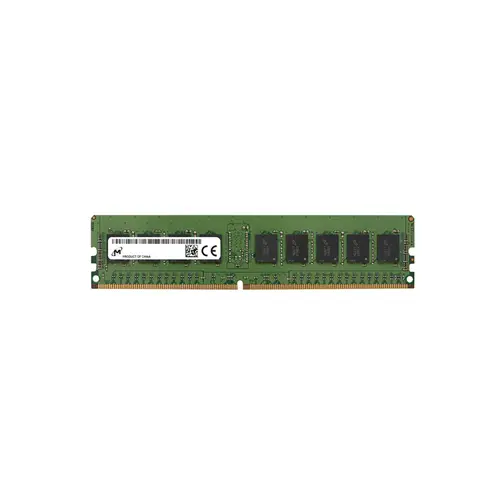
The Micron MTA18ASF1G72PZ-2G1A2IK is an 8GB DDR4 RDIMM built for server infrastructure, where reliability and consistent performance define mission-critical operations. Its four core characteristics directly address the realities of data center workloads. First, Error Correcting Code (ECC) actively detects and corrects single-bit memory errors, eliminating silent data corruption that could cascade through financial ledgers or in-memory databases and produce costly miscalculations. Second, the registered signal type buffers command and address lines, preserving signal integrity when all channels are heavily populated—essential for virtualization clusters running dozens of virtual machines that require large, stable memory footprints per node. Third, the 1.2V low-voltage DDR4 design reduces power consumption and thermal load in densely packed racks, extending the thermal headroom for CPUs and lowering operating expenditure. Finally, the single-rank x4 architecture delivers consistent bandwidth and efficient command scheduling, which directly benefits memory-analytics platforms like Redis or SAP HANA by sustaining high throughput under parallel access patterns. Together, these attributes ensure that the memory subsystem never becomes the weak link in your virtualized infrastructure or real-time database tier, providing the trust your data demands and the stability your operations require.
Server Memory Identified: The specifications (ECC, Registered, RDIMM, 288-pin) confirm this is a DDR4-2133 server-grade module. Capacity planning must leverage Registered DIMMs for stability at scale, populating channels symmetrically to maximize bandwidth and interleaving.
General Virtualization
Deploy at least one 8GB RDIMM per memory channel to enable full interleaving, providing consistent performance for moderate virtual machine density. For a typical dual-socket server with 8 channels per CPU, populate a minimum of 8 identical modules (64GB total) to avoid NUMA imbalances. Scale by adding identical 8GB sticks in matched sets, ensuring even distribution across both processors.
In-Memory Database
Minimize latency by populating all channels with single-rank x4 RDIMMs as specified; one module per channel delivers optimal electrical loading and clock cycle efficiency. For larger datasets, use two modules per channel (2DPC) but be aware of the speed drop to 1866MT/s—test if higher capacity with slightly reduced frequency outweighs raw latency. Aim for balanced capacity on each memory controller to sustain linear scale-up.
High-Performance Computing
Maximize memory bandwidth by installing exactly one single-rank RDIMM per channel across all available channels, fully utilizing the 2133MT/s speed. This configuration extracts peak performance for bandwidth-sensitive simulations. For capacity-bound HPC workflows, populate two modules per channel while accepting the lower operating speed, and ensure process pinning aligns with the NUMA topology to preserve performance.
Rigorously tested server memory, compatible with Dell PowerEdge R750, HPE ProLiant DL380 Gen10, and Lenovo ThinkSystem SR650.
Q: Can I mix this MTA18ASF1G72PZ-2G1A2IK with other memory modules of different brands or speeds?
A: We strongly advise against mixing RDIMMs of different brands, speeds, or ranks. Mixing can cause signal integrity issues, POST failures, and system instability in mission-critical server environments. Uniformity is essential for validated reliability.
Q: Is this memory compatible with my server platform, such as Intel Xeon Scalable or AMD EPYC?
A: This is a standard DDR4-2133 ECC Registered DIMM. It is compatible with most Intel Xeon E5-2600 v3/v4 and select AMD EPYC platforms using 288-pin RDIMM slots. Verify your system’s qualified vendor list (QVL) for specific 8GB RDIMM support.
Q: What is the recommended DIMM population order for optimal performance on a server board?
A: For typical dual-processor servers, populate identical RDIMMs per channel starting with the farthest slot from the CPU. Follow the motherboard manual’s memory population guide, usually matching DIMMs in balanced configurations for optimal memory interleaving and bandwidth.
Q: Does this module support overclocking or XMP profiles?
A: No, this is an industry-standard ECC RDIMM for servers. It does not support XMP or user overclocking. It adheres strictly to JEDEC DDR4-2133 specifications to guarantee data integrity and long-term reliability in 24/7 operation environments.
Q: What warranty and typical failure rate can I expect?
A: This Micron module comes with a 1-year warranty. With integrated ECC and stringent testing, enterprise-grade RDIMMs have an annualized failure rate (AFR) typically well below 0.5% under specified operating conditions, ensuring exceptional long-term reliability.