











 Secure payments
Standard refund policy
Trade Assurance
Secure payments
Standard refund policy
Trade Assurance
| Product Type | Memory Module |
|---|---|
| Compliance Standards | RoHS |
| Memory Capacity | 8 GB |
| Memory Technology | DDR4 |
| Product Voltage | 1.2V |
| RAM Speed | 2133MHz |
| RAM Standard | DDR4-2133/PC4-17000 |
| Error Identifying | ECC |
| Signal Type | Registered |
| Column Access Strobe (CAS) | CL15 |
| Rank | Single Rank x4 |
| Quantity of Pins | 288-pin |
| RAM Genre | RDIMM |
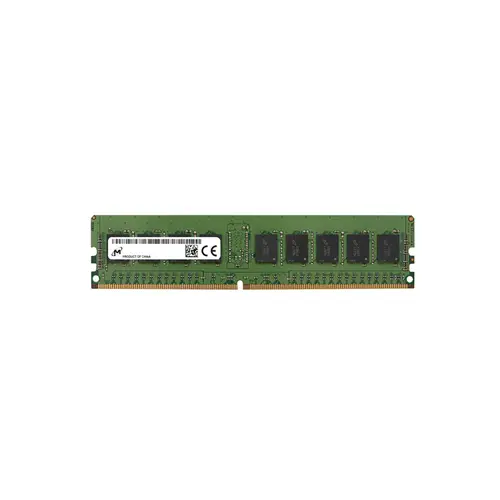
This 8 GB DDR4-2133 registered ECC module (RDIMM) is purpose‑built for server platforms handling virtualization, in‑memory databases, and other mission‑critical workloads where data integrity is paramount. The single‑rank x4 organization reduces electrical loading and improves thermal efficiency, while the registered command/address interface and hardware ECC correction deliver exceptional signal stability and protection against data corruption in dense memory configurations.
1. Registered DIMM architecture stabilizes command and address signaling across fully populated server banks, maximizing node uptime in dense virtualization clusters.
2. ECC protection silently corrects single-bit memory errors in real time, preserving financial transaction accuracy and long-running computational integrity.
3. An 8 GB module density fits optimally into mid-tier virtual machine hosts, balancing guest memory allocation without stranding idle capacity.
4. The 2133 MT/s speed delivers a foundational, low-latency throughput tier ideal for caching and database indexing workloads that prioritize steady-state reliability.
5. 1.2 V operation curbs per-DIMM energy draw and rack-level cooling demands, directly translating to lower power bills in hyperscale data centers.
The Micron MTA18ASF1G72PZ-2G1AV is a server-grade Registered DIMM engineered to solve the real-world reliability and scaling challenges that keep data center architects awake at night. Its ECC capability actively corrects single-bit memory errors before they silently corrupt data, a non-negotiable safeguard in virtualization clusters where a single flipped bit can cascade across dozens of guest systems or poison a transactional database record. The registered buffer, meanwhile, re-drives address and command signals so you can populate all available channels with high-density modules without signal degradation—critical when running large in-memory databases like SAP HANA or Redis, where every module must remain rock-solid under sustained, heavy query loads. The 1.2V DDR4 design may look like a simple number, but across a fleet of hundreds of nodes it directly lowers power draw and cooling expense, translating energy efficiency into operational cost savings. Moreover, the single-rank x4 organization strikes an ideal balance between bank-level parallelism and latency, boosting bandwidth efficiency for mixed enterprise workloads. This isn’t just a memory stick; it’s how you keep virtualized environments stable, accelerate real-time analytics, and protect data integrity around the clock.
This 8GB DDR4-2133 ECC Registered RDIMM is designed for server environments. Below are capacity planning guidelines for key workloads.
General Virtualization
Populate all memory channels symmetrically with one 8GB RDIMM per channel to ensure balanced performance and ECC protection. A dual-socket server with eight memory channels can support 20–30 light VMs using 64GB (8 DIMMs). Scale horizontally by adding a second identical DIMM per channel for 128GB when consolidation density increases.
In-Memory Database
Maximize capacity by populating every available DIMM slot. A typical dual-socket server with 24 slots can achieve 192GB using these 8GB RDIMMs. Ensure symmetric population across processors to maintain memory interleaving, and rely on ECC to protect in-memory data structures from corruption.
High-Performance Computing
High-bandwidth HPC workloads benefit from populating one DIMM per memory channel to avoid rank contention and latency penalties. An 8-channel node provides 64GB and uniform memory access across NUMA nodes when all channels are filled identically. This configuration maximizes memory throughput for parallel simulations and data analysis.
This RDIMM has been rigorously validated for servers including Dell PowerEdge R630, HPE ProLiant DL380 Gen9, and Lenovo x3650 M5.
Q: Can I mix this MTA18ASF1G72PZ-2G1AV with other memory modules of different brands or speeds?
A: Mixing RDIMMs is not recommended. Mismatched ranks, timings, or vendors can cause signal integrity issues and system instability. For guaranteed reliability, populate with identical Micron modules validated for your server.
Q: Is this memory compatible with my system?
A: It is compatible with servers using Intel Xeon E5-2600 v3/v4 or select AMD EPYC platforms that require 1.2 V DDR4 ECC Registered DIMMs. Always verify against your motherboard's Qualified Vendor List for confirmation.
Q: What is the recommended DIMM population order for optimal performance?
A: Populate identical DIMMs per channel, starting with the slot farthest from the CPU (typically blue slots first). Balance capacity across all memory channels to maximize bandwidth and maintain ECC protection.
Q: Does this module support overclocking or XMP profiles?
A: No. As a server-class ECC Registered DIMM, it follows JEDEC standard DDR4-2133 at CL15 for maximum stability. Overclocking and XMP are not supported, as data integrity takes priority in server environments.
Q: What warranty and typical failure rate can I expect?
A: This module includes a 1-year warranty. Enterprise-grade RDIMMs exhibit very low annualized failure rates (typically <0.2%) under specified operating conditions, ensuring excellent long-term reliability for critical workloads.