











 Secure payments
Standard refund policy
Trade Assurance
Secure payments
Standard refund policy
Trade Assurance
| Product Type | Memory Module |
|---|---|
| Memory Capacity | 8 GB |
| Memory Technology | DDR4 |
| Product Voltage | 1.2V |
| RAM Speed | 2133MHz |
| RAM Standard | DDR4-2133/PC4-17000 |
| Error Identifying | ECC |
| Signal Type | Registered |
| Column Access Strobe (CAS) | CL15 |
| Rank | Single Rank x4 |
| Quantity of Pins | 288-pin |
| RAM Genre | RDIMM |
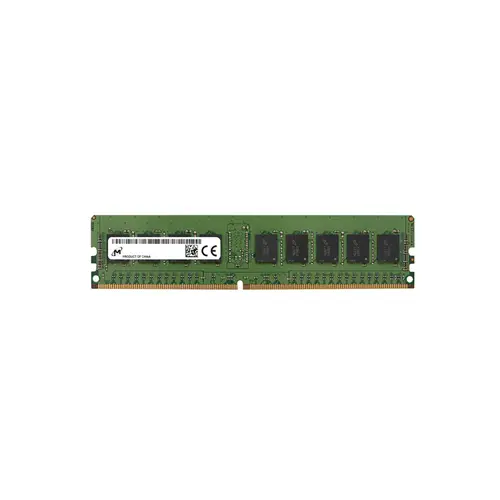
Designed for server platforms, this 8GB DDR4-2133 RDIMM with ECC and registered signal type ensures data integrity in virtualized environments and memory-intensive applications like in-memory databases. Its single-rank x4 configuration reduces electrical loading on the memory bus, enabling stable operation at CL15 latency in dense multi-DIMM server deployments.
1. ECC memory proactively detects and corrects single-bit errors, preserving the integrity of transactional databases and virtualized workloads where even silent data corruption is unacceptable.
2. Registered signal technology buffers command and address lines to stabilize signal integrity in fully loaded server platforms, enabling dependable scaling to hundreds of gigabytes per node.
3. The memory capacity strikes a purposeful balance for lightweight hypervisor deployments and edge services, supporting ample container density without wasting power or budget on overprovisioned resources.
4. Standard DDR4 speed ensures deterministic, predictable latency for in-memory caching and financial processing applications, where consistent response time matters more than peak bandwidth.
5. Single-rank organization minimizes electrical load on the memory channel, allowing servers to populate multiple DIMMs per channel while preserving thermal headroom and overall system stability.
The Micron MTA18ASF1G72PZ-2G1B is a server-class DDR4-2133 Registered DIMM, and its four core attributes directly address the reliability and performance pressures inside modern data centers. Its ECC engine proactively corrects single-bit errors caused by cosmic radiation or electrical noise, which means a virtualized cluster running dozens of VMs avoids silent data corruption that could crash critical applications or force an entire host into a failover event. The registered signal buffer stabilizes command and address lines across fully populated memory channels, so your dual-socket server can support maximum capacity without signal degradation, keeping every virtual machine responsive during peak consolidation hours. With a 2133MT/s transfer rate and CL15 latency, operations in an in-memory database like Redis or SAP HANA execute with near-immediate index lookups, reducing transaction lag when millions of queries hit the dataset simultaneously. Finally, the single-rank x4 organization harnesses internal bank parallelism to deliver consistent, predictable bandwidth; combined with a low 1.2V operating voltage, it trims power consumption across a hyperscale farm while sustaining the steady throughput that memory analytics and real-time OLTP workloads demand. This RDIMM transforms raw specifications into uptime assurance and tangible operational efficiency.
General Virtualization
For a typical hypervisor hosting multiple light to moderate VMs, an 8 GB RDIMM is a baseline module. Deploy these in balanced channel configurations—begin with four identical modules for quad-channel operation to maximize memory bandwidth, providing 32 GB total for a small-scale host. Scale by populating all channels symmetrically to avoid performance penalties.
In-Memory Database
In-memory databases demand low latency and high availability; ECC Registered DIMMs are non-negotiable. An 8 GB single-rank module can serve as a building block for larger capacity sets, but capacity limits per server will push you toward higher-density modules. Where ultra-low latency is prioritized over raw capacity, populate all memory channels with multiple 8 GB RDIMMs to keep rank count manageable while leveraging chip-kill and advanced ECC features.
High-Performance Computing (HPC)
HPC workloads thrive on both bandwidth and error resilience. Install 8 GB RDIMMs in fully balanced, populated-channel configurations—typically six or eight identical DIMMs per socket—to sustain peak memory bandwidth during parallel computations. Single-rank x4 modules help maintain optimal signal integrity at the rated 2133 MT/s, and Registered ECC ensures results remain uncorrupted across long-running simulation jobs.
Rigorously tested server memory. Compatible with Dell PowerEdge R630, HP ProLiant DL380 Gen9, Lenovo ThinkSystem SR550.
Q: Can I mix this MTA18ASF1G72PZ-2G1B with other memory modules of different brands or speeds?
A: Mixing is not recommended for Registered DIMMs. Different brands, speeds, or ranks may cause signal integrity issues and system instability. For reliable server operation, always populate with identical Micron part numbers.
Q: Is this memory compatible with my Intel Xeon E5-2600 v4 server platform?
A: Yes. This DDR4-2133 ECC Registered DIMM is designed for dual-socket Intel Xeon E5-2600 v3/v4 and similar platforms using C610 series chipsets. Always verify your server board's qualified vendor list for confirmation.
Q: What is the recommended DIMM population order for optimal performance?
A: Populate identical DIMMs per channel, filling the farthest slot from the CPU first (slot 1). Balance capacity across all memory channels and follow the manufacturer's population guidelines in the system manual to ensure optimal bandwidth.
Q: Does this module support overclocking or XMP profiles?
A: No. This is an industry-standard server RDIMM adhering to JEDEC specs. It does not support XMP or overclocking. Enterprise memory prioritizes stability and data integrity over user-configurable speed profiles.
Q: What warranty and typical failure rate can I expect?
A: This Micron module includes a one-year warranty. Enterprise RDIMMs like this typically exhibit an annualized failure rate (AFR) well below 0.5% under normal operating conditions, ensuring high reliability for mission-critical workloads.