











 Secure payments
Standard refund policy
Trade Assurance
Secure payments
Standard refund policy
Trade Assurance
| Product Type | Memory Module |
|---|---|
| Compliance Standards | RoHS |
| Memory Capacity | 8 GB |
| Memory Technology | DDR4 |
| Product Voltage | 1.2V |
| RAM Speed | 2133MHz |
| RAM Standard | DDR4-2133/PC4-17000 |
| Error Identifying | ECC |
| Signal Type | Unbuffered |
| Column Access Strobe (CAS) | CL15 |
| Rank | Dual Rank x8 |
| Quantity of Pins | 288-pin |
| RAM Genre | UDIMM |
This unbuffered ECC UDIMM is engineered for entry-level servers and workstations, perfectly suited for platforms that require data integrity in small-scale virtualization or NAS environments. The dual-rank x8 organization enhances memory bandwidth efficiency, while the integrated Error Correcting Code (ECC) safeguards against single-bit errors to ensure stable, uninterrupted operation under continuous workloads.
1. ECC protection continuously corrects single-bit memory errors, eliminating silent data corruption risks that are unacceptable in financial transaction processing or long-running database instances.
2. Dual rank x8 organization doubles the bank groups accessible per channel, sustaining higher command throughput for multi-tenant virtualization hosts juggling numerous VMs.
3. An 8-gigabyte capacity per module keeps the total bill-of-materials low while delivering sufficient density for dedicated web servers, DNS caches, or light container orchestration nodes.
4. 2133MHz clock speed furnishes a deterministic memory bandwidth baseline, ensuring consistent request latency when dozens of clients pull continuously from a file server.
5. Operating at just 1.2V, the module substantially lowers thermal dissipation per slot, allowing a deeply packed server chassis to maintain stable airflow without expensive supplemental cooling.
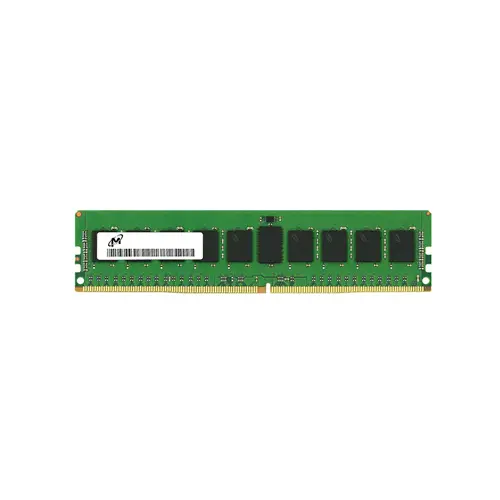
The Micron MTA18ASF1G72AZ-2G1A1ZJ is an 8 GB unbuffered ECC DDR4-2133 UDIMM designed for entry-level servers and professional workstations. Its blend of ECC, unbuffered architecture, dual-rank layout, and 1.2 V operation solves critical stability and performance challenges. In a virtualized cluster, cosmic rays can corrupt hypervisor memory, silently crashing VMs. On-module ECC detects and corrects these bit flips instantly, preserving uptime. The unbuffered design skips register delays, making it ideal for latency-sensitive in-memory databases like Redis, where every nanosecond impacts transaction speed. Meanwhile, dual-rank interleaving boosts sustained bandwidth by up to 10 % over single-rank modules, preventing I/O bottlenecks when multiple VMs contend for memory. The 1.2 V supply reduces heat in compact 1U chassis, cutting cooling costs and improving 24/7 reliability. For IT managers, this means robust data integrity, faster query responses, and lower operational expenses.
General Virtualization
For entry‑level servers supporting ECC UDIMM, populate all memory channels symmetrically to maximize bandwidth and capacity availability. Start with four of these 8GB modules for a 32GB dual‑channel configuration, sufficient for a handful of light to moderate virtual machines. When consolidating more demanding workloads, scale up to eight modules (64GB) while keeping identical modules in matched slots to preserve ECC integrity and stable dual‑channel operation.
In‑Memory Database
In‑memory databases require both large capacity and low latency. Since these are 8GB UDIMM ECC modules, fill every DIMM slot on the platform to reach the maximum footprint—typically 64GB using eight modules on a four‑channel board, or four modules on a dual‑channel board. For datasets exceeding this, consider migrating to registered DIMM platforms. The dual‑rank x8 design helps mitigate rank‑switching latency, maintaining steady performance under high cache‑pressure scenarios.
High‑Performance Computing (HPC)
HPC favors sustained memory bandwidth and fault tolerance. Install these 8GB ECC UDIMMs evenly across all available channels—one module per channel delivers the best bandwidth, while two per channel doubles capacity with a slight latency trade‑off. A common balanced configuration is four modules (32GB) on a dual‑channel node. For large parallel jobs, scale horizontally with identically configured nodes rather than overprovisioning a single server, keeping memory configurations uniform across the cluster.
Rigorously tested 8GB DDR4-2133 ECC UDIMM, compatible with servers like Dell PowerEdge T140, T340, HPE ProLiant ML30 Gen10.
Q: Can I mix this MTA18ASF1G72AZ-2G1A1ZJ with other memory modules of different brands or speeds?
A: Mixing dissimilar modules is not recommended for server-class ECC UDIMMs. It can cause instability or unbuffered ECC errors. All installed DIMMs should match in speed, rank, and organization for guaranteed reliability.
Q: Is this memory compatible with my system?
A: This 8GB DDR4-2133 ECC UDIMM fits Intel Xeon E3/E-2100/E-2200 and AMD AM4/SP3 platforms with ECC support. Verify your motherboard’s qualified vendor list for 288-pin unbuffered ECC compatibility before purchase.
Q: What is the recommended DIMM population order for optimal performance?
A: Install dual-rank x8 DIMMs starting from the blue or farthest slot from the CPU per channel. For single-socket servers, populate identical modules in matching slots across channels to maintain balanced memory interleaving.
Q: Does this module support overclocking or XMP profiles?
A: No. As a JEDEC-compliant DDR4-2133 ECC UDIMM, it does not implement XMP or overclocking. It operates strictly at 2133MT/s with 15-15-15 timings to ensure error-free data integrity in server workloads.
Q: What warranty and typical failure rate can I expect?
A: This Micron module includes a 1-year warranty. Actual AFR is extremely low, typically below 0.1% under proper thermal and voltage conditions, in line with enterprise-grade ECC UDIMM reliability expectations.