











 Secure payments
Standard refund policy
Trade Assurance
Secure payments
Standard refund policy
Trade Assurance
| Product Type | Memory Module |
|---|---|
| Memory Capacity | 8 GB |
| Memory Technology | DDR4 |
| Product Voltage | 1.2V |
| RAM Speed | 2133MHz |
| RAM Standard | DDR4-2133/PC4-17000 |
| Error Identifying | ECC |
| Signal Type | Registered |
| Column Access Strobe (CAS) | CL15 |
| Rank | Dual Rank x8 |
| Quantity of Pins | 288-pin |
| RAM Genre | RDIMM |
Designed as a server-class RDIMM, this 8GB DDR4-2133 module with ECC and a registered signal type ensures data integrity and signal stability for mission-critical workloads such as virtualization and in-memory databases. Its dual-rank x8 configuration and tight CL15 latency balance capacity access with low response times, optimizing memory bandwidth in multi-DIMM server deployments.
1. Registered signal type stabilizes signal integrity across fully populated memory channels, essential for maintaining uptime in dense server deployments that cannot tolerate downtime.
2. ECC error correction silently detects and repairs single-bit memory faults, preserving transactional data integrity for financial processing and database operations.
3. Dual Rank x8 organization increases memory-level parallelism, keeping server memory channels fully saturated and delivering consistent VM responsiveness under heavy consolidation.
4. DDR4-2133 speed provides balanced bandwidth per channel, efficiently handling concurrent requests in content delivery platforms and entry-level private cloud nodes.
5. 1.2V low voltage shrinks the datacenter power envelope and cuts thermal buildup, directly lowering total cost of ownership in hyperscale and rack-dense environments.
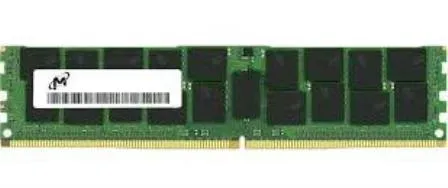
When you are running a virtualized cluster hosting dozens of mission-critical VMs on a single server, silent data corruption is your worst enemy. The Micron MTA18ASF1G72PDZ-2G1A2, an 8GB DDR4-2133 Registered DIMM, turns that anxiety into assurance. Its ECC engine continuously detects and corrects single-bit errors—flips caused by background radiation or electrical noise—so a transient fault never cascades into a crashed hypervisor or a corrupted customer database. That integrity is essential for in-memory databases like Redis or SAP HANA, where even one mangled value can derail real-time analytics or financial transactions.
The module’s Registered signal buffering is what makes dense, large-scale configurations possible. By re-driving address and command signals through an on-board register, it stabilizes communication between the processor and a full bank of DIMMs, eliminating the electrical loading issues that plague unbuffered memory. In a virtualization host stuffed with memory channels, this means you can populate all slots confidently and deliver the massive capacity that containerized workloads and live migrations demand. Complementing this, the dual-rank x8 architecture boosts throughput by enabling rank interleaving: while one rank completes a refresh or precharge, the other is ready for access, which cuts latency in database lookups and keeps transactional engines fed with data. All of this operates at a frugal 1.2V, lowering power draw per DIMM and cumulative thermal output in blade servers, which directly reduces your cooling overhead and lets you sustain performance under heavy, sustained load without throttling.
Capacity Planning Guide for Server DDR4 ECC Registered RDIMM (8GB, 2133 MHz, Dual Rank x8)
This memory is a server‑class module, identified by ECC, registered (RDIMM), and 288‑pin form factor. It suits typical rack and tower servers where reliability and moderate capacity are required. Plan around the 8 GB density across three common workloads.
General Virtualization
Populate all memory channels symmetrically with at least one 8 GB RDIMM per channel to enable balanced access. To improve throughput via dual‑rank interleaving, step up to two identical modules per channel, delivering 16 GB per channel while maintaining the rated 2133 MT/s speed. For a dual‑socket server with eight channels per CPU, a 16‑module configuration yields 128 GB total – a cost‑effective starting point for dozens of light to medium VMs.
In‑Memory Database
Maximize capacity by installing two 8 GB RDIMMs per channel across all populated channels, keeping 2 DPC to avoid speed down‑clocking. This dual‑rank arrangement enhances bank‑level parallelism and reduces latency under heavy read‑modify‑write loads. For larger datasets, fill every available DIMM slot while accepting a slight frequency drop; a typical 24‑slot dual‑processor server can reach 192–384 GB using 8 GB modules, though high‑capacity 32 GB+ DIMMs are preferred for production.
High Performance Computing
Bandwidth‑sensitive simulations benefit from populating one 8 GB RDIMM per channel, guaranteeing the full 2133 MT/s data rate with no rank‑induced speed limits. While per‑node capacity is modest (e.g., 64 GB with 8 channels), this configuration maximizes aggregate memory bandwidth per socket. Scale‑out clusters using many such nodes provide both high throughput and sufficient memory per core for message‑passing workloads.
Rigorously tested server memory. Compatible with Dell PowerEdge R740, HPE ProLiant DL380 Gen10, Lenovo ThinkSystem SR650, and more.
Q: Can I mix this MTA18ASF1G72PDZ-2G1A2 with other memory modules of different brands or speeds?
A: Mixing Registered ECC modules of different brands or speeds is not recommended. It may cause system instability or fail to POST. For reliable operation, always use identical part numbers and ranks across all channels.
Q: Is this memory compatible with my system?
A: This DDR4-2133 Registered ECC RDIMM is compatible with server platforms supporting the standard, such as Intel Xeon E5 v3/v4 or certain AMD EPYC configurations. Please verify your motherboard's Qualified Vendor List (QVL) before purchase.
Q: What is the recommended DIMM population order for optimal performance?
A: Follow your server motherboard’s population guide. Typically, you should populate identical DIMMs in the first slot of each memory channel to balance the load and achieve maximum memory bandwidth.
Q: Does this module support overclocking or XMP profiles?
A: No, this ECC Registered DIMM adheres strictly to JEDEC standard profiles for enterprise reliability. It does not support overclocking or Intel XMP, as data integrity and stability are prioritized.
Q: What warranty and typical failure rate can I expect?
A: This module includes a 1-year warranty. Enterprise-class ECC RDIMMs are manufactured to stringent standards, exhibiting a very low annualized failure rate due to built-in error correction and thorough factory testing.