











 Secure payments
Standard refund policy
Trade Assurance
Secure payments
Standard refund policy
Trade Assurance
| Product Type | Memory Module |
|---|---|
| Compliance Standards | RoHS |
| Memory Capacity | 8 GB |
| Memory Technology | DDR4 |
| Product Voltage | 1.2V |
| RAM Speed | 2133MHz |
| RAM Standard | DDR4-2133/PC4-17000 |
| Error Identifying | ECC |
| Signal Type | Registered |
| Column Access Strobe (CAS) | CL15 |
| Rank | Single Rank x4 |
| Quantity of Pins | 288-pin |
| RAM Genre | RDIMM |
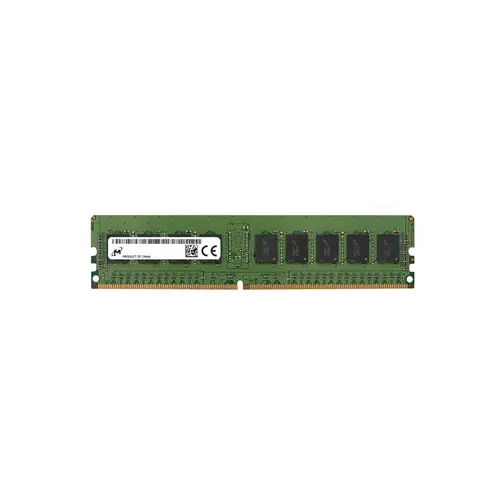
Designed for server-class platforms, this 8GB DDR4-2133 RDIMM with ECC ensures data integrity and system stability in mission-critical workloads such as virtualization and in-memory databases. Its single-rank x4 configuration with registered signal type reduces electrical loading on the memory bus, enabling higher capacity scaling while the CL15 latency delivers reliable, low-latency access for dense computing environments.
1. Registered signal type offloads command and address signaling from the memory controller, ensuring stable operation even with fully populated DIMM slots in high-density rack servers.
2. ECC error correction actively detects and repairs single-bit data errors, preserving transactional integrity in databases and financial computing environments.
3. Single Rank x4 configuration reduces electrical loading on the memory channel, maintaining clean signal integrity when scaling capacity across multiple modules.
4. The 8 GB capacity strikes a balance for lightweight hypervisor deployments and containerized microservices at the edge.
5. DDR4-2133 base frequency provides consistent, thermally efficient bandwidth for latency-sensitive enterprise workloads that prioritize uptime over raw clock speed.
The Micron MTA18ASF1G72PZ-2G1A2KJ is a server DDR4 RDIMM whose four core attributes are engineered specifically to address the relentless demands of virtualized data centers and memory-intensive workloads. First, error correction continuously detects and fixes single-bit upsets, eliminating silent data corruption that can crash hypervisor-managed VMs or poison an in-memory database like Redis. Second, the registered architecture buffers command and address lines, allowing you to populate high-density memory configurations without signal degradation—this is vital when consolidating dozens of virtual machines per host. Third, its 2133 MT/s speed with PC4-17000 bandwidth delivers a consistent 17 GB/s per channel, ensuring that real-time analytics engines or large caching tiers never stall under peak concurrent queries. Finally, the single-rank x4 organization with CL15 latency minimizes row conflicts and access delays when multiple VMs hammer the memory simultaneously. For you, this means lower operational risk, predictable performance under heavy consolidation ratios, and infrastructure that scales reliably without memory-induced failures.
General Virtualization
For a general virtualization host, populate memory channels evenly to maximize bandwidth. Start with a minimum of four identical 8 GB RDIMMs per CPU socket (32 GB total) to comfortably run 8–10 light VMs, and scale to eight modules (64 GB) for moderate consolidation. Always use balanced configurations—one DIMM per channel—to avoid performance penalties on registered DDR4-2133 platforms.
In-Memory Database
In-memory databases such as Redis or SAP HANA demand both capacity and reliability, making ECC registered memory critical. Deploy a fully populated set of 8 GB RDIMMs across all channels to reach 128 GB or more per node, ensuring the working dataset resides entirely in DRAM. Pair this with memory mirroring or sparing if uptime is paramount, as bit errors without ECC correction can corrupt live data.
High Performance Computing
HPC workloads benefit from maximum per-channel bandwidth rather than sheer volume in most cases. Fill every channel with one 8 GB RDIMM to keep the memory interface at peak throughput (e.g., eight modules per dual-socket server for a 64 GB balanced configuration). Avoid mixing single-rank and dual-rank DIMMs in the same channel, and validate that your 2133 MT/s speed aligns with the processor’s memory fabric to prevent clock-downs under full load.
Rigorously tested server memory, compatible with Dell PowerEdge R760, HPE ProLiant DL380 Gen10, Lenovo ThinkSystem SR650, and more.
Q: Can I mix this MTA18ASF1G72PZ-2G1A2KJ with other memory modules of different brands or speeds?
A: Mixing brands or speeds is strongly discouraged for registered ECC memory. Mismatched modules may cause boot failures or data integrity issues. Use identical part numbers for guaranteed compatibility.
Q: Is this memory compatible with my system?
A: This 8GB DDR4-2133 RDIMM supports Intel Xeon E5-2600 v3/v4 and AMD EPYC 7001 platforms requiring registered ECC memory. Confirm your server board's qualified vendor list before purchase.
Q: What is the recommended DIMM population order for optimal performance?
A: Populate memory starting with the slot farthest from the CPU per channel, balancing identical DIMMs across all memory channels. Consult your server's service manual for exact slot numbering.
Q: Does this module support overclocking or XMP profiles?
A: No. As a server-grade registered ECC DIMM, it operates strictly at JEDEC-standard DDR4-2133 with CL15 timings. Overclocking and XMP are not supported; reliability is prioritized.
Q: What warranty and typical failure rate can I expect?
A: This module includes a 1-year warranty. Enterprise RDIMMs like this typically exhibit an annualized failure rate below 0.2% under specified environmental conditions, ensuring mission-critical uptime.