











 Secure payments
Standard refund policy
Trade Assurance
Secure payments
Standard refund policy
Trade Assurance
| Product Type | Memory Module |
|---|---|
| Memory Capacity | 8 GB |
| Memory Technology | DDR4 |
| Product Voltage | 1.2V |
| RAM Speed | 2133MHz |
| RAM Standard | DDR4-2133/PC4-17000 |
| Error Identifying | ECC |
| Signal Type | Registered |
| Column Access Strobe (CAS) | CL15 |
| Rank | Single Rank x4 |
| Quantity of Pins | 288-pin |
| RAM Genre | RDIMM |
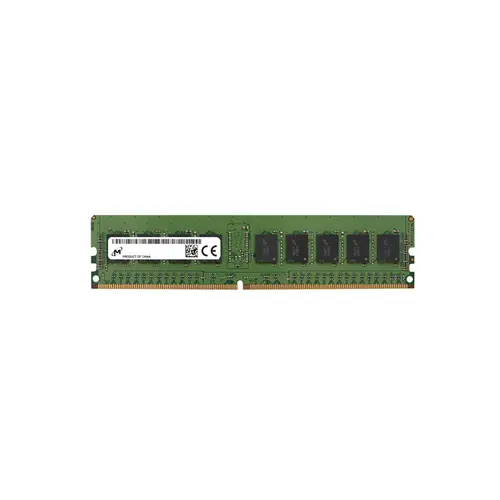
This Registered ECC DDR4-2133 module, organized as a single-rank x4 RDIMM, is purpose-built for server platforms requiring high data integrity in virtualized environments and memory-intensive enterprise applications. Its 1.2V operating voltage and registered signal architecture ensure stable, efficient operation across populated channels, while the single-rank design reduces electrical loading and improves command rate performance in dense memory configurations.
1. Registered buffering isolates electrical loading from the memory controller, allowing fully populated server nodes to maintain rock‑solid stability under 24/7 operation.
2. ECC in‑situ error correction eliminates silent data corruption, giving virtualized workloads and transactional databases the absolute integrity they demand.
3. 2133 MT/s per‑channel throughput supplies ample sustained bandwidth for multi‑tenant private cloud environments where consistent, jitter‑free performance is non‑negotiable.
4. Single Rank x4 organization reduces bus loading while enabling advanced symbol‑based correction schemes, raising fault resilience without sacrificing access speed.
5. 1.2V operation drives down rack‑level power consumption and cooling requirements, directly shrinking OpEx in dense hyperscale deployments.
This Micron RDIMM (MTA18ASF1G72PZ-2G1B1QG) is purpose-built for enterprise servers, and its four key characteristics solve real-world data center challenges. The ECC technology is your frontline defense against silent data corruption. In a virtualization cluster managing dozens of VMs, a cosmic-ray-induced bit flip can silently cascade into corrupted databases or node crashes; on-the-fly error correction repairs single-bit errors instantly, safeguarding transactional integrity and uptime. The Registered signal buffer directly addresses scalability. When you fully populate memory channels to run massive in-memory databases like Redis or SAP HANA, the register re-drives command and address signals, eliminating instability that would plague unbuffered modules and letting you scale capacity without compromising reliability. Its Single Rank x4 organization further optimizes that environment. Compared to dual-rank alternatives, it exerts lower electrical loading on the bus, delivering consistently higher sustained bandwidth and reduced access latency for database query storms. Finally, the 1.2V DDR4-2133 operation with CAS 15 strikes a deliberate balance: it provides the predictable, energy-efficient throughput essential for dense rack deployments while keeping thermals under control during sustained analytics workloads. This means fewer mysterious node failures, predictable VM performance, and a memory foundation you can trust under pressure.
General Virtualization
To host numerous VMs, balance capacity and memory bandwidth. On a dual-socket server with four memory channels per CPU, populate two of these 8GB RDIMMs per channel (2DPC) to achieve a balanced 128 GB configuration using 16 identical modules. This provides ample headroom for VM density while maintaining ECC reliability.
In-Memory Database
In-memory databases demand maximum capacity and uniform low latency. Fill all available DIMM slots with the 8GB single-rank RDIMM—up to 24 identical modules for 192 GB on a high-density, multi-socket platform. Uniform modules prevent timing inconsistencies, as sheer capacity outweighs minor speed differences.
High-Performance Computing
HPC workloads require peak memory bandwidth. Install one DIMM per channel (1DPC) to maintain the full 2133 MT/s without clock throttling. An eight-channel platform equipped with eight of these 8GB modules delivers 64 GB of balanced, high-throughput memory. Only move to two DIMMs per channel if the workload demands more capacity than bandwidth.
Rigorously tested server memory, compatible with Dell PowerEdge R630/R730, HPE ProLiant DL380 Gen9, Lenovo ThinkSystem SR650.
Q: Can I mix this MTA18ASF1G72PZ-2G1B1QG with other memory modules of different brands or speeds?
A: Mixing RDIMMs with different brands, speeds, or ranks is strongly discouraged. It can lead to system instability or boot failures. Always use identical Micron modules in server deployments for guaranteed compatibility and reliability.
Q: Is this memory compatible with my system?
A: This 8GB DDR4-2133 Registered ECC DIMM targets server platforms. Confirm your motherboard supports 288-pin RDIMMs and check the Intel Xeon or AMD EPYC memory QVL list to ensure proper compatibility.
Q: What is the recommended DIMM population order for optimal performance?
A: Follow your server board’s manual. Typically, populate the farthest slot from the CPU per channel first, then balance identical DIMMs across all memory channels to achieve optimal throughput and interleaving.
Q: Does this module support overclocking or XMP profiles?
A: No. This is a JEDEC-compliant server RDIMM running at DDR4-2133 CL15. Overclocking and XMP are not supported, as enterprise memory prioritizes data integrity and long-term stability over peak frequencies.
Q: What warranty and typical failure rate can I expect?
A: It carries a 1-year warranty. As an enterprise-grade Micron Registered DIMM, the expected annualized failure rate (AFR) is well under 0.5% under normal server operating conditions, ensuring high reliability.