











 Secure payments
Standard refund policy
Trade Assurance
Secure payments
Standard refund policy
Trade Assurance
| Product Type | Memory Module |
|---|---|
| Compliance Standards | RoHS |
| Memory Capacity | 8 GB |
| Memory Technology | DDR4 |
| Product Voltage | 1.2V |
| RAM Speed | 2400MHz |
| RAM Standard | DDR4-2400/PC4-19200 |
| Error Identifying | ECC |
| Signal Type | Registered |
| Column Access Strobe (CAS) | CL17 |
| Rank | Dual Rank x8 |
| Quantity of Pins | 288-pin |
| RAM Genre | RDIMM |
This RDIMM is purpose-built for server platforms and excels in virtualized environments and in-memory databases where data integrity is non-negotiable. Its registered signal architecture stabilizes multi-rank configurations, while the ECC and dual-rank x8 organization boost fault tolerance and memory interleaving for consistent performance under heavy enterprise workloads.
1. An 8 GB capacity per module strikes an optimal density for virtualized infrastructure, allowing IT architects to pack more productive virtual machines onto a single host without immediate investment in higher-cost DIMMs.
2. ECC error correction actively detects and repairs single-bit memory faults, upholding data integrity for financial ledgers and life-safety services that cannot tolerate silent corruption.
3. Registered signal buffering decouples the memory controller from direct chip loading, so fully populated 24-slot servers maintain rock‑steady signal quality during sustained 24/7 operation.
4. Dual‑rank x8 organization leverages rank interleaving to keep the memory pipeline saturated, maximizing available bandwidth for large in‑memory databases under concurrent query loads.
5. 2400 MHz DDR4 speed provides ample per‑channel throughput for multi‑core Xeon processors, efficiently handling mixed enterprise workloads without becoming the performance bottleneck.
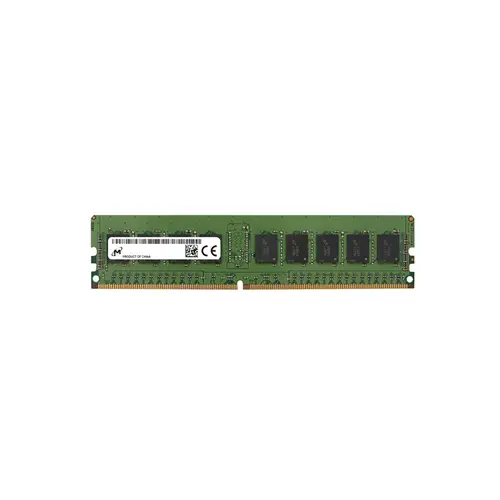
The MTA18ASF1G72PDZ-2G3A2 is an 8GB DDR4‑2400 Registered DIMM purpose‑built for server environments where relentless uptime and data accuracy are not optional. Its four core attributes—ECC error correction, registered buffering, dual‑rank x8 architecture, and 1.2V efficiency—directly solve the critical pain points of modern data centers. In dense virtualization clusters running dozens of VMs on a single node, a cosmic ray or electrical noise can silently flip a memory bit. Without ECC, that instantaneous corruption could cascade into crashed guest operating systems and violated SLAs; with it, every single‑bit error is detected and corrected on the fly, preserving workload integrity. The registered feature amplifies stability when you populate all memory channels to support massive terabyte‑scale configurations, eliminating the signal degradation that plagues unbuffered modules and letting you scale confidently. Then consider an in‑memory analytics database like SAP HANA or a high‑throughput Redis cache. The dual‑rank layout uses rank interleaving to overlap row activation commands, effectively cutting latency and raising throughput so real‑time dashboards and financial transactions complete faster. Finally, the low 1.2V supply voltage shaves power consumption across entire server racks, which translates to fewer hot spots, lower cooling overhead, and a measurably better total cost of ownership. For IT architects, this module converts raw reliability metrics into true business continuity.
General Virtualization
For virtualization hosts, always install identical 8GB RDIMMs in symmetric populations across all memory channels to avoid performance penalties. A minimal balanced config uses eight modules (64GB) on a dual‑socket server with four channels per CPU, comfortably running dozens of VMs. For higher consolidation ratios, scale to sixteen modules (128GB) while maintaining the same channel distribution.
In-Memory Database
In-memory databases require large, fault‑tolerant memory pools. Fully populate every DIMM slot with these 8GB ECC Registered DIMMs—for example, sixteen modules provide 128GB of protected capacity. The CL17 latency and 2400MT/s speed are adequate for real‑time analytics, and registered signaling guarantees stable operation with all slots occupied.
High-Performance Computing
Memory bandwidth is critical for HPC. Populate one 8GB RDIMM per channel (e.g., eight modules for 64GB on an eight‑channel platform) to utilize the full memory bus width. The dual‑rank x8 configuration enhances bandwidth through interleaving. For capacity‑heavy simulations, move to two DIMMs per channel (128GB), taking care to balance ranks for optimal throughput.
Rigorously tested, this RDIMM is compatible with Dell PowerEdge R740/R640, HPE ProLiant DL380 Gen10, Lenovo ThinkSystem SR650, and more.
Q: Can I mix this MTA18ASF1G72PDZ-2G3A2 with other memory modules of different brands or speeds?
A: Mixing RDIMMs of different brands or speeds is not recommended. This can cause POST failures or instability. For reliable server operation, always use identical Micron-certified modules with the same part number.
Q: Is this memory compatible with my system?
A: This DDR4-2400 Registered ECC DIMM is designed for Intel Xeon Scalable and AMD EPYC platforms. It requires a server motherboard with 288-pin RDIMM slots. Verify your system supports registered memory and the correct rank configuration.
Q: What is the recommended DIMM population order for optimal performance?
A: Populate identical DIMMs per channel, starting with the slot furthest from the CPU. Follow your server vendor’s guide strictly. For this dual-rank module, balanced channel loading maximizes memory bandwidth and interleaving.
Q: Does this module support overclocking or XMP profiles?
A: No. As an enterprise-class Registered ECC module, it strictly adheres to JEDEC DDR4-2400 standards. Overclocking and XMP are not supported and would compromise signal integrity and data reliability.
Q: What warranty and typical failure rate can I expect?
A: This Micron module includes a 1-year warranty. RDIMMs built for 24/7 operation exhibit very low annualized failure rates, typically under 0.5%, ensuring robust long-term reliability in demanding server environments.