











 Secure payments
Standard refund policy
Trade Assurance
Secure payments
Standard refund policy
Trade Assurance
| Product Type | Memory Module |
|---|---|
| Memory Capacity | 8 GB |
| Memory Technology | DDR4 |
| Product Voltage | 1.2V |
| RAM Speed | 2400MHz |
| RAM Standard | DDR4-2400/PC4-19200 |
| Error Identifying | ECC |
| Signal Type | Registered |
| Column Access Strobe (CAS) | CL17 |
| Rank | Single Rank x4 |
| Quantity of Pins | 288-pin |
| RAM Genre | RDIMM |
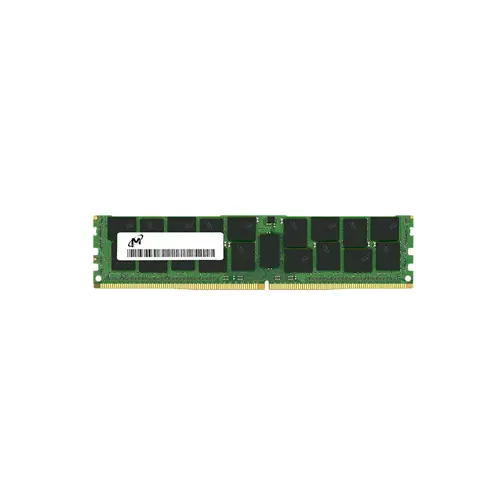
This Micron 8GB DDR4-2400 RDIMM features ECC and registered signal technology, ensuring robust data integrity and signal stability for mission-critical server workloads such as virtualization and in-memory databases. Its single-rank x4 organization reduces electrical loading on the memory bus, enabling higher density configurations while maintaining reliable 1.2V operation and CL17 latency.
1. Registered clock and command signals stabilize multi-DIMM configurations, essential for maintaining uptime in memory-intensive 24/7 server operations.
2. End-to-end error correction prevents single-bit data corruption, delivering the data integrity mandated by financial and database applications.
3. Fourth-generation DDR technology delivers higher efficiency and lower power draw than its predecessor, reducing data center cooling overhead.
4. Per-module capacity strikes a balance between density and cost, enabling granular memory scaling in entry-level server deployments.
5. Single-rank x4 architecture reduces electrical loading on the memory channel, sustaining high signal quality across all slots in a fully populated server.
The Micron MTA18ASF1G72PZ-2G3A3IK is an 8GB DDR4-2400 Registered DIMM, purpose-built for server environments where data integrity and continuous uptime are non-negotiable. Its four defining characteristics directly address the critical pain points of IT infrastructure managers. First, ECC (Error Correcting Code) technology proactively detects and corrects single-bit memory errors caused by background radiation or electrical noise, which can silently corrupt transactions in a financial database or cause a virtual machine to crash. Second, the Registered (buffered) signal architecture stabilizes electrical loads on the memory bus, allowing you to populate all channels with multiple DIMMs without sacrificing signal integrity—essential when scaling a virtualization cluster running dozens of VMs under VMware ESXi. Third, the single-rank x4 organization delivers a balanced combination of bandwidth and latency, optimizing throughput for in-memory databases like Redis or SAP HANA, where microseconds matter during peak query loads. Finally, the 1.2V operating voltage reduces thermal stress inside dense 1U rack servers, lowering energy costs and improving long-term reliability. These features collectively mean fewer application errors, seamless scalability, and a lower total cost of ownership for your data center.
General Virtualization
For modest-density virtualization hosts, install six to eight of these 8 GB RDIMMs in a dual-socket server to achieve 48–64 GB total capacity. Populate one DIMM per channel to balance memory bandwidth and leave room for future expansion. This configuration comfortably supports 20–30 lightweight VMs while keeping 1.2 V power and cooling within typical datacenter limits.
In-Memory Database
To maximize capacity and maintain data integrity for in-memory workloads like Redis or SAP HANA, fully populate all memory channels with these ECC Registered DIMMs. A dual-socket system with 16 modules yields 128 GB, suitable for moderate in-memory datasets. The single-rank x4 design helps reduce electrical loading, enabling stable operation at the rated 2400 MT/s under sustained, latency-sensitive transactional loads.
High-Performance Computing
For HPC clusters, deploy these modules in a symmetric 8-DIMM per node configuration (64 GB total) to saturate all memory channels. The registered ECC technology ensures silent data corruption is caught during large-scale parallel simulations. Prioritize matching identical part numbers across nodes to guarantee uniform CL17 timing and 1.2 V operation, simplifying cluster-wide performance tuning and job scheduling predictability.
Rigorously tested server memory. Compatible systems: Dell PowerEdge R740, HPE DL380 Gen10, Lenovo SR650, Cisco UCS C240 M5.
Q: Can I mix this MTA18ASF1G72PZ-2G3A3IK with other memory modules of different brands or speeds?
A: Mixing different brands or speeds with this RDIMM is not recommended. It may cause signal instability and system errors. For guaranteed reliability, only combine identical Micron-certified modules with the same part number.
Q: Is this memory compatible with my system?
A: This DDR4-2400 ECC Registered DIMM is designed for servers with Intel Xeon E5-2600 v3/v4 or select AMD EPYC platforms. Please verify that your motherboard supports 288-pin RDIMMs and check the vendor's Qualified Vendor List (QVL).
Q: What is the recommended DIMM population order for optimal performance?
A: For optimal performance, populate identical RDIMMs in balanced configurations across all memory channels, typically starting with the first slot of each channel. Always follow the population rules in your server motherboard's manual to preserve multi-channel interleaving.
Q: Does this module support overclocking or XMP profiles?
A: No. Registered server memory operates strictly at JEDEC-standard DDR4-2400 CL17 timings and does not support overclocking or XMP profiles. It is engineered for compliance and stability in enterprise environments, not for performance tuning.
Q: What warranty and typical failure rate can I expect?
A: This module carries a 1-year warranty. Its typical Annualized Failure Rate (AFR) is well below 0.5%, reflecting the high reliability of Micron's server-grade RDIMMs under normal operating conditions.