











 Secure payments
Standard refund policy
Trade Assurance
Secure payments
Standard refund policy
Trade Assurance
| Product Type | Memory Module |
|---|---|
| Memory Capacity | 8 GB |
| Memory Technology | DDR4 |
| Product Voltage | 1.2V |
| RAM Speed | 2400MHz |
| RAM Standard | DDR4-2400/PC4-19200 |
| Error Identifying | ECC |
| Signal Type | Registered |
| Column Access Strobe (CAS) | CL17 |
| Rank | Dual Rank x8 |
| Quantity of Pins | 288-pin |
| RAM Genre | RDIMM |
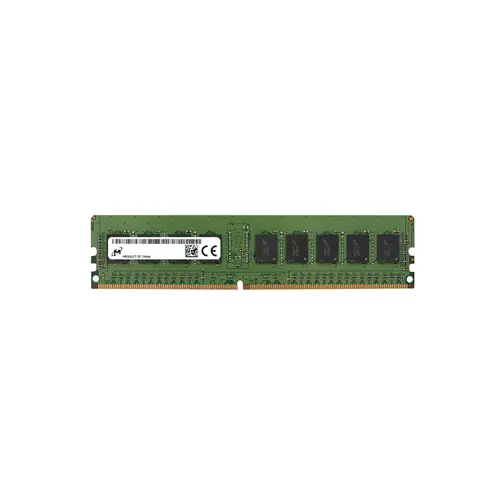
Designed for servers and workstations, this 8GB DDR4-2400 Registered ECC RDIMM delivers critical data integrity and operational stability for virtualization, in-memory databases, and enterprise workloads. Its registered signal architecture enhances signal integrity under heavy load, while the Dual Rank x8 configuration enables efficient interleaving for improved memory bandwidth and the ECC engine provides single-bit error correction to prevent silent data corruption.
1. ECC protection silently corrects single-bit memory errors as they occur, preserving data integrity and preventing costly downtime in always-on virtualized and transactional server environments.
2. Registered buffering amplifies signal integrity across densely populated memory channels, allowing servers to scale to higher DIMM counts for expanded virtualization density without compromising stability.
3. Dual-rank x8 organization enables rank interleaving that keeps the memory channel fully saturated, delivering higher sustained bandwidth critical for consistent VM responsiveness under consolidation.
4. This speed grade provides a balanced throughput sweet spot for mainstream server processors, ensuring reliable multi-core memory access without introducing excessive power or thermal overhead.
5. Low operating voltage minimizes energy consumption and heat generation per DIMM, directly lowering cooling demands and operational costs in high-density rack deployments.
As a Registered DIMM with ECC, the Micron MTA18ASF1G72PDZ-2G3A2IK is purpose‑built for server environments where even a single undetected error can cascade into financial loss or data corruption. Its ECC technology continuously corrects single‑bit memory errors and detects multi‑bit faults. In a virtualisation cluster hosting dozens of VMs, a bit flip in shared memory pages could silently crash a critical container; ECC turns that risk into a non‑event, preserving uptime and transaction integrity.
The registered signal buffer on this module stabilises heavy memory loads, allowing a platform to support large configurations without command‑address degradation. When paired with its dual‑rank x8 organisation, the module balances bank interleaving and bandwidth delivery. An in‑memory database like Redis sees immediate benefit: dual‑rank parallelism increases command throughput, reducing latency spikes during high‑concurrency reads, while the 2400 MT/s speed delivers consistent 19.2 GB/s bandwidth.
For IT architects running dense compute or database nodes, selecting this 8 GB RDIMM means deploying predictable, error‑free performance in every memory channel—reducing silent data corruption, preventing unexpected reboots, and safeguarding the availability that service‑level agreements demand.
General Virtualization
This 8GB DDR4-2400 ECC RDIMM is ideal for moderate-density virtualization hosts. A balanced configuration for a hypervisor running 10–15 light VMs would equip the server with eight identical modules (64GB total), populating one DIMM per channel to maximize memory bandwidth while retaining ECC protection. Start small with two modules per CPU for initial deployment and scale symmetrically.
In-Memory Database
For in-memory databases like Redis or Memcached, low latency and data integrity are critical. Deploy a minimum of eight registered DIMMs (64GB) across all memory channels to sustain high throughput and service large datasets entirely in RAM. Always install modules in identical matched sets to maintain lockstep ECC scrubbing and avoid performance penalties from unbalanced ranks.
High-Performance Computing
HPC workloads demand maximum memory bandwidth per core. Populate all memory channels evenly with this 8GB RDIMM—typically one DIMM per channel per socket—to achieve optimal DDR4-2400 speeds. For memory-bound simulations, scale to 16 modules (128GB) on dual-socket nodes, keeping dual-rank x8 modules for the best combination of capacity and command rate efficiency.
Rigorously tested, compatible with: Dell PowerEdge R750, HPE ProLiant DL380 Gen10, Lenovo ThinkSystem SR650, and more.
Q: Can I mix this MTA18ASF1G72PDZ-2G3A2IK with other memory modules of different brands or speeds?
A: Mixing is not recommended for RDIMMs. Different brands, speeds, or ranks can cause signal integrity issues, ECC errors, and system instability. Stick to identical modules for validated reliability.
Q: Is this memory compatible with my system?
A: This DDR4-2400 ECC Registered DIMM is designed for server platforms like Intel Xeon E5-2600 v3/v4 or AMD EPYC 7001 series. Verify your motherboard or server manual supports RDIMM at 1.2V.
Q: What is the recommended DIMM population order for optimal performance?
A: Populate identical DIMMs per memory channel, starting with the slot farthest from the CPU. Follow your server board’s guide, typically filling blue slots first to maintain balanced interleaving and capacity.
Q: Does this module support overclocking or XMP profiles?
A: No. This is a JEDEC-compliant server RDIMM running at standard DDR4-2400 with CL17. It does not support XMP or overclocking, as enterprise platforms prioritize stability and error correction.
Q: What warranty and typical failure rate can I expect?
A: This Micron module includes a 1-year warranty. Enterprise-class RDIMMs exhibit an annualized failure rate below 0.5%, ensuring robust long-term reliability in 24/7 data center environments.