











 Secure payments
Standard refund policy
Trade Assurance
Secure payments
Standard refund policy
Trade Assurance
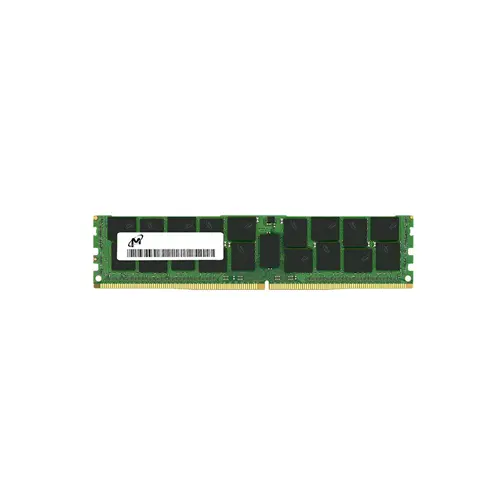
| Product Type | Memory Module |
|---|---|
| Memory Capacity | 8 GB |
| Memory Technology | DDR4 |
| Product Voltage | 1.2V |
| RAM Speed | 2400MHz |
| RAM Standard | DDR4-2400/PC4-19200 |
| Error Identifying | ECC |
| Signal Type | Registered |
| Column Access Strobe (CAS) | CL17 |
| Rank | Single Rank x4 |
| Quantity of Pins | 288-pin |
| RAM Genre | RDIMM |
Designed as a server-grade RDIMM, this 8 GB DDR4-2400 module with ECC and registered signal buffering is optimized for virtualization and in-memory databases where data integrity and signal stability under fully populated memory channels are critical. Its single-rank x4 organization ensures balanced load and low latency (CL17) for consistent performance in dense multi-DIMM configurations.
1. ECC protection silently detects and corrects single-bit errors, guarding against silent data corruption in mission-critical databases and financial transaction systems.
2. Registered signal buffering stabilizes high-capacity memory configurations by reducing electrical load on the memory controller, essential for sustaining uptime in dense virtualized environments.
3. Single Rank x4 organization maximizes signal integrity and enables lower latency within the DRAM bank group, directly improving throughput for latency-sensitive workloads like in-memory analytics.
4. 2400MHz operating speed delivers a reliable baseline bandwidth that balances power efficiency and performance, fitting mixed-workload hosting where consistent response times matter more than peak bursts.
5. An 8 GB capacity provides a cost-optimized building block for vertical scaling, allowing fine-grained memory provisioning in light virtualization or edge server deployments without overcommitting resources.
As a DDR4-2400 registered DIMM with ECC, the Micron MTA18ASF1G72PZ-2G3B is purpose-built for server platforms where data integrity and scalability are non-negotiable. Its ECC actively corrects single-bit errors—common in dense memory arrays—preventing silent corruption that could crash a virtualized cluster or compromise an in-memory database like Redis. The registered buffer strengthens command and address signals, letting you fully load memory channels without signal degradation, crucial for hosting dozens of VMs on one host. The module’s single-rank x4 organization harnesses the parallel bandwidth of x4 DRAM devices, while CL17 latency accelerates small-block transactions. This combination boosts query throughput in memory-analytics engines and ensures stable live migrations. In short, this RDIMM converts a potential failure point into a reliable performance accelerator for your mission-critical workloads.
General Virtualization
For a typical hypervisor hosting multiple VMs, install at least four of these 8 GB RDIMMs to achieve 32 GB total capacity, evenly distributed across the available memory channels. This ensures balanced memory access and adequate headroom for moderate consolidation ratios. In dense environments, scale to eight modules (64 GB) to avoid ballooning and swapping penalties.
In-Memory Database
In-memory databases demand extremely low latency and high capacity to hold entire datasets in RAM. Populate all DIMM slots with these 8 GB RDIMMs to maximize total capacity—on a dual-socket server this can often reach 128 GB or more. Pair modules symmetrically per channel to sustain rated bandwidth, and prioritize identical SKUs to avoid ECC training issues that could degrade real-time query performance.
High-Performance Computing (HPC)
HPC workloads thrive on memory bandwidth rather than raw capacity alone. Install one module per channel across all available memory channels—typically six or eight in a modern server—to enable full channel interleaving with these 2400 MHz Registered ECC DIMMs. A total of 48–64 GB using six to eight identical 8 GB sticks minimizes access contention and delivers consistent throughput for tightly-coupled parallel simulations and computational fluid dynamics codes.
Rigorously tested server memory; compatible with Dell PowerEdge R740, HPE ProLiant DL380 Gen10, Lenovo ThinkSystem SR650.
Q: Can I mix this MTA18ASF1G72PZ-2G3B with other memory modules of different brands or speeds?
A: Mixing RDIMMs of different brands or speeds is not recommended. Mismatched modules may cause signal integrity issues, stability problems, or force the system to downclock to the slowest installed speed, undermining server reliability.
Q: Is this memory compatible with my system?
A: This DDR4-2400 ECC Registered DIMM is designed for servers. It requires a compatible Intel Xeon E5-2600 v3/v4, Scalable, or AMD EPYC platform with a chipset supporting registered memory. Verify with your motherboard's qualified vendor list.
Q: What is the recommended DIMM population order for optimal performance?
A: Populate identical DIMMs per channel, starting with the first slot (often blue) in each memory channel. Balance across all populated channels to maximize interleaving. Always consult your server’s specific population guidelines for the best throughput.
Q: Does this module support overclocking or XMP profiles?
A: No. This is a JEDEC-compliant server RDIMM operating at standard 2400MT/s. It does not support overclocking or XMP profiles; these features are reserved for enthusiast desktop memory and can jeopardize data integrity on servers.
Q: What warranty and typical failure rate can I expect?
A: This module includes a 1-year warranty. Built with industry-grade components, its annualized failure rate (AFR) is typically well below 0.5% under normal operating conditions, ensuring high long-term reliability in 24/7 server environments.