











 Secure payments
Standard refund policy
Trade Assurance
Secure payments
Standard refund policy
Trade Assurance
| Product Type | Memory Module |
|---|---|
| Memory Capacity | 8 GB |
| Memory Technology | DDR4 |
| Product Voltage | 1.2V |
| RAM Speed | 2400MHz |
| RAM Standard | DDR4-2400/PC4-19200 |
| Error Identifying | ECC |
| Signal Type | Registered |
| Column Access Strobe (CAS) | CL17 |
| Rank | Single Rank x8 |
| Quantity of Pins | 288-pin |
| RAM Genre | RDIMM |
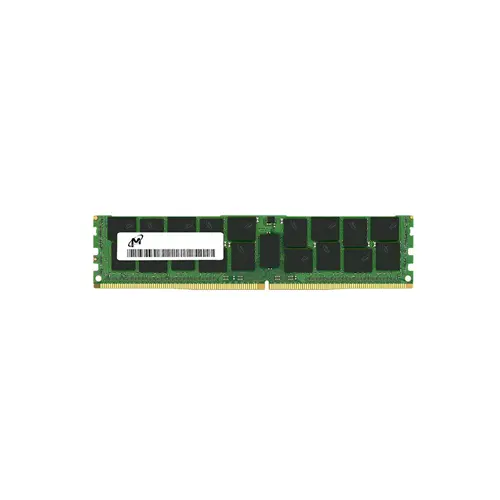
This Micron MTA9ASF1G72PZ-2G3B1MG is an 8GB DDR4-2400 registered ECC RDIMM engineered for server platforms where data integrity and system stability are paramount, making it ideal for virtualization hosts, in-memory databases, and other mission-critical enterprise workloads. Its single-rank x8 configuration minimizes electrical loading on the memory bus for improved signal integrity at higher speeds, while the registered signal type and ECC provide the buffering and error correction necessary to sustain 24/7 operation under demanding multi-DIMM configurations.
1. Error-correcting code protection silently detects and corrects single-bit memory faults, preventing silent data corruption in financial transaction logs and virtualized database environments.
2. Registered signal buffering stabilizes the command and address buses under heavy DIMM counts, enabling dense server configurations to scale memory capacity without compromising platform reliability.
3. An eight-gigabyte module provides a cost-effective granular unit for memory provisioning, allowing IT operators to right-size capacity for lightweight container hosts or entry-level virtual machines with minimal stranded resources.
4. The DDR4-2400 transfer rate yields substantial per-channel bandwidth, sustaining responsive application performance when multiple tenants hit in-memory datasets on a shared hypervisor.
5. Single-rank x8 organization minimizes electrical load per channel, helping multi-DIMM server builds maintain consistent high-speed signaling and reducing memory controller strain during peak data center operation.
Built specifically for server platforms, the MTA9ASF1G72PZ-2G3B1MG RDIMM tackles reliability and performance challenges that directly affect your enterprise uptime and operational cost. Its ECC technology is vital in virtualized clusters where dozens of VMs share the same physical footprint. A silent bit flip in memory—common under high background radiation or aging silicon—can corrupt a database transaction or crash a critical application without warning. ECC detects and corrects such errors on the fly, preventing data integrity failures that would otherwise cascade across your virtual infrastructure. The Registered signal buffering addresses the scalability pain point: when you fully load server memory channels to run SAP HANA or large in-memory analytics, unbuffered modules suffer signal degradation, forcing lower clock speeds or reduced population. This RDIMM sinks command and address signals through an onboard register, so you can reliably populate 16, 24, or even 32 DIMM slots without sacrificing the rated 2400MHz. Combined with a low 1.2V operating voltage that cuts power draw across dense rack deployments, and a single-rank x8 organization that streamlines sequential read throughput for fast query responses, this module keeps your database workloads running cleanly, keeps cooling demands in check, and preserves uninterrupted service—exactly what a production-grade data center demands.
General Virtualization
For modest VM density with 8 GB RDIMMs, populate at least one module per channel to maintain balanced memory bandwidth. A dual-socket server using 16 modules (128 GB total) comfortably hosts 20–30 light VMs, while heavier workloads benefit from populating all available channels before increasing DIMM size.
In-Memory Database
In-memory databases like Redis or SAP HANA demand low latency and strict data integrity, making ECC Registered memory essential. Use multiple 8 GB modules to build a capacity pool aligned with dataset size, and leverage memory interleaving by installing identical modules across all memory channels for optimal throughput.
High-Performance Computing
HPC workloads thrive on bandwidth-sensitive, parallel access patterns. Deploy 8 GB Registered ECC modules in a fully balanced configuration—typically one DIMM per channel across all sockets—to maximize sustained memory bandwidth and minimize NUMA penalties in compute-bound clusters.
Rigorously tested server memory, compatible with Dell PowerEdge R760, HPE ProLiant DL380 Gen10, Lenovo ThinkSystem SR650, and similar systems.
Q: Can I mix this MTA9ASF1G72PZ-2G3B1MG with other memory modules of different brands or speeds?
A: Mixing brands or speeds is not recommended for this registered ECC server DIMM. Consistent part numbers and identical ranks across all channels ensure signal integrity and prevent instability in mission-critical environments.
Q: Is this memory compatible with my system?
A: This DDR4-2400 RDIMM is designed for Intel Xeon Scalable and AMD EPYC platforms using C620 or equivalent chipsets. Verify support for 288-pin ECC Registered memory via the server board's qualified vendor list.
Q: What is the recommended DIMM population order for optimal performance?
A: Populate identically across memory channels starting with the farthest slot per channel. For balanced interleaving, install single-rank x8 modules in sets that match CPU memory controller channels, following the board's labeling sequence.
Q: Does this module support overclocking or XMP profiles?
A: No. This registered server memory strictly follows JEDEC DDR4-2400 standards at CL17 for maximum data integrity. It does not support overclocking, XMP, or custom timing profiles.
Q: What warranty and typical failure rate can I expect?
A: This Micron module includes a one-year warranty. Enterprise DDR4 RDIMMs like this typically deliver an annualized failure rate well below 0.5%, reflecting rigorous screening and error-correction reliability.