











 Secure payments
Standard refund policy
Trade Assurance
Secure payments
Standard refund policy
Trade Assurance
| Product Type | Memory Module |
|---|---|
| Compliance Standards | RoHS,CE,WEEE |
| Memory Capacity | 8 GB |
| Memory Technology | DDR4 |
| Product Voltage | 1.2V |
| RAM Speed | 2400MHz |
| RAM Standard | DDR4-2400/PC4-19200 |
| Error Identifying | ECC |
| Signal Type | Unbuffered |
| Column Access Strobe (CAS) | CL17 |
| Rank | Single Rank x8 |
| Quantity of Pins | 288-pin |
| RAM Genre | UDIMM |
Designed for entry-level servers and workstations requiring data integrity, this 8GB DDR4-2400 UDIMM with ECC is ideal for light virtualization, file services, and memory-resilient applications. Its unbuffered signal type and single-rank x8 organization ensure low latency and stable electrical loading, while built-in error correction guards against single-bit data corruption.
1. Integrated ECC silently corrects single-bit errors in real time, preserving long-running process integrity and eliminating a major source of unexpected server downtime.
2. An 8 GB capacity per stick allows flexible population for lightweight hypervisor hosts or container nodes, balancing memory density with cost-effective scaling.
3. The 2400 MT/s transfer rate delivers a solid 19.2 GB/s peak bandwidth per channel, keeping latency-sensitive caching and small database operations consistently responsive.
4. Single-rank x8 organization reduces electrical load on the memory bus, which helps maintain signal stability in fully populated server boards and supports reliable 24/7 operation.
5. Unbuffered UDIMM architecture strips out register delay to achieve lower access latency, a practical advantage for edge servers and micro-services where every nanosecond counts.
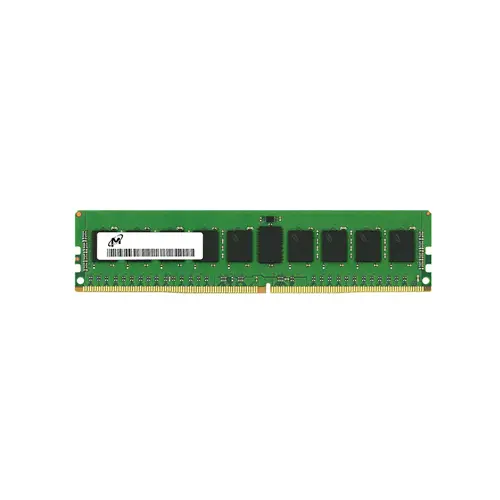
The Micron MTA9ASF1G72AZ-2G3B1ZK is an 8GB DDR4-2400 UDIMM engineered for entry-level servers and workstations, where every bit of data integrity and system stability has a direct operational impact. Its ECC technology actively detects and corrects single-bit memory errors before they corrupt your data—a silent safeguard that, in a virtualized cluster, prevents a flipped bit from crashing multiple guest machines or, in financial or scientific computing, keeps a long-running simulation accurate to the last decimal. The 1.2V operating voltage reduces power draw and waste heat across a fleet of always‑on systems; for a small business running a 24/7 database server, this translates directly into lower energy bills and less stress on cooling, extending component lifespan. The single‑rank x8 organization optimizes signal integrity and reduces the electrical load on the memory controller, ensuring stable boot‑ups and compatibility across mixed‑module configurations, which is critical when you need to expand memory in a headless server without risking POST failures. Its 2400MT/s speed, paired with a CL17 latency, provides a responsive baseline that keeps virtual desktops snappy and in‑memory databases like Redis serving queries without throttling. Together, these characteristics mean fewer downtime incidents, tighter total cost of ownership, and the confidence that your uptime‑sensitive workloads are backed by enterprise‑grade memory, not consumer‑grade compromises.
General Virtualization
For a typical hypervisor hosting 10–15 light to moderate VMs, populate a dual-socket server with eight identical 8 GB ECC UDIMMs (64 GB total) installed in a balanced interleaved configuration across all memory channels. This ensures adequate headroom for memory overcommitment while maintaining the data integrity ECC provides—essential for stable multi-tenant environments.
In-Memory Database
In-memory workloads demand both capacity and low latency; aim for the maximum supported UDIMM population on the platform. For a single-socket server board with four DIMM slots, install four 8 GB modules to reach 32 GB, leaving room for a dataset that fits entirely in RAM. Select identical single-rank x8 DIMMs operated at the native 2400 MT/s to avoid rank-switching delays and sustain predictable access times under heavy read/write pressure.
High-Performance Computing
HPC nodes benefit from memory bandwidth as much as capacity. Populate all channels evenly—e.g., six modules in a triple-channel or eight in a quad-channel configuration—with these ECC UDIMMs to unlock full interleaved bandwidth. The unbuffered, low-voltage (1.2 V) design helps control per-node power consumption, which is critical when scaling to hundreds of compute nodes in a cluster while still protecting large-scale simulations with single-bit error correction.
Rigorously validated server memory compatible with Dell PowerEdge T140, T340, HP ML30 Gen10, Lenovo ST50.
Q: Can I mix this MTA9ASF1G72AZ-2G3B1ZK with other memory modules of different brands or speeds?
A: Mixing is not recommended for server environments. Differing brands, speeds, or ranks may cause instability or prevent ECC functionality. For reliable operation, use identical modules with the same Micron part number across all channels.
Q: Is this memory compatible with my Intel Xeon E3 or AMD Ryzen server board?
A: This UDIMM requires DDR4 ECC support. It is compatible with platforms like Intel Xeon E3-1200 v5/v6, select Core i3, and AMD Ryzen processors on chipsets such as C232, C236, or B450 that explicitly support ECC unbuffered memory.
Q: What is the recommended DIMM population order for optimal performance?
A: Populate identical modules per memory channel starting with the furthest slot from the CPU. Typically fill blue slots first, then black. Always follow your server board manual to balance channels and maintain symmetric ECC operation.
Q: Does this module support overclocking or XMP profiles?
A: No. As JEDEC-compliant ECC server memory, it operates strictly at DDR4-2400 with a fixed CL17 timing. It does not include XMP profiles and is not designed for overclocking to ensure 24/7 data integrity.
Q: What warranty and typical failure rate can I expect?
A: This module includes a one-year warranty. In typical controlled server environments, the annualized failure rate (AFR) is extremely low, under 0.5%, owing to rigorous screening and ECC error correction reliability.