











 Secure payments
Standard refund policy
Trade Assurance
Secure payments
Standard refund policy
Trade Assurance
| Product Type | Memory Module |
|---|---|
| Memory Capacity | 8 GB |
| Memory Technology | DDR4 |
| Product Voltage | 1.2V |
| RAM Speed | 2400MHz |
| RAM Standard | DDR4-2400/PC4-19200 |
| Error Identifying | ECC |
| Signal Type | Unbuffered |
| Column Access Strobe (CAS) | CL17 |
| Rank | Single Rank x8 |
| Quantity of Pins | 288-pin |
| RAM Genre | UDIMM |
This DDR4-2400 UDIMM with ECC is engineered for entry-level servers and single-socket workstations running data-critical workloads such as virtualization and in-memory databases, where uncompromised data integrity is essential. The unbuffered, single-rank x8 design minimizes electrical loading on the memory controller for superior signal stability and low latency, while on-die ECC correction reliably eliminates single-bit errors to maintain system uptime.
1. ECC single-bit error correction safeguards transactional data integrity, essential for financial databases and virtualization hosts that cannot tolerate silent corruption.
2. A density of eight gigabytes per module balances cost-per-slot with sufficient headroom to support multiple lightweight virtual machines or container-based microservices.
3. DDR4-2400 transfer rate delivers stable mainstream bandwidth, keeping memory-bound server workloads like in-memory caches and web tiers responsive under load.
4. Operating at the JEDEC low-voltage baseline reduces overall rack-level power draw and cooling expenditure, extending service life in always-on data centers.
5. Single-rank configuration limits DIMM thermal output and electrical loading, enabling denser population on a server board without throttling penalties.
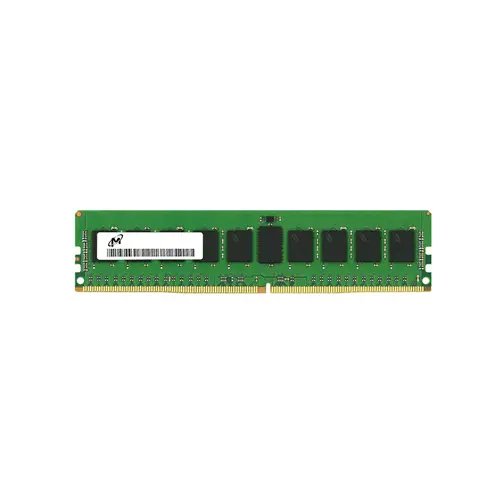
The Micron MTA9ASF1G72AZ-2G3A1Z is an 8GB DDR4-2400 ECC UDIMM purpose-built for entry-level servers, workstations, and network-attached storage where uptime is non-negotiable. Its ECC instantly corrects single-bit errors. In a ZFS-based NAS or a hypervisor running containers, a flipped bit can silently corrupt file systems or crash virtual machines; ECC prevents this data decay, keeping your services and file integrity intact around the clock. The unbuffered architecture then cuts latency compared to registered alternatives, which becomes a tangible advantage when this module caches a Redis database—every nanosecond saved directly accelerates transaction throughput. Operating at just 1.2 volts, it draws minimal power and generates less heat, allowing a micro-server running 24/7 to stay cooler, more stable, and more energy-efficient without sacrificing the 2400 MHz clock. Finally, the single-rank x8 layout ensures broad compatibility and clean signal integrity even when all four slots are populated on a C242 or X570 workstation board, making a worry-free path to 32 GB. It is more than memory; it is the bedrock for error-free, always-on computing.
General Virtualization
For a modest virtualization host, use this 8 GB ECC UDIMM in pairs to enable dual-channel mode and ensure data integrity. A baseline configuration of 4 identical modules (32 GB total) comfortably supports 8–10 light VMs. Scale to 64 GB with eight modules if running heavier per-VM memory allocations, always populating identical DIMMs per memory channel.
In-Memory Database
In-memory workloads demand both capacity and error correction. Start with a minimum of 4 modules (32 GB) for a small Redis or Memcached instance, placing them in dual-channel, symmetric slots. For larger datasets, maximize the board’s UDIMM slots with identical 8 GB ECC sticks—96 GB to 128 GB across channels—to reduce swapping and maintain 1.2V power efficiency without sacrificing data protection.
High-Performance Computing (HPC)
HPC nodes benefit from balanced memory bandwidth. Equip each memory channel with one 8 GB ECC UDIMM to populate all channels equally—this often means 4 or 6 modules for quad/six-channel platforms, achieving 32 GB or 48 GB. The 2400 MT/s speed and ECC help prevent silent data corruption during long-running calculations, and single-rank x8 modules keep command rates low for reliable throughput.
Rigorously tested server memory compatible with Dell PowerEdge T40, T140, HPE ProLiant DL20 Gen10, Lenovo ThinkSystem ST250, and more.
Q: Can I mix this MTA9ASF1G72AZ-2G3A1Z with other memory modules of different brands or speeds?
A: Mixing modules is not recommended for server environments. Identical part numbers ensure signal integrity, ECC consistency, and validated stability. Mixed speeds will default to the lowest common JEDEC profile and may cause subtle reliability issues.
Q: Is this memory compatible with my system?
A: This is a DDR4-2400 ECC Unbuffered DIMM. It requires a server/workstation board with Intel Xeon E3/E-2100/2200 or AMD Ryzen PRO platforms that explicitly support ECC UDIMMs. Check the motherboard QVL for compatibility.
Q: What is the recommended DIMM population order for optimal performance?
A: Follow the server board's memory population guide. Typically, populate identical modules in matching colors per channel, starting farthest from the CPU socket. This preserves balanced interleaving and full memory bandwidth.
Q: Does this module support overclocking or XMP profiles?
A: No. This is a JEDEC-compliant server memory module. It operates strictly at PC4-19200 (2400MHz) with standard timings and 1.2V. XMP overclocking profiles are not supported to maintain mission-critical data integrity.
Q: What warranty and typical failure rate can I expect?
A: It carries a 1-year warranty. As an enterprise-grade ECC UDIMM manufactured by Micron, the annualized failure rate (AFR) is typically well under 0.5%, reflecting exceptional long-term reliability.