











 Secure payments
Standard refund policy
Trade Assurance
Secure payments
Standard refund policy
Trade Assurance
| Product Type | Memory Module |
|---|---|
| Compliance Standards | RoHS |
| Memory Capacity | 8 GB |
| Memory Technology | DDR4 |
| RAM Speed | 2400 |
| RAM Standard | DDR4-2400/PC4-19200 |
| Error Identifying | Non-ECC |
| Signal Type | Unbuffered |
| Column Access Strobe (CAS) | CL17 |
| Rank | Single Rank x8 |
| Quantity of Pins | 260-pin |
| RAM Genre | SoDIMM |
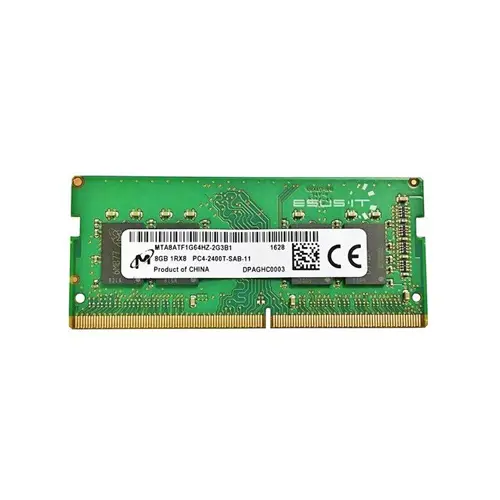
Designed for notebooks and small-form-factor mobile workstations, this Micron 8GB DDR4-2400 SO-DIMM provides a straightforward plug-and-play upgrade with its Unbuffered, Non-ECC architecture and standard 1.2V low-power operation. Its single-rank x8 configuration and CL17 latency ensure stable signal integrity and broad compatibility across OEM platforms, making it an ideal choice for multitasking-heavy productivity workloads and memory-constrained ultraportables.
1. SoDIMM form factor with a 260-pin interface ensures a straightforward drop-in fit for slim notebook slots, making user self-upgrades virtually foolproof.
2. 8 GB capacity provides ample headroom for fluid multi-tab browsing and office multitasking, comfortably extending the useful life of mainstream laptops.
3. DDR4 technology inherently runs at lower voltage than its predecessors, helping preserve battery runtime and reduce fan intrusion during untethered work.
4. 2400 MT/s transfer rate strikes a sweet spot for responsive day-to-day computing, delivering smooth application switching without overtaxing the thermal envelope.
5. Single Rank x8 organization reduces electrical load on the memory controller, enhancing power efficiency and keeping the internal chassis cooler under sustained use.
Designed for modern notebooks, the Micron MTA8ATF1G64HZ-2G3B1 is an 8 GB DDR4-2400 SODIMM that directly addresses the daily compromises mobile users face. Its unbuffered, non-ECC architecture and low-voltage DDR4 operation (1.2V) mean less strain on your battery, tangibly extending unplugged productivity sessions. For the road-warrior upgrading a thin-and-light ultrabook, the compact 260-pin SODIMM form factor guarantees a drop-in fit where space is brutally limited, eliminating guesswork and physical incompatibility headaches. In a mobile workstation juggling large spreadsheets, data analysis, or multiple virtual meetings, the single-rank x8 configuration reduces electrical loading, which enhances memory controller stability and prevents unexpected slowdowns under sustained loads. This translates to buttery-smooth multitasking without the thermal spikes that cause throttling in cramped chassis. The plug-and-play compatibility with virtually any Intel or AMD notebook platform turns a system upgrade into a five-minute job, instantly revitalizing an aging laptop with the headroom needed for modern collaboration apps and responsive desktop performance—without sacrificing the battery life you rely on between flights or client visits.
Laptop Upgrade
For typical systems shipping with a single 8 GB DDR4‑2400 SoDIMM, the cleanest capacity boost is to add an identical second module, enabling dual‑channel mode and doubling the total to 16 GB. If the notebook already has a soldered module plus one free slot, replacing the removable stick with this 8 GB part (if it matches the soldered timings) can still deliver a meaningful multitasking improvement. Always verify the system’s maximum supported capacity per slot before pairing a new module with existing memory.
Mobile Workstation
Professional workloads like 3D rendering, CAD, or large dataset analysis demand far more than a single 8 GB stick. Plan to populate both SoDIMM slots with high‑capacity 16 GB or 32 GB DDR4‑2400 modules to reach 32 GB or 64 GB totals. While the speed grade is fixed at 2400 MT/s, maximizing channel count and capacity reduces swapping and accelerates sustained computation. Validate motherboard limits and confirm ECC is not required, as this unbuffered non‑ECC memory targets client‑class mobile workstations.
Ultrabook Power Saving
This 8 GB SoDIMM operates at the standard 1.2 V DDR4 voltage, which already offers lower power draw than previous‑generation DDR3L. In an ultralight clamshell, installing a single module and leaving one slot empty can save a small amount of board power, extending battery run time for web browsing, office apps, and media streaming. For the longest endurance, pair any upgrade with system firmware power profiles, and note that the module’s single‑rank x8 organization adds a slight idle‑power advantage over dual‑rank alternatives.
Rigorously tested, this DDR4 SODIMM is compatible with laptops like Dell Latitude 7490, HP EliteBook 840 G5, Lenovo T480.
Q: Can I mix this MTA8ATF1G64HZ-2G3B1 with other memory modules of different brands or speeds?
A: Mixing is possible but not recommended. The system will default to the slowest module's speed, and mismatched ranks or timings may cause instability, especially in laptops where validation is critical.
Q: Is this memory compatible with my system?
A: This is a DDR4-2400 non-ECC unbuffered SoDIMM. It fits notebooks supporting DDR4, 260-pin slots, and 8 GB single-rank modules. Verify your laptop model supports DDR4 and the specific speed and capacity.
Q: What is the recommended DIMM population order for optimal performance?
A: If your laptop has two slots, install identical modules as a matched pair to enable dual-channel mode for peak bandwidth. A single module works fine but offers half the theoretical memory bandwidth.
Q: Does this module support overclocking or XMP profiles?
A: No, this module adheres to JEDEC DDR4-2400 standard timings and does not include XMP. In a laptop environment, overclocking is typically locked by the BIOS and not supported.
Q: What warranty and typical failure rate can I expect?
A: This module comes with a one-year warranty. Typical failure rates for original Micron DRAM are well below industry average, often less than 0.1% annually under normal operating conditions.