











 Secure payments
Standard refund policy
Trade Assurance
Secure payments
Standard refund policy
Trade Assurance
| Product Type | Memory Module |
|---|---|
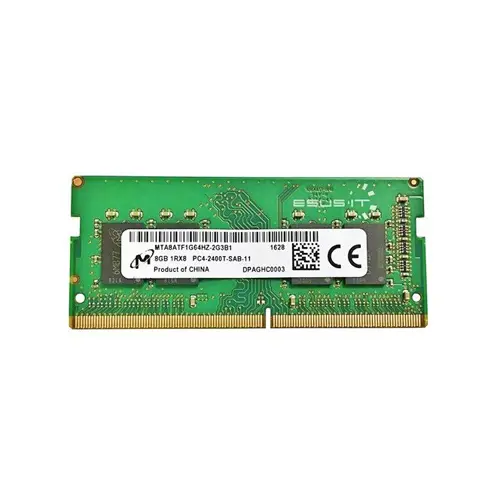
| Memory Capacity | 8 GB |
| Memory Technology | DDR4 |
| RAM Speed | 2400 |
| RAM Standard | DDR4-2400/PC4-19200 |
| Error Identifying | Non-ECC |
| Signal Type | Unbuffered |
| Column Access Strobe (CAS) | CL17 |
| Rank | Single Rank x8 |
| Quantity of Pins | 260-pin |
| RAM Genre | SoDIMM |
This unbuffered, non-ECC DDR4-2400 SO-DIMM is purpose-built for notebooks and mobile workstations, delivering a reliable plug-and-play upgrade for mainstream office and light content-creation workloads. Its single-rank x8 organization and CL17 latency ensure broad compatibility and power-efficient operation, which helps extend battery runtime in thermally constrained portable systems.
1. SoDIMM form factor allows effortless drop-in upgrades, fitting snugly into compact notebook chassis and ensuring wide compatibility across mainstream laptops.
2. 8 GB capacity handles everyday multitasking with confidence, keeping multiple office suites, video conferences, and browser tabs fluid without slowdowns.
3. DDR4 technology operates at an energy-conscious 1.2V, noticeably extending battery life while minimizing excess heat during extended off-plug productivity.
4. 2400 MT/s transfer speed accelerates application launches and file access, so on-the-go professionals spend less time staring at loading screens.
5. CL17 low-latency timing delivers snappy window switching and input responsiveness, making the system feel instantaneous under casual workload bursts.
Based on the SoDIMM form factor and 260-pin interface, the Micron MTA8ATF1G64HZ-2G3H1 is clearly engineered for notebooks. Its four defining characteristics—DDR4 low-voltage efficiency, a compact SoDIMM footprint, 2400MHz speed with CL17 latency, and an 8GB single-rank x8 architecture—directly address the real-world frustrations of mobile users.
For the ultralight laptop owner, the 1.2V DDR4 rail is transformative. It significantly reduces power draw compared to older memory, directly extending battery life during long flights or back-to-back meetings, and produces less heat in tightly sealed chassis. The slim SoDIMM design slides into cramped ultrabook slots without conflict, making a user-upgrade from 4GB painless. Meanwhile, in a mobile workstation scenario where a professional juggles VMs and large CAD assemblies, the 8GB capacity handled by a single rank of chips eases the burden on the processor’s memory controller, boosting platform stability under load. Paired with the 2400MT/s bandwidth and a responsive CL17 timing, data flows quickly to the CPU, minimizing lag when rotating a complex 3D model or snapshotting a virtual machine. These features collectively mean fewer compromises: you get snappy multitasking, cooler operation, and the freedom to work longer away from an outlet.
Laptop Upgrade
For most users seeking to refresh an older notebook, this 8 GB DDR4‑2400 SoDIMM is an ideal drop‑in upgrade. Install a second identical module alongside the existing one to enable dual‑channel mode, doubling capacity to 16 GB and noticeably improving integrated graphics performance and multitasking responsiveness. If your system has only one slot, swap out a 4 GB or 8 GB stick directly—the single‑rank x8 organization ensures broad compatibility with mainstream laptop chipsets.
Mobile Workstation
A mobile workstation running demanding software such as CAD, 3D rendering, or large data analysis benefits from maximized memory bandwidth and capacity. Using two of these 8 GB modules in dual‑channel provides a solid 16 GB baseline that accelerates I/O‑heavy tasks and prevents excessive paging. When the workload outgrows 16 GB, replace both slots with higher‑capacity modules (e.g., 32 GB or 64 GB kits) while retaining the same DDR4‑2400 standard to guarantee stable operation under sustained load.
Ultrabook Power Saving
Ultra‑compact laptops and 2‑in‑1 devices prioritize battery runtime, and this unbuffered Non‑ECC module naturally supports a low 1.2 V operating voltage that reduces overall platform power draw. Pairing a single 8 GB SoDIMM with a soldered‑on 8 GB (or leaving the second slot empty) keeps the power envelope lower than a fully populated dual‑channel setup. Configure the system to use the module in a single‑channel arrangement when battery longevity matters more than peak throughput, extending wireless productivity hours.
Guaranteed compatibility after rigorous validation: Dell Latitude 7490, Lenovo T480, HP EliteBook 850 G5, and more.
Q: Can I mix this MTA8ATF1G64HZ-2G3H1 with other memory modules of different brands or speeds?
A: Mixing modules is not recommended for notebooks. Even with identical specs, variations in ICs or SPD programming can cause instability. For guaranteed compatibility, use matched kits, especially in dual-channel configurations.
Q: Is this memory compatible with my system?
A: This SoDIMM fits notebooks supporting DDR4 2400MT/s non-ECC unbuffered memory. It is compatible with Intel 6th Gen Core and newer, or AMD Ryzen mobile platforms using 260-pin slots. Verify your laptop's DDR generation and maximum supported speed.
Q: What is the recommended DIMM population order for optimal performance?
A: Most laptops have one or two slots. For dual-channel operation, populate both slots with identical modules. If only one module is installed, it will run in single-channel mode; no specific slot order is required.
Q: Does this module support overclocking or XMP profiles?
A: No, this is a standard JEDEC-compliant DDR4-2400 CL17 SoDIMM. Laptop memory typically does not support XMP overclocking and runs at fixed JEDEC timings for stability and power efficiency.
Q: What warranty and typical failure rate can I expect?
A: This module includes a 1-year warranty. With DRAM manufactured to tight specifications, the annualized failure rate is typically below 0.5% under normal operating conditions, ensuring reliable long-term performance.