











 Secure payments
Standard refund policy
Trade Assurance
Secure payments
Standard refund policy
Trade Assurance
| Product Type | Memory Module |
|---|---|
| Compliance Standards | RoHS |
| Memory Capacity | 8 GB |
| Memory Technology | DDR4 |
| Product Voltage | 1.2V |
| RAM Speed | 2400MHz |
| RAM Standard | DDR4-2400/PC4-19200 |
| Error Identifying | Non-ECC |
| Signal Type | Unbuffered |
| Column Access Strobe (CAS) | CL17 |
| Rank | Single Rank x8 |
| Quantity of Pins | 288-pin |
| RAM Genre | UDIMM |
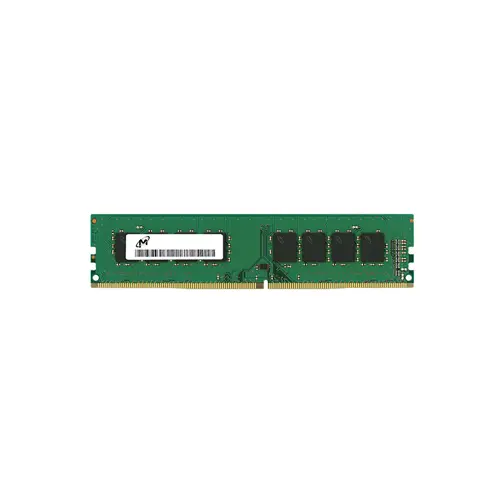
Designed for desktop platforms, this Micron 8GB DDR4-2400 UDIMM (PC4-19200) leverages a single-rank x8 configuration and a CAS latency of 17 to deliver low-latency, stable unbuffered performance ideal for gaming, content creation, and everyday productivity. Its 1.2V operating voltage and standard JEDEC profile ensure reliable plug-and-play compatibility, while the single-rank architecture can ease memory controller loading for potentially higher overclocking headroom on Z-series motherboards.
1. Single Rank x8 configuration reduces the electrical load on the memory controller, enhancing overclocking headroom and stability for high-FPS gaming rigs.
2. 8 GB capacity provides a smooth multitasking baseline, allowing content creators to run editing suites and browser sessions without triggering excessive page-file slowdowns.
3. DDR4 technology delivers higher bandwidth per watt than its predecessors, helping streamers maintain a stutter-free broadcast while gaming from a single desktop.
4. 2400 MHz speed ensures fast data transfers that translate into quicker level loads and snappier application launches in everyday productivity and entertainment.
5. CL17 latency strikes a fine balance between response time and affordability, giving competitive gamers tighter input-to-display feedback without the premium cost of extreme low-latency kits.
Taking a close look at the specs for MTA8ATF1G64AZ-2G3B1, the 288-pin UDIMM form factor, unbuffered signal type, and non-ECC error handling clearly position this as desktop memory. For gamers, content creators, and power users, the four defining traits of this DDR4 module translate directly into a smoother, more responsive real-world experience.
With a frequency of 2400MHz and a CL17 latency, every mouse click and keystroke feels near-instant. In a fast-paced triple-A title where split-second reactions decide victory, that tight timing reduces the delay between your command and on-screen action, preventing micro-stutter and lag. When editing 4K video, the combination of bandwidth and low latency keeps the timeline scrubbing buttery smooth, even with multiple color-graded layers. The single-rank x8 organization minimizes the electrical load on the memory controller, which greatly improves compatibility with a wider range of motherboards and makes it far easier to achieve stable overclocks, especially in dual-channel configurations. That means enthusiasts can safely push their systems further for extra frames per second. Finally, the 1.2V operating voltage draws less power and generates minimal heat. During an overnight render or an eight-hour gaming marathon, this efficiency keeps your rig cooler and extends component longevity, giving you uncompromised stability when it matters most.
Capacity Planning Guide for Desktop DDR4 UDIMM
The provided specification — Non-ECC, Unbuffered, 288-pin DDR4-2400 UDIMM at 1.2V — identifies this as standard desktop memory. Its 8GB single-rank modules are versatile for consumer builds, but capacity planning should align clearly with the intended workload.
Gaming Build
For modern gaming, a 16GB dual-channel kit (2x8GB) is the sweet spot, eliminating stutter in demanding titles while keeping costs in check. If streaming or heavy multitasking is planned, step up to a 32GB (2x16GB or 4x8GB) configuration to provide ample headroom. Always install modules in matched pairs to enable dual-channel bandwidth, which measurably improves frame-time consistency.
Content Creation
Video editing, 3D rendering, and large photo batches rapidly consume memory capacity. A 64GB setup (using four of these 8GB modules, or migrating to higher-density kits) is advisable for timeline scrubbing at full resolution and handling complex scenes without disk swapping. Prioritize total capacity over raw frequency when preview rendering, though 2400MHz remains adequate for most entry-level creator workflows.
General Productivity
For office applications, web browsing, and light multitasking, a single 8GB module is the cost-effective baseline. Upgrading to 16GB (2x8GB) delivers the best price-to-performance ratio, comfortably supporting dozens of browser tabs and office suites simultaneously. This modest dual-channel configuration avoids overinvestment while ensuring smooth everyday operation.
This rigorously tested 8GB DDR4 2400MHz UDIMM is compatible with desktops like Dell OptiPlex 7040, HP EliteDesk 800 G3, and Lenovo ThinkCentre M910.
Q: Can I mix this MTA8ATF1G64AZ-2G3B1 with other memory modules of different brands or speeds?
A: While mixing is physically possible, the system will default to the slowest module’s speed and timings, potentially causing instability. For guaranteed dual‑channel performance and reliability, we strongly recommend identical modules.
Q: Is this memory compatible with my Intel or AMD desktop motherboard?
A: It fits any DDR4 UDIMM desktop board with a 288‑pin slot, supporting 2400MHz non‑ECC memory. Common compatible chipsets include Intel 100/200/300 series and AMD AM4. Please check your motherboard QVL for full validation.
Q: What is the recommended DIMM population order for optimal performance?
A: For dual‑channel operation, install the two modules in the far‑right and second‑from‑left slots (typically DIMM_A2 and DIMM_B2). Consult your motherboard manual for exact slot numbering to maximize memory bandwidth.
Q: Does this module support overclocking or XMP profiles?
A: No. This is a standard JEDEC DDR4‑2400 module running at 1.2V with fixed CL17 timings. It does not include XMP profiles and is not designed for overclocking. It will run reliably at its rated 2400MHz.
Q: What warranty and typical failure rate can I expect?
A: This module is covered by a 1‑year warranty. Like most quality DDR4 UDIMMs, the annualized failure rate is extremely low (below 0.1%), ensuring stable operation throughout its lifespan in a normal desktop environment.