











 Secure payments
Standard refund policy
Trade Assurance
Secure payments
Standard refund policy
Trade Assurance
| Product Type | Memory Module |
|---|---|
| Memory Capacity | 8 GB |
| Memory Technology | DDR4 |
| Product Voltage | 1.2V |
| RAM Speed | 2666MHz |
| RAM Standard | DDR4-2666/PC4-21300 |
| Error Identifying | ECC |
| Signal Type | Registered |
| Column Access Strobe (CAS) | CL19 |
| Rank | Dual Rank x8 |
| Quantity of Pins | 288-pin |
| RAM Genre | RDIMM |
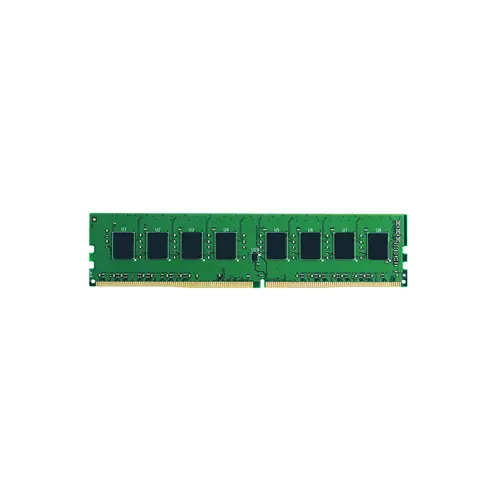
This registered ECC DDR4-2666 RDIMM in 8 GB density, featuring a dual-rank x8 organization and CL19 latency, is purpose-built for server platforms running memory-intensive virtualization or in-memory database workloads where data integrity is paramount. Its 1.2 V operating voltage and registered signal type ensure stable, power-efficient operation across dense 288‑pin memory channels in rack‑optimized deployments.
1. ECC error correction actively detects and fixes single-bit memory errors in real time, preserving data integrity for financial transactions and database operations where even a silent corruption is unacceptable.
2. Registered signal buffering stabilizes electrical loading on the memory bus, allowing dense server configurations to scale memory capacity without compromising command-and-address reliability under heavy multi-DIMM loads.
3. Dual Rank x8 organization interleaves memory accesses across two internal rank groups, boosting effective bandwidth and reducing latency collisions for virtualized workloads running numerous concurrent tenants.
4. The 8 GB capacity density hits a cost-optimized sweet spot for moderate virtualization nodes and web-serving clusters, packing enough headroom per channel to handle common hypervisor and container footprints without overprovisioning.
5. 2666 MHz speed delivers balanced throughput-per-watt suited to mainstream enterprise workloads, sustaining responsive data flow for mid-tier application servers while keeping thermal and power budgets aligned with modern data center efficiency targets.
The Micron MTA18ASF1G72PDZ-2G6E1 is an 8GB DDR4-2666 RDIMM engineered specifically for server platforms, where uptime and data integrity are non-negotiable. Its core features address the real-world pressures IT teams face every day. In a virtualized cluster running dozens of VMs on a single host, ECC memory is not a luxury—it silently corrects single-bit errors caused by background radiation, preventing corrupted transactions from propagating into critical guest operating systems and averting unexplained crashes that consume hours of forensic troubleshooting. The registered signal type re-drives command and address signals through an on-DIMM buffer, stabilizing the memory bus when multiple modules are populated and ensuring the host can scale to support memory-hungry hypervisors without signal degradation. For an in-memory database like Redis or a real-time analytics engine, the dual-rank x8 organization interleaves data accesses across two internal rank groups, extracting additional bandwidth and lowering effective latency during sustained read streams, which directly accelerates query response times under load. Operating at a low 1.2V, this RDIMM also contributes to lower power draw per DIMM in dense 1U and 2U deployments, helping data centers shrink their cooling envelope while maintaining the 2666MT/s throughput that keeps latency-sensitive applications snappy.
General Virtualization
Install identical 8 GB DDR4-2666 ECC RDIMMs across all memory channels to ensure balanced interleaving and maximum bandwidth. For a dual-socket platform with 12 memory channels, 12 modules deliver 96 GB—sufficient for moderate consolidation—while registered ECC safeguards multi-tenant stability.
In-Memory Database
Use dual-rank x8 8 GB RDIMMs across all available channels to reduce latency and increase throughput. To achieve larger capacities, populate every slot (e.g., 24 modules for 192 GB) on a dual-socket board; this configuration meets entry-level in-memory database requirements with strong data protection.
High Performance Computing (HPC)
Populate each memory channel with one 8 GB DIMM for peak bandwidth, critical for parallel simulations. If more memory is needed, fill all channels with identical dual-rank modules to sustain high throughput without penalties, while registered ECC ensures reliability during extended runs.
Rigorously tested, this server memory is compatible with Dell PowerEdge R740, HPE ProLiant DL380 Gen10, Lenovo ThinkSystem SR650, and similar.
Q: Can I mix this MTA18ASF1G72PDZ-2G6E1 with other memory modules of different brands or speeds?
A: Mixing RDIMMs with differing brands or speeds is strongly discouraged. Inconsistent rank, timing, and ECC characteristics can destabilize the server. Use identical modules for guaranteed reliability.
Q: Is this memory compatible with my server platform?
A: This DDR4-2666 ECC RDIMM is qualified for most platforms supporting 288-pin Registered DIMMs, including Intel Xeon Scalable and AMD EPYC. Verify against your motherboard's memory QVL for exact support.
Q: What is the recommended DIMM population order for optimal performance?
A: Always follow your server board's population guide. Typically, install identical DIMMs per channel, filling the slot farthest from the CPU first on each channel to ensure balanced memory interleaving.
Q: Does this module support overclocking or XMP profiles?
A: No. As a server-grade ECC Registered DIMM, it runs strictly at JEDEC-standard DDR4-2666 speeds. Overclocking and XMP are not supported to preserve data integrity and operational stability.
Q: What warranty and typical failure rate can I expect?
A: This module comes with a 1-year warranty. Enterprise ECC RDIMMs like this one are built for high reliability, with an expected annualized failure rate typically well below 0.5% under normal conditions.