











 Secure payments
Standard refund policy
Trade Assurance
Secure payments
Standard refund policy
Trade Assurance
| Product Type | Memory Module |
|---|---|
| Memory Capacity | 8 GB |
| Memory Technology | DDR4 |
| Product Voltage | 1.2V |
| RAM Speed | 2666MHz |
| RAM Standard | DDR4-2666/PC4-21300 |
| Error Identifying | ECC |
| Signal Type | Registered |
| Column Access Strobe (CAS) | CL19 |
| Rank | Single Rank x8 |
| Quantity of Pins | 288-pin |
| RAM Genre | RDIMM |
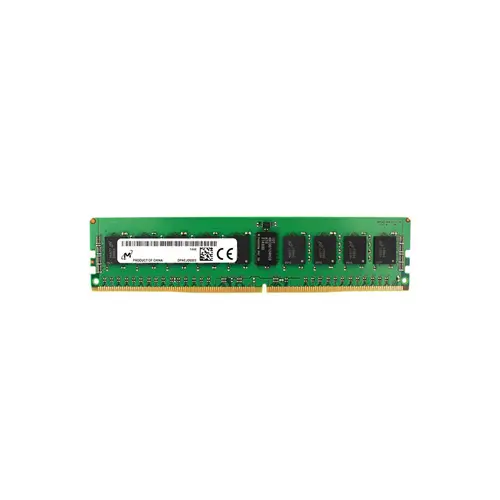
This DDR4-2666 Registered ECC module, configured as a single-rank x8 RDIMM with CL19 latency, is engineered for server platforms handling virtualization and in-memory databases where data integrity and stable signal registration are critical. Its 1.2V operating voltage and registered signal type ensure reliable, power-efficient performance in dense multi-DIMM server deployments.
1. ECC self-correcting memory protects transactional data in flight, ensuring that long-running database and analytics workloads remain free from silent bit-level corruption.
2. Registered buffering reinforces command-address signal integrity, allowing hyperscale deployments to pack more modules per channel without compromising uptime.
3. The module’s capacity is well matched for entry virtualization hosts and containerized microservices, where right-sized memory allocation drives higher consolidation density.
4. Elevated transfer rate sustains predictable throughput under multi-tenant access patterns, keeping response times tight across concurrent query streams.
5. Single Rank x8 organization exposes the full channel bandwidth to the memory controller, a benefit for latency-bound server tasks like in-memory caching and real-time processing.
In a data center where every millisecond of latency and every bit of accuracy counts, this Micron DDR4-2666 ECC Registered DIMM is engineered to eliminate the silent failures that plague commodity memory. Picture a dense virtualization cluster running dozens of VMs on a single node. Without error correction, a cosmic ray-induced bit flip inside a virtualized database could corrupt financial transactions or snapshot states, leading to cascading outages. The module’s ECC engine detects and corrects single-bit errors in real time, preserving data integrity without host intervention. Meanwhile, its registered signal buffer stabilizes the command and address buses when you populate all 24 or 32 slots in a 2U server—this lets you scale to terabyte-class memory pools without signal degradation, directly translating into more virtual machines per rack and lower licensing overhead.
Consider an in-memory analytics platform like a real-time Redis or SAP HANA instance. The single-rank x8 organization of the MTA9ASF1G72PZ delivers consistent electrical loading, which allows the 2666 MT/s bandwidth to stream predictable, low-latency responses under query bursts. The 1.2 V operating voltage significantly reduces the thermal footprint compared to older generations; across a cluster of hundreds of servers, this power efficiency slashes both cooling demands and electricity costs, making it a strategic choice for sustainability-focused operations where uptime and TCO are your true performance metrics.
General Virtualization
For virtualized environments, populate memory channels evenly with registered 8GB DDR4-2666 RDIMMs. A common configuration is one DIMM per channel (e.g., 8 modules for 64GB) to balance capacity and bandwidth, supporting dozens of lightweight VMs without performance bottlenecks.
In-Memory Database
In-memory databases thrive on low latency and high bandwidth; therefore, install identical 8GB RDIMMs across all memory channels—preferably two DIMMs per channel for 128GB when data sets are large. The ECC and registered design keep data error-free under constant heavy access, while single-rank x8 modules reduce electrical loading, enabling stable operation at 2666MHz even with fully populated channels.
High-Performance Computing (HPC)
HPC clusters demand the highest memory throughput. Equip each memory channel with a single 8GB RDIMM (64GB total for an 8-channel server), avoiding mixing DIMM types to maintain uniform latency. ECC protection guards against silent data corruption during long parallel simulations, and registered buffering allows reliable scaling across many nodes.
Strictly tested and proven compatible with Dell PowerEdge R740, R750, HPE DL380 Gen10, Lenovo SR650, and more.
Q: Can I mix this MTA9ASF1G72PZ-2G6D1SI with other memory modules of different brands or speeds?
A: Mixing is not recommended. Registered ECC memory requires matched speed, rank, and timings. Discrepancies can lead to system instability, POST failures, or data integrity risks in server environments.
Q: Is this memory compatible with my system?
A: This RDIMM is designed for servers supporting DDR4-2666 Registered ECC. It works with Intel Xeon Scalable or AMD EPYC platforms. Always verify your motherboard’s QVL and support for Registered DIMMs.
Q: What is the recommended DIMM population order for optimal performance?
A: Follow your server's manual to populate identical modules per channel in balanced order. Typically, install in the first slot of each memory channel to maximize bandwidth and maintain uniform memory access.
Q: Does this module support overclocking or XMP profiles?
A: No. This enterprise-grade RDIMM strictly adheres to JEDEC DDR4-2666 standard timings. Overclocking and XMP are not supported to ensure 24/7 reliability and ECC data integrity.
Q: What warranty and typical failure rate can I expect?
A: This Micron module includes a 1-year warranty. Failure rates are extremely low with an annualized failure rate typically below 0.1% under normal server operating conditions and thermal limits.