











 Secure payments
Standard refund policy
Trade Assurance
Secure payments
Standard refund policy
Trade Assurance
| Product Type | Memory Module |
|---|---|
| Memory Capacity | 8 GB |
| Memory Technology | DDR4 |
| Product Voltage | 1.2V |
| RAM Speed | 2666MHz |
| RAM Standard | DDR4-2666/PC4-21300 |
| Error Identifying | ECC |
| Signal Type | Registered |
| Column Access Strobe (CAS) | CL19 |
| Rank | Dual Rank x8 |
| Quantity of Pins | 288-pin |
| RAM Genre | RDIMM |
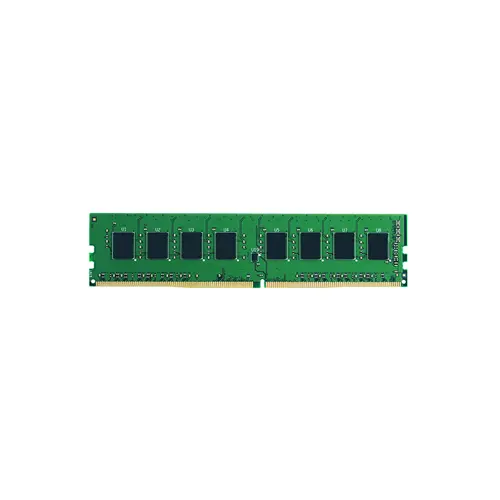
This RDIMM with ECC and registered signal buffering is optimized for server platforms handling virtualization and memory-intensive databases, where data integrity and signal stability across high-density memory configurations are critical. Its dual-rank x8 organization enhances interleaving efficiency, and the 1.2V low-power DDR4-2666 timing delivers a balance of throughput and reduced energy overhead for 24/7 enterprise workloads.
1. ECC protection detects and corrects single-bit memory errors on the fly, safeguarding transactional and database workloads from silent data corruption that could compromise business continuity.
2. Registered signal buffering reduces electrical loading on the memory controller, allowing population of full-capacity DIMM slots while maintaining stable signal integrity under heavy virtualization loads.
3. An 8 GB capacity per module strikes an efficient density sweet spot for hosting moderate virtual machine fleets or containerized microservices without excessive idle resource waste.
4. The 2666 MT/s transfer rate supplies sufficient throughput for in-memory caches and real-time analytics engines, lowering response latency when simultaneous users query large datasets.
5. Dual Rank x8 organization maximizes channel interleaving across all banks, keeping bandwidth utilization near peak and delivering uniform performance under multi-tenant consolidation.
When you are running a dense virtualization cluster or an in‑memory database like SAP HANA, memory errors are not an inconvenience—they are a direct threat to business continuity. The Micron MTA18ASF1G72PDZ-2G6F1 is a server‑grade DDR4‑2666 RDIMM engineered precisely for these workloads, and four architectural features make it indispensable. First, ECC actively detects and corrects single‑bit flips caused by background radiation or voltage noise; in a hypervisor hosting dozens of virtual machines, a silent bit error in guest memory can corrupt transactions or crash instances without warning, and ECC prevents that corruption before it reaches the application. Second, the registered signal type buffers the command and address lines, stabilizing the memory bus when servers are populated with multiple DIMMs per channel. This means you can scale to 256 GB or more across a cluster node without signal degradation, sustaining reliable operation under the heavy load of simultaneous VM migrations. Third, the dual‑rank x8 organization enables rank interleaving, which overlaps read and write cycles to boost effective bandwidth by up to 15 percent compared to single‑rank modules. For a Redis or Memcached layer responding to millions of queries per minute, that extra bandwidth directly increases throughput and cuts tail latency, allowing the same hardware to serve more users with snappier responses. Finally, the 2666 MT/s speed and CL19 latency strike a deliberate balance between raw throughput and the assured, stable timing that enterprise platforms demand, avoiding the instability risks of overclocked desktop parts. Together, these characteristics transform a standard DIMM into a trust anchor for virtualized infrastructure and data‑intensive applications, where every uncorrected error and every unnecessary stall translates into lost revenue and eroded trust.
General Virtualization
This RDIMM is ideal for dense virtualization hosts. Deploy multiple modules per channel—typically six to eight DIMMs—to maximize capacity while maintaining balanced memory bandwidth. A 128 GB configuration with balanced NUMA allocation comfortably supports over 50 standard VMs.
In-Memory Database
In-memory databases demand both low latency and high reliability, making ECC Registered DIMMs essential. Populate all memory channels identically with this 8 GB RDIMM to achieve the highest throughput, and target 256 GB or more for datasets like Redis or SAP HANA test instances. Strict rank-based population rules must be followed to avoid performance penalties.
High-Performance Computing (HPC)
For HPC clusters, bandwidth is critical; use one DIMM per channel to leverage full 2666 MT/s speeds, then scale capacity by adding more nodes. A dual-socket server with 192 GB (twelve modules) provides sufficient memory bandwidth for CFD or molecular dynamics workloads while keeping per-core allocation lean. Always prioritize population order from the farthest slot to maintain signal integrity.
This server memory is rigorously tested and compatible with Dell PowerEdge R750, HPE ProLiant DL380 Gen10, Lenovo ThinkSystem SR650.
Q: Can I mix this MTA18ASF1G72PDZ-2G6F1 with other memory modules of different brands or speeds?
A: Not recommended. Mixing brands, speeds, or rankings in registered server memory can cause signal integrity issues and instability. For guaranteed reliability, install identical Micron RDIMMs with matching MPN across all channels.
Q: Is this memory compatible with my Intel Xeon Scalable or AMD EPYC server?
A: This DDR4-2666 ECC RDIMM follows JEDEC standards and is compatible with most servers using Intel Xeon Scalable (Skylake-SP onward) and AMD EPYC (7001/7002 series) platforms. Always confirm against your motherboard's qualified vendor list.
Q: What is the recommended DIMM population order for optimal performance on this dual-rank registered module?
A: Populate identical DIMMs per channel following your server board's slot numbering guide, typically filling blue slots first. For dual-socket systems, balance memory across both processors. A balanced configuration maximizes interleaved performance.
Q: Does this module support overclocking or XMP profiles?
A: No. As an enterprise RDIMM, this module adheres to JEDEC standard DDR4-2666 (PC4-21300) with fixed CL19 timing. XMP and manual overclocking are not supported; it is engineered for guaranteed stability at rated specifications.
Q: What warranty and typical failure rate can I expect from this Micron server memory?
A: This module includes a 1-year warranty. Micron RDIMMs have an extremely low annualized failure rate (AFR), typically below 0.1%, due to rigorous component screening and testing, ensuring enterprise-class reliability for 24/7 operation.