











 Secure payments
Standard refund policy
Trade Assurance
Secure payments
Standard refund policy
Trade Assurance
| Product Type | Memory Module |
|---|---|
| Memory Capacity | 8 GB |
| Memory Technology | DDR4 |
| Product Voltage | 1.2V |
| RAM Speed | 2666MHz |
| RAM Standard | DDR4-2666/PC4-21300 |
| Error Identifying | ECC |
| Signal Type | Registered |
| Column Access Strobe (CAS) | CL19 |
| Rank | Single Rank x8 |
| Quantity of Pins | 288-pin |
| RAM Genre | RDIMM |
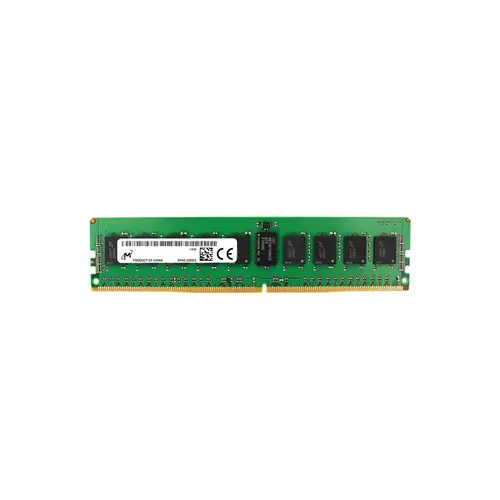
This Micron 8GB DDR4-2666 RDIMM is purpose-built for server platforms, delivering data integrity and reliability through its registered signal type with full ECC protection for demanding workloads such as virtualization and in-memory databases. Its single-rank x8 configuration ensures low electrical loading and stable operation at the JEDEC-standard 1.2V, making it an ideal choice for dense memory deployments where consistent 2666MT/s throughput and enhanced uptime are critical.
1. End-to-end error correction safeguards transactional data integrity in financial or database servers where even a single-bit error cannot be tolerated.
2. Registered buffering stabilizes signal integrity across densely populated memory channels, essential for scaling up to massive RAM footprints in virtualized environments.
3. High throughput per DIMM ensures brisk data feed for memory-bandwidth-hungry workloads like in-memory analytics and real-time processing clusters.
4. Tuned CAS latency balances access speed with command stability, reducing memory controller stalls during sustained heavy read/write operations.
5. Single-rank x8 organization minimizes load on the memory bus, enabling faster command rates and consistent performance when multiple modules are installed per channel.
The Micron MTA9ASF1G72PZ-2G6D1RK, an 8GB DDR4-2666 RDIMM, is built for server environments demanding reliability and scalability. Its four standout attributes translate directly into operational advantage. ECC memory corrects single-bit errors on the fly, safeguarding virtualized clusters from data corruption and unplanned downtime. Registered buffering strengthens command/address signals, letting you fully populate DIMM slots across dual-socket boards without signal integrity loss—critical for dense VM hosting. The combination of 2666MT/s speed and a single-rank x8 design ensures consistent low latency and high bandwidth; this keeps in-memory databases like Redis or SAP HANA delivering real-time responses, while avoiding performance penalties linked to dual-rank modules in 1-DPC configurations. 1.2V operation reduces rack power and cooling needs, directly lowering energy bills. For IT teams running virtualization farms or memory-analytics platforms, this module means uncompromising data integrity, linear capacity scaling, sustained application speed, and a cooler, more efficient data center.
This DDR4-2666 RDIMM with ECC and registered signaling is server-grade memory. For capacity planning, always install modules in sets that match the memory-channel layout of your server platform – typically balanced across six or eight channels per CPU – to maintain uniform performance and full ECC protection.
General Virtualization
Populate at least one DIMM per memory channel to maximize available bandwidth for multiple VMs. A common starting point is six or eight of these 8 GB modules per socket, yielding 48–64 GB, which comfortably supports a moderate number of general-purpose virtual machines. As VM density grows, fill additional slots with identical registered DIMMs to scale capacity without sacrificing channel interleaving.
In-Memory Database
Maximize total capacity by fully populating all DIMM slots while keeping populations symmetrical across memory controllers. Even with 8 GB modules, building a large memory pool – for example, 24 modules for 192 GB – supplies the fast, fault-tolerant footprint required by in-memory databases like Redis or SAP HANA. Always match module ranks and part numbers to avoid training failures and maintain consistent latency.
High-Performance Computing (HPC)
For bandwidth-sensitive HPC workloads, install one registered DIMM per channel on every populated memory controller. The single-rank x8 organization of this module reduces electrical loading, helping sustain high clock rates. A balanced 1-DIMM-per-channel configuration ensures maximum memory throughput, which is critical for scientific simulations, CFD, and heavily threaded parallel processing.
Rigorously tested server memory, compatible with Dell PowerEdge R740, HPE ProLiant DL380 Gen10, Lenovo ThinkSystem SR650.
Q: Can I mix this MTA9ASF1G72PZ-2G6D1RK with other memory modules of different brands or speeds?
A: Mixing with different brands or speeds is strongly discouraged for registered ECC memory. It may cause stability issues, unbootable servers, or subtle data corruption. Use identical modules per channel for validated reliability.
Q: Is this memory compatible with my system?
A: This RDIMM is compatible with servers using Intel Xeon Scalable or AMD EPYC platforms that support DDR4-2666 ECC registered DIMMs. Please verify your motherboard’s qualified vendor list for the exact chipset and CPU.
Q: What is the recommended DIMM population order for optimal performance?
A: Follow your server manual’s population guidelines. Generally, populate the farthest slot per channel first (often blue slots) to balance memory channels and maintain signal integrity. This maximizes bandwidth and reduces latency.
Q: Does this module support overclocking or XMP profiles?
A: No. As a JEDEC-compliant server RDIMM, it does not support overclocking or XMP. It runs strictly at DDR4-2666 with standard timings to ensure 24/7 data integrity and platform stability.
Q: What warranty and typical failure rate can I expect?
A: This module includes a 1-year warranty. Server-grade ECC memory typically has an annualized failure rate well below 0.1% under rated conditions, offering exceptional long-term reliability.