











 Secure payments
Standard refund policy
Trade Assurance
Secure payments
Standard refund policy
Trade Assurance
| Product Type | Memory Module |
|---|---|
| Memory Capacity | 8 GB |
| Memory Technology | DDR4 |
| Product Voltage | 1.2V |
| RAM Speed | 2666MHz |
| RAM Standard | DDR4-2666/PC4-21300 |
| Error Identifying | ECC |
| Signal Type | Registered |
| Column Access Strobe (CAS) | CL19 |
| Rank | Single Rank x8 |
| Quantity of Pins | 288-pin |
| RAM Genre | RDIMM |
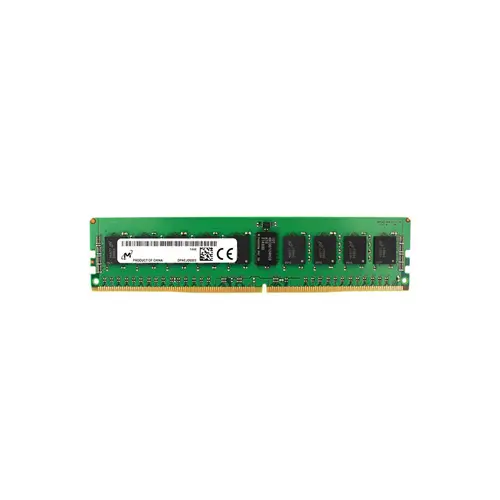
This DDR4-2666 Registered ECC RDIMM is designed for server platforms, making it ideal for mission-critical workloads such as virtualization, in-memory databases, and data-intensive applications where data integrity is non-negotiable. Its registered signal architecture and ECC capability ensure stable operation under high memory density configurations, while the single-rank x8 organization delivers consistent latency and broad compatibility across enterprise-grade systems.
1. ECC protection silently corrects single-bit errors in real time, preserving data integrity for mission-critical databases and financial transactions.
2. Registered buffering stabilizes command and address signals, enabling dense multi-DIMM configurations without compromising reliability under sustained loads.
3. DDR4 data rate delivers robust per-channel bandwidth, allowing a hypervisor to service numerous virtual machines simultaneously without memory bottlenecks.
4. Low-voltage operation reduces overall rack power consumption and thermal stress, directly contributing to a lower total cost of ownership in always-on deployments.
5. Single Rank construction minimizes electrical loading on the memory bus, making it easier to populate every channel fully and expand memory capacity for heavy consolidation use cases.
When you select the Micron MTA9ASF1G72PZ-2G6D1SG, you are deploying a server-grade DDR4 RDIMM engineered for mission-critical environments. In virtualized clusters, ECC error correction actively prevents single-bit upsets from corrupting hypervisor states or in-memory databases like SAP HANA—this means unplanned downtime due to silent data corruption is virtually eliminated. Registered buffering decouples the memory controller from excessive electrical loads, allowing you to populate all channels with high-capacity modules while maintaining rock-solid signal integrity at 2666MHz. This directly translates to confidently hosting more VMs per server without stability trade-offs. Operating at just 1.2V, the module cuts overall power consumption and cooling demands in densely packed racks, reducing your operational expenditure. Moreover, the single-rank x8 architecture presents a lighter load to the memory controller, optimizing command latencies at CL19 and maximizing throughput for latency-sensitive applications like in-memory caching and transactional databases. Together, these features ensure that every clock cycle delivers dependable, efficient performance where data integrity and uptime are non-negotiable.
General Virtualization
Start with four 8GB modules (32GB) to populate one DIMM per memory channel, enabling balanced interleaving and stable VM density. For higher consolidation, deploy eight modules (64GB), which delivers ample capacity for mid-sized environments. Always use identical, registered ECC DIMMs to maintain memory reliability under mixed workloads.
In-Memory Database
Populate all memory channels equally—typically 12 or 16 modules per dual-socket server—to create a 96GB or 128GB uniform memory space. The identical single-rank x8 design prevents rank contention and minimizes latency, critical for in-memory analytics. Plan to fill every channel with the same part number to maximize throughput and uphold data integrity under constant high-speed access.
High-Performance Computing (HPC)
Install six or eight 8GB modules per CPU socket, fully populating each channel for peak 2666MHz bandwidth. The single-rank x8 construction reduces electrical loading, sustaining higher clocks under sustained load. Ensure symmetric channel population to avoid NUMA imbalances; registered ECC provides the precision required for parallel simulations and model runs.
Rigorously tested for server compatibility; compatible with Dell PowerEdge R740/R760, HPE ProLiant DL380 Gen10, Lenovo ThinkSystem SR650, and similar systems.
Q: Can I mix this MTA9ASF1G72PZ-2G6D1SG with other memory modules of different brands or speeds?
A: Mixing RDIMMs of different brands or speeds is not recommended. It may cause POST failures, instability, or force the system to run all modules at the lowest common speed, compromising performance.
Q: Is this memory compatible with my Intel or AMD server platform?
A: This DDR4-2666 Registered ECC DIMM is compatible with servers using Intel Xeon Scalable or AMD EPYC 7000 series processors. Verify that your motherboard supports 8GB RDIMMs and a 1.2V operating voltage.
Q: What is the recommended DIMM population order for optimal performance?
A: For optimal performance, populate identical DIMMs per channel following the server motherboard’s slot numbering (usually channels 1-3 or 1-4 first). Always consult your system’s manual for balanced memory configuration guidelines.
Q: Does this module support overclocking or XMP profiles?
A: No. This is a standard JEDEC-compliant Registered ECC server module operating at a fixed 2666MHz frequency. It does not support XMP profiles or overclocking, ensuring platform stability and data integrity.
Q: What warranty and typical failure rate can I expect?
A: This module is covered by a 1-year warranty. Enterprise-class RDIMMs typically exhibit very low annualized failure rates (under 0.5%), but exact rates vary by deployment environment and workload.