











 Secure payments
Standard refund policy
Trade Assurance
Secure payments
Standard refund policy
Trade Assurance
| Product Type | Memory Module |
|---|---|
| Memory Capacity | 8 GB |
| Memory Technology | DDR4 |
| Product Voltage | 1.2V |
| RAM Speed | 2666MHz |
| RAM Standard | DDR4-2666/PC4-21300 |
| Error Identifying | ECC |
| Signal Type | Registered |
| Column Access Strobe (CAS) | CL19 |
| Rank | Single Rank x8 |
| Quantity of Pins | 288-pin |
| RAM Genre | RDIMM |
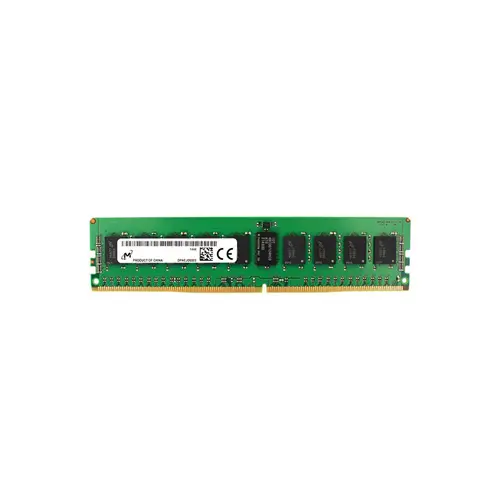
Designed for enterprise servers and workstations requiring uncompromising data integrity, this 8GB DDR4-2666 Registered DIMM with ECC ensures reliable operation in virtualized environments, in-memory databases, and mission-critical workloads. Its single-rank x8 configuration reduces electrical loading on the memory bus, enabling higher population density per channel while the registered signal type enhances signal integrity for large memory arrays.
1. Error correction capability protects against single-bit data corruption, ensuring transactional accuracy in financial databases and long-running scientific computations.
2. On-chip register buffering stabilizes high-density server configurations, enabling 24/7 operation under extreme virtualization workloads without signal degradation.
3. This memory frequency balances throughput and power, keeping latency-sensitive cloud services responsive while avoiding thermal penalties.
4. A single-rank design reduces electrical loading on the memory bus, preserving signal integrity in densely populated rack servers for error-free data handling.
5. This capacity granularity fits hyper-converged infrastructure where per-VM memory allocation is optimized alongside multiple co-resident modules.
Based on its RDIMM form factor, ECC, and registered signal type, the Micron MTA9ASF1G72PZ-2G6D2 is unequivocally a server-grade memory module built for data center reliability. For IT architects managing dense virtualization clusters, ECC is non-negotiable — it constantly detects and corrects single-bit errors caused by cosmic radiation or electrical noise, preventing silent data corruption that could crash dozens of virtual machines or, worse, quietly flip a financial transaction. The registered buffer directly addresses the pain of scaling; it stabilizes command signals so you can populate all memory channels without signal degradation, essential when running in-memory databases like SAP HANA or Redis where a large, rock-solid footprint determines real-time analytics speed. Meanwhile, its single-rank x8 organization maximizes bandwidth efficiency and lowers access latency under heavy, random workloads, giving hypervisors like VMware ESXi faster context switching without bottlenecking. At 1.2V and 2666MHz, this 8GB module also trims your power budget while delivering consistent performance, meaning every watt in a crowded rack translates into dependable throughput for mission-critical services, not wasted heat.
General Virtualization
For general virtualization, capacity and reliability are paramount. Equip a dual-socket server with 16 of these 8GB RDIMMs (128GB total), populating every memory channel symmetrically to enable interleaving and support dozens of VMs. Scale to 32 modules (256GB) for heavier consolidation, and leverage the built-in ECC and registered signaling to prevent data corruption in multi-tenant environments.
In-Memory Database
In-memory databases demand low latency and high sustained bandwidth. Install 32 x 8GB Registered DIMMs across both processors to achieve 256GB, adhering to a one-DIMM-per-channel (1DPC) configuration for peak speed. The ECC capability safeguards critical in-memory tables, while the registered interface maintains signal integrity under relentless transactional workloads.
High-Performance Computing (HPC)
HPC clusters prioritize balanced memory bandwidth per core. For a dual-socket node with eight channels each, deploy 16 x 8GB RDIMMs (128GB) at 1DPC to maximize throughput for simulation codes. Memory-hungry workloads can double to 32 modules (256GB) provided 1DPC is preserved. ECC ensures result accuracy during multi-day parallel runs, and uniform slot population eliminates bandwidth bottlenecks.
Proven compatibility: rigorously tested with Dell PowerEdge R760, HPE ProLiant DL380 Gen10, Lenovo ThinkSystem SR650 and more.
Q: Can I mix this MTA9ASF1G72PZ-2G6D2 with other memory modules of different brands or speeds?
A: Mixing memory is not recommended for server environments. Different brands, speeds, or ranks may cause instability or force the system to downclock to the lowest common speed. For guaranteed reliability, use identical modules.
Q: Is this memory compatible with my system?
A: This DDR4-2666 RDIMM with ECC is compatible with Intel Xeon Scalable (Purley) and AMD EPYC platforms that support registered memory. Verify the motherboard’s QVL list and ensure your CPU supports 8 GB single-rank RDIMMs.
Q: What is the recommended DIMM population order for optimal performance?
A: Populate identical DIMMs in the first slot of each memory channel (usually blue slots) to enable balanced multi-channel interleaving. For dual-socket servers, balance memory across both CPUs. Consult your system’s population guide for slot numbering.
Q: Does this module support overclocking or XMP profiles?
A: No. Registered ECC server memory operates at JEDEC standard timings (CL19) for maximum data integrity and stability. Overclocking and XMP are unsupported and could compromise error correction and long-term reliability.
Q: What warranty and typical failure rate can I expect?
A: This module includes a 1-year warranty. Designed for enterprise workloads, typical annualized failure rates (AFR) for these RDIMMs are below 0.5%, ensuring high MTBF and dependable 24/7 operation in server environments.