











 Secure payments
Standard refund policy
Trade Assurance
Secure payments
Standard refund policy
Trade Assurance
| Product Type | Memory Module |
|---|---|
| Memory Capacity | 8 GB |
| Memory Technology | DDR4 |
| Product Voltage | 1.2V |
| RAM Speed | 2666MHz |
| RAM Standard | DDR4-2666/PC4-21300 |
| Error Identifying | ECC |
| Signal Type | Registered |
| Column Access Strobe (CAS) | CL19 |
| Rank | Single Rank x8 |
| Quantity of Pins | 288-pin |
| RAM Genre | RDIMM |
This RDIMM with ECC and registered signal technology is engineered for server platforms handling mission-critical workloads such as virtualization, in-memory databases, and enterprise data processing where data integrity and system stability are paramount. Its single-rank x8 configuration and CL19 latency provide a balanced combination of signal integrity and consistent performance, ensuring reliable operation under sustained heavy loads in multi-DIMM memory channels.
1. ECC protection silently detects and corrects memory errors, preserving data integrity for financial transactions and mission-critical databases that cannot tolerate silent corruption.
2. Registered signal buffering stabilizes command and address lines, enabling densely packed server nodes to scale memory capacity without sacrificing bus reliability under heavy concurrent access.
3. RDIMM architecture ensures compatibility with enterprise server boards and maximizes memory density, supporting robust virtualized environments where dozens of VMs run side by side.
4. High memory transfer speed lowers the latency of large in-memory datasets, accelerating real-time analytics and speeding up responses in high-frequency trading platforms.
5. Low operating voltage reduces server power draw and cooling demands, lowering total cost of ownership and helping data centers meet energy-efficiency targets.
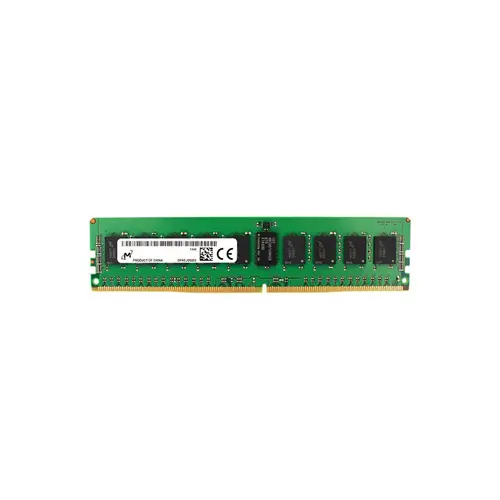
The Micron MTA9ASF1G72PZ-2G6J1RI is unmistakably a server memory module, defined by its Registered DIMM architecture, ECC functionality, and 288-pin form factor. In a hypervisor cluster running dozens of virtual machines, the Error Correcting Code is your first line of defense against silent data corruption; it automatically intercepts and corrects single-bit flips triggered by cosmic rays or electrical noise, preventing a compromised VM from cascading into application crashes or database inconsistencies. The registered signal buffer absolves the memory controller of directly driving every chip, which means you can populate all channels with greater stability when scaling to support memory-intensive enterprise workloads. Consider an in-memory database such as Redis or SAP HANA: the 2666MT/s throughput paired with a single-rank x8 organization delivers consistent bandwidth and low access latency under constant query pressure, keeping real-time transactions fluid. Meanwhile, the 1.2V operating voltage drops energy consumption per DIMM by roughly 20 percent compared to earlier DDR standards, reducing thermal stress and power bills across a 24/7 datacenter. This is not merely a specification sheet—it is uptime insurance, scalable capacity, and predictable performance translated directly into operational resilience and lower total cost of ownership.
General Virtualization
For a typical hypervisor hosting multiple VMs, populate channels evenly for balanced memory bandwidth. Deploy six to eight of these 8GB RDIMMs in a dual-socket server to reach 48–64GB per node, leaving room for future scaling without oversubscribing memory.
In-Memory Database
In-memory databases demand both capacity and error resilience, making ECC registered DIMMs essential. Fully load all memory channels with identical 8GB RDIMMs—aim for at least 128GB (16 modules) on a single-socket system—to keep entire datasets in RAM and prevent paging latency.
High-Performance Computing (HPC)
HPC workloads benefit from maximum memory bandwidth and low latency. Populate one DIMM per channel (1DPC) using these single-rank x8 2666MT/s modules to achieve the rated speed without downclocking. For compute nodes running memory-bandwidth-bound simulations, install eight modules (64GB total) across all channels to deliver consistent 21.3GB/s peak bandwidth per channel.
Rigorously tested server DDR4 ECC Registered memory. Compatible with Dell PowerEdge R750, HPE ProLiant DL380 Gen10, Lenovo ThinkSystem SR650, and more.
Q: Can I mix this MTA9ASF1G72PZ-2G6J1RI with other memory modules of different brands or speeds?
A: Mixing RDIMMs of different brands or speeds is not recommended. The system will downclock all modules to the lowest common speed or may fail to boot, risking instability in mission‑critical server environments.
Q: Is this memory compatible with my system? Which Intel or AMD platforms are supported?
A: This DDR4‑2666 RDIMM is validated for Intel Xeon Scalable (Skylake‑SP/Cascade Lake) and AMD EPYC 7001/7002 series platforms. Confirm your server board supports registered ECC memory and a 288‑pin DDR4 interface.
Q: What is the recommended DIMM population order for optimal performance?
A: For dual‑socket servers, populate identical DIMMs per channel starting with the farthest slot from the CPU. Follow your motherboard’s memory configuration guide to balance channels and maintain interleaving for maximum throughput.
Q: Does this module support overclocking or XMP profiles?
A: No. This is a JEDEC‑compliant registered server memory module. It does not support XMP or overclocking; it operates strictly at the standard DDR4‑2666 CL19 profile to guarantee data integrity in enterprise environments.
Q: What warranty and typical failure rate can I expect?
A: This module carries a one‑year warranty. Enterprise‑grade RDIMMs typically exhibit a very low annualized failure rate (under 0.3%), provided they are operated within specified temperature and voltage limits.