











 Secure payments
Standard refund policy
Trade Assurance
Secure payments
Standard refund policy
Trade Assurance
| Product Type | Memory Module |
|---|---|
| Memory Capacity | 8 GB |
| Memory Technology | DDR4 |
| Product Voltage | 1.2V |
| RAM Speed | 2666MHz |
| RAM Standard | DDR4-2666/PC4-21300 |
| Error Identifying | ECC |
| Signal Type | Registered |
| Column Access Strobe (CAS) | CL19 |
| Rank | Single Rank x8 |
| Quantity of Pins | 288-pin |
| RAM Genre | RDIMM |
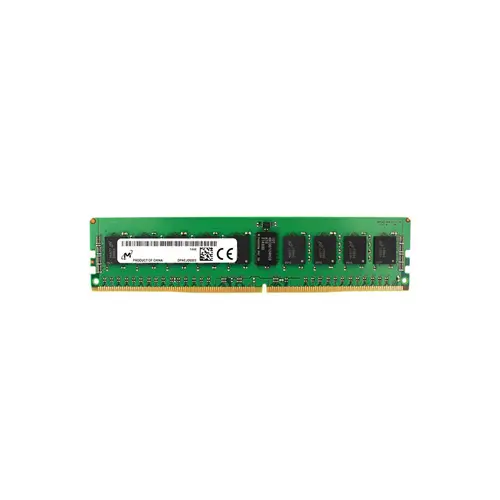
This RDIMM is engineered for server platforms where data integrity and uptime are critical, utilizing registered ECC to correct single-bit errors and detect multi-bit faults, which is essential for virtualization, in-memory databases, and transactional workloads. Its single-rank x8 configuration reduces the electrical load on the memory controller, enabling higher memory population and stable operation at DDR4-2666 with a low 1.2V operating voltage for improved energy efficiency in dense rack deployments.
1. Error-correcting code circuitry silently detects and corrects single-bit faults, preserving transactional integrity for databases and financial ledgers that cannot tolerate silent data corruption.
2. Registered command and address buffering stabilizes signal paths in high-capacity server configurations, enabling platforms to scale up memory footprints reliably for dense virtualization without risking electrical instability.
3. This module density offers a power-efficient building block for edge compute or light containerized hosts, delivering adequate headroom for hypervisor overhead and critical services without wasting idle energy at scale.
4. The speed grade balances bandwidth delivery to match contemporary multi-core server processors, ensuring that concurrent request streams in distributed caching and web server tiers never stall from memory starvation.
5. Single-rank architecture reduces per-DIMM bus load, preserving rated clock performance when fully populating channels and strengthening operational continuity in always-on rack-mount deployments.
The Micron MTA9ASF1G72PZ-2G6D1QG is a purpose-built server DDR4 RDIMM that tackles critical datacenter challenges through four key attributes: ECC error correction, registered signal buffering, a 2666MHz single-rank x8 architecture, and 1.2V low voltage. In a virtualization cluster, ECC actively prevents single-bit errors from corrupting your hypervisor and causing multi-tenant outages; meanwhile, the registered buffer stabilizes address and command lines, letting you fully populate dual-socket servers without signal degradation, which maximizes VM density. For in-memory databases like SAP HANA, the 2666MT/s frequency combined with CL19 latency delivers the rapid access and high bandwidth needed to process transactions without microsecond delays that hurt revenue. The single-rank configuration further ensures consistent electrical performance under heavy load. Lastly, 1.2V operation dramatically lowers power draw and thermal output, reducing TCO in large-scale deployments. Simply put, this module gives you unwavering data integrity, seamless scalability, and the responsive performance your mission-critical workloads demand.
The provided module is a DDR4-2666 ECC Registered RDIMM (single‑rank, 8GB), confirming it is server‑class memory. The capacity planning guidance below addresses three typical server workloads using this specific module.
General Virtualization
For balanced performance, populate all memory channels uniformly. On a dual‑socket server with six channels per CPU, install twelve identical 8GB RDIMMs (one per channel) to obtain 96GB total. This 1DPC configuration delivers full 2666MHz speed and sufficient bandwidth for multiple VMs. If higher capacity is needed, add a second identical module per channel while accepting slightly reduced frequency.
In‑Memory Database
In‑memory databases require maximum capacity and uncompromised reliability. Fill every available DIMM slot symmetrically across both CPU sockets using the same 8GB RDIMMs. For a six‑channel platform supporting two DIMMs per channel, deploy 24 modules to reach 192GB, maintaining balanced channel populations and enabling ECC monitoring to safeguard data integrity.
High‑Performance Computing
HPC applications prioritize memory bandwidth over raw capacity. Use one 8GB RDIMM per channel (1DPC) across all memory channels to preserve the native 2666MHz data rate. A dual‑socket server with six channels per CPU would employ twelve modules for a balanced 96GB footprint, minimizing latency and ensuring consistent performance during parallel computations.
Rigorously tested, compatible with servers like Dell PowerEdge R760, HPE ProLiant DL380 Gen11, and Lenovo ThinkSystem SR650 V3.
Q: Can I mix this MTA9ASF1G72PZ-2G6D1QG with other memory modules of different brands or speeds?
A: Mixing is not recommended for registered server memory. Different timings, ranks, or vendors can cause POST failures or stability issues. Always use identical modules to ensure reliable ECC operation and to maintain system uptime in enterprise environments.
Q: Is this memory compatible with my server system?
A: This 8GB DDR4-2666 ECC RDIMM supports Intel Xeon Scalable (Purley/Whitley) and AMD EPYC 7001/7002/7003 platforms. Verify your motherboard requires 288-pin Registered DIMMs with 1.2V and PC4-21300 rating. Consult the server's Qualified Vendor List for exact compatibility.
Q: What is the recommended DIMM population order for optimal performance?
A: Follow the server motherboard manual. Generally, populate identical DIMMs per channel to balance channels. Start with slots farthest from the CPU, typically blue slots first, then white. Symmetrical population across CPU memory controllers maximizes memory bandwidth.
Q: Does this module support overclocking or XMP profiles?
A: No. This is a JEDEC-compliant ECC Registered DIMM. Server memory runs at the specified standard speed of 2666MHz with no XMP or overclocking support. Stability and data integrity take precedence over overclocking in server operations.
Q: What warranty and typical failure rate can I expect?
A: It includes a 1-year warranty. Typical field failure rates are extremely low (<0.2% AFR) for Micron server DRAM, thanks to rigorous screening and JEDEC reliability testing. ECC function also mitigates soft errors during operation.