











 Secure payments
Standard refund policy
Trade Assurance
Secure payments
Standard refund policy
Trade Assurance
| Product Type | Memory Module |
|---|---|
| Memory Capacity | 8 GB |
| Memory Technology | DDR4 |
| Product Voltage | 1.2V |
| RAM Speed | 2666MHz |
| RAM Standard | DDR4-2666/PC4-21300 |
| Error Identifying | ECC |
| Signal Type | Registered |
| Column Access Strobe (CAS) | CL19 |
| Rank | Dual Rank x8 |
| Quantity of Pins | 288-pin |
| RAM Genre | RDIMM |
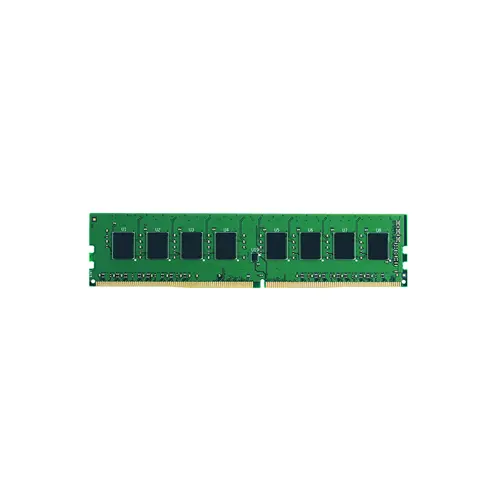
This 8GB DDR4-2666 RDIMM with ECC and registered signaling is optimized for server platforms running memory-intensive workloads such as virtualization and in-memory databases, ensuring robust data integrity under continuous operation. Its dual-rank x8 organization enhances memory bandwidth through rank interleaving, while the low CL19 latency and 1.2V operating voltage contribute to efficient, stable performance in dense rack deployments.
1. ECC error correction detects and corrects single-bit memory faults silently, safeguarding transactional databases and long-running virtualization hosts from undetected data corruption.
2. Registered signal buffering stabilizes command and address lines across fully populated server channels, essential for maintaining signal integrity in dense multi-DIMM configurations.
3. Dual Rank x8 organization enables interleaved bank access that sustains high memory bandwidth, critical for consistent performance when hosting numerous concurrent virtual machines.
4. Low operating voltage reduces thermal dissipation per module, helping data centers control cooling costs and improve power efficiency in high-density rack deployments.
5. The memory speed provides a balanced throughput foundation, ensuring predictable latency for enterprise applications like in-memory caching and real-time analytics without introducing a bandwidth bottleneck.
Built for server-class reliability, the Micron MTA18ASF1G72PDZ-2G6B is an 8GB DDR4-2666 RDIMM that turns four technical features into tangible business continuity. In a virtualized cluster running dozens of VMs, ECC error correction actively prevents single-bit upsets from cosmic radiation or electrical noise. That means a flipped bit in a guest operating system never silently corrupts a financial transaction or hypervisor memory map—your services stay accurate and online. The registered signal buffer is equally critical: it redrives address and command lines so you can populate all 24 DIMM slots on a dual-socket server without signal degradation. For an in-memory database like Redis or SAP HANA, the dual-rank x8 organization interleaves accesses across two internal ranks, delivering substantially higher bandwidth per channel compared to single-rank modules. This translates directly into faster query throughput when every microsecond of latency matters. At a low 1.2V operating voltage, the module also helps data centers reduce thermal load and energy cost per virtualized workload without compromising the 2666MT/s speed that feeds CPU cores.
General Virtualization
Populate all server memory channels with identical 8GB DDR4-2666 RDIMMs to maximize capacity and interleaved bandwidth. A balanced six- or eight-module configuration per CPU (48GB–64GB) delivers strong VM density, benefiting from the dual-rank x8 design and 1.2V power efficiency. Scale by adding modules in matched sets to maintain uniform performance as virtualization demands increase.
In-Memory Database
In-memory databases require low latency and high bandwidth; install these 8GB RDIMMs to saturate every memory channel—typically 8 or 16 modules per server—achieving 64GB–128GB. The registered ECC and dual-rank architecture safeguard data integrity during heavy loads, but ensure all DIMMs are identical to avoid clock-down. For growth, plan to adopt higher-capacity modules while preserving identical rank configurations.
High-Performance Computing
For HPC, maximize bandwidth by filling each memory channel with one 8GB RDIMM, creating a uniform dual-rank x8 population that enables optimal rank interleaving. A dual-socket node with 12–16 modules (96GB–128GB) provides balanced 2666MHz throughput, while ECC protection prevents silent data corruption during long simulations.
Tested rigorously for server compatibility: Dell PowerEdge R760, R750, R740, HPE ProLiant DL380 Gen10, Lenovo ThinkSystem SR650, and more.
Q: Can I mix this MTA18ASF1G72PDZ-2G6B with other memory modules of different brands or speeds?
A: Mixing modules is not recommended for registered ECC memory. Identical part numbers ensure signal integrity and prevent system instability. For optimal reliability in server environments, use matched kits with the same rank and speed.
Q: Is this memory compatible with my system?
A: This DDR4-2666 ECC RDIMM is designed for server platforms using Intel Xeon Scalable, Xeon E5-2600 v4, or AMD EPYC 7001 series processors. Verify your board's support for registered DIMMs and 1.2 V operation before purchase.
Q: What is the recommended DIMM population order for optimal performance?
A: Follow your server motherboard's population guide. Typically, populate identical DIMMs in the first slot of each memory channel (often blue slots) to maximize interleaving. Balanced configurations across all memory controllers yield best throughput.
Q: Does this module support overclocking or XMP profiles?
A: No. This ECC registered memory complies with JEDEC DDR4-2666 standards and does not support overclocking or XMP. It is engineered for 24/7 data integrity and stability in mission-critical server workloads.
Q: What warranty and typical failure rate can I expect?
A: This module includes a one-year warranty. Enterprise-class RDIMMs exhibit extremely low annualized failure rates (AFR), typically below 0.5%, thanks to rigorous screening and error-correction capabilities.